1,830 posters, 67 videos, 75 audios, 29 topics, 22 sessions, 4,727 authors, 1,697 institutions
ePostersLive by SciGen Technologies S.A. All rights reserved.
RCOG World Congress 2023
June 12 - 14, 2023 | London, UK

EP.0169
Sexuality after breast cancer treatment: an additional burden
Poster Presenter
Authors
Hadir Laamiri, Hatem Frikha, Haithem Aloui, Khaoula Magdoud, Rami Hammami, Rahma Bouhmida, Meriem Ouederni, Amal Chermiti, Mohamed Badis Channoufi, Saber Hassine Abouda
Affiliations
Maternity and Neonatology Centre of Tunis Department C, Maternity and Neonatology Centre of Tunis Emergency Department
Part of Topic
Lifestyle Medicine in Woman's Health
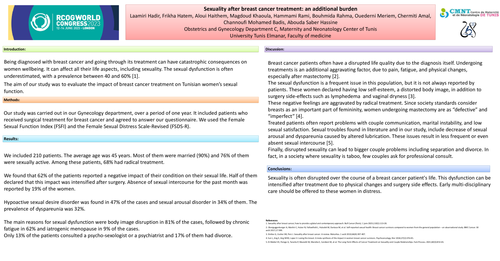
Sexuality after breast cancer treatment: an additional burden Laamiri Hadir, Frikha Hatem, Aloui Haithem, Magdoud Khaoula, Hammami Rami, Bouhmida Rahma, Ouederni Meriem, Chermiti Amal, Channoufi Mohamed Badis, Abouda Saber Hassine Obstetrics and Gynecology Department C, Maternity and Neonatology Center of Tunis University Tunis Elmanar, Faculty of medicine
Introduction:
Being diagnosed with breast cancer and going through its treatment can have catastrophic consequences on women wellbeing. It can affect all their life aspects, including sexuality. The sexual dysfunction is often underestimated, with a prevalence between 40 and 60% [1]. The aim of our study was to evaluate the impact of breast cancer treatment on Tunisian women’s sexual function.
Methods:
Our study was carried out in our Gynecology department, over a period of one year. It included patients who received surgical treatment for breast cancer and agreed to answer our questionnaire. We used the Female Sexual Function Index (FSFI) and the Female Sexual Distress Scale-Revised (FSDS-R).
Results:
We included 210 patients. The average age was 45 years. Most of them were married (90%) and 76% of them were sexually active. Among these patients, 68% had radical treatment. We found that 62% of the patients reported a negative impact of their condition on their sexual life. Half of them declared that this impact was intensified after surgery. Absence of sexual intercourse for the past month was reported by 19% of the women. Hypoactive sexual desire disorder was found in 47% of the cases and sexual arousal disorder in 34% of them. The prevalence of dyspareunia was 32%. The main reasons for sexual dysfunction were body image disruption in 81% of the cases, followed by chronic fatigue in 62% and iatrogenic menopause in 9% of the cases. Only 13% of the patients consulted a psycho-sexologist or a psychiatrist and 17% of them had divorce.
Discussion:
Breast cancer patients often have a disrupted life quality due to the diagnosis itself. Undergoing treatments is an additional aggravating factor, due to pain, fatigue, and physical changes, especially after mastectomy [2]. The sexual dysfunction is a frequent issue in this population, but it is not always reported by patients. These women declared having low self-esteem, a distorted body image, in addition to surgery side-effects such as lymphedema and vaginal dryness [3]. These negative feelings are aggravated by radical treatment. Since society standards consider breasts as an important part of femininity, women undergoing mastectomy are as “defective” and “imperfect” [4]. Treated patients often report problems with couple communication, marital instability, and low sexual satisfaction. Sexual troubles found in literature and in our study, include decrease of sexual arousal and dyspareunia caused by altered lubrication. These issues result in less frequent or even absent sexual intercourse [5]. Finally, disrupted sexuality can lead to bigger couple problems including separation and divorce. In fact, in a society where sexuality is taboo, few couples ask for professional consult
Conclusions:
Sexuality is often disrupted over the course of a breast cancer patient's life. This dysfunction can be intensified after treatment due to physical changes and surgery side effects. Early multi-disciplinary care should be offered to these women in distress.
References: 1. Sexuality after breast cancer, how to provide a global and contemporary approach. Bull Cancer (Paris). 1 janv 2023;110(1):113-28. 2. Oberguggenberger A, Martini C, Huber N, Fallowfield L, Hubalek M, Daniaux M, et al. Self-reported sexual health: Breast cancer survivors compared to women from the general population – an observational study. BMC Cancer. 30 août 2017;17:599. 3. Emilee G, Ussher JM, Perz J. Sexuality after breast cancer: A review. Maturitas. 1 août 2010;66(4):397-407. 4. Sun L, Ang E, Ang WHD, Lopez V. Losing the breast: A meta-synthesis of the impact in women breast cancer survivors. Psychooncology. févr 2018;27(2):376-85. 5. Di Mattei VE, Perego G, Taranto P, Mazzetti M, Marotta E, Candiani M, et al. The Long-Term Effects of Cancer Treatment on Sexuality and Couple Relationships. Fam Process. 2021;60(3):853-65.