1,830 posters, 67 videos, 75 audios, 29 topics, 22 sessions, 4,727 authors, 1,697 institutions
ePostersLive by SciGen Technologies S.A. All rights reserved.
RCOG World Congress 2023
June 12 - 14, 2023 | London, UK

EP.0581
Analyzing cesarean delivery rates in Tertiary care Centre using Modified Robson classification
Poster Presenter
Authors
Affiliations
Part of Topic
Women’s Health and Policies
Analyzing cesarean delivery rates in Tertiary care Centre using Modified Robson classification
Objective:
To analyze cesarean section rates based on modified Robson ten group classification system
Design:
A prospective analytical study
Method:
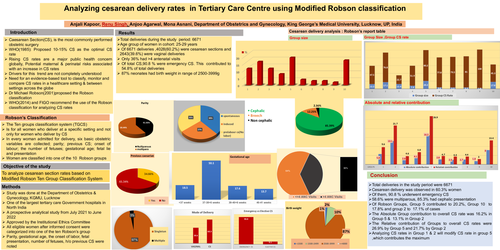
The study was carried over one year period from July 2021 to June 2022 in one of the largest North India tertiary care government hospitals. The study was approved by the Institutional ethics committee. All women who were admitted for delivery were eligible after informed consent. The maternal characteristics noted were parity, gestational age, onset of labor, fetal presentation, and the number of fetuses. All were classified and reclassified into one of the ten Robson’s group and its subgroup. The group size, the group cesarean rate, the relative contribution of each group to overall cesarean section rate was calculated. Further, the overall cesarean rate and the absolute contribution of each group to the overall cesarean rates were analyzed. The overall cesarean rate is taken as the ratio of cesarean deliveries to total deliveries during the study period.
Results
The total deliveries during the period were 6671. Of them,39.6% were vaginal deliveries. The overall cesarean section rate was 60.3%. Of them, 90.8% were emergency cesarean deliveries while only 9.1% underwent elective cesarean sections. Majority of women were in the age group of 25 to 29 years. Amongst all women ,64% had less than four antenatal visits while only 36% took antenatal care. Maximum number of women ,1349(20.2%) were in group 5 followed by 1191(17.8%) in group 10 and 1142(17.1%) in group 2 respectively. The cesarean section rate within the group was maximum in group 8(81.8%) followed by group 5(80.5%) and group 7(79.5%). The absolute contribution by each group to the overall cesarean section rate was 16.2% and 13.1% by group 5 and 2 respectively.
Conclusion
There is a worldwide need to monitor the cesarean delivery rates. The Robson ten group classification system recommended by WHO is an invaluable tool to identify the women and their group who contribute most to the cesarean delivery rates. It provides baseline data that will help the health authorities in implementing evidence based cesarean policies.