1,830 posters, 67 videos, 75 audios, 29 topics, 22 sessions, 4,727 authors, 1,697 institutions
ePostersLive by SciGen Technologies S.A. All rights reserved.
RCOG World Congress 2023
June 12 - 14, 2023 | London, UK

EP.0457
Abdominal wall endometriosis: over 10 years of experience at two medical institutions
Poster Presenter
Authors
Affiliations
Part of Topic
Endometriosis and Uterine Disorders
Abdominal wall endometriosis: over 10 years of experience at two large medical institutions
Qiyu Zhong#1, Shuhang Qin#2, Shuzhong Yao2, Xiaochuan Chen1, Xiao Li1, Shuqin Chen*1
1Department of Gynecology and Obstetrics, The Sixth Affiliated Hospital, Sun Yat-Sen University
2Department of Gynecology and Obstetrics, The First Affiliated Hospital, Sun Yat-Sen University
Background and objectives:
Abdominal wall endometriosis (AWE) is a rare condition defined by the presence of endometrial tissue in the subcutaneous fat and muscles of the abdominal wall. There are multiple treatments for AWE, mainly including drug therapy, surgical resection, and ultrasonic ablation.
Wide surgical resection is the standard treatment for AWE. The location, size, and method of excision of the lesion may be associated with postoperative complications, residual disease and recurrence.
In this study, patients with AWE were retrospectively analysed to explore patient characteristics, presentation, intraoperative findings, clinical outcomes and correlated factors in AWE.
Design:
An retrospective, descriptive, observational study.
A cohort of 313 women who underwent surgery at two institutions from January 1, 2011, through October 31, 2021, and had a confirmed diagnosis of AWE on histopathology were included.
Study parameters were compared between patients with peritoneal-type and nonperitoneal-type AWE. Univariate and multivariate logistic regression models were used to analyse risk factors for postoperative complications and recurrence/residual disease.
Main Results:
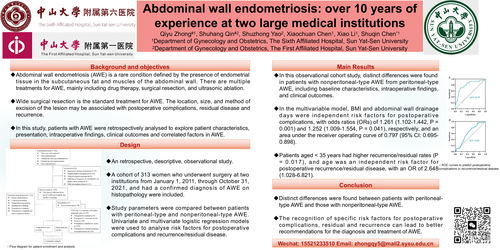
In this observational cohort study, distinct differences were found in patients with nonperitoneal-type AWE from peritoneal-type AWE, including baseline characteristics, intraoperative findings, and clinical outcomes.
In the multivariable model, BMI and abdominal wall drainage days were independent risk factors for postoperative complications, with odds ratios (ORs) of 1.261 (1.102-1.442, P = 0.001) and 1.252 (1.009-1.554, P = 0.041), respectively, and an area under the receiver operating curve of 0.797 (95% CI: 0.695-0.898).
Patients aged < 35 years had higher recurrence/residual rates (P = 0.017), and age was an independent risk factor for postoperative recurrence/residual disease, with an OR of 2.648 (1.028-6.821).
Conclusion:
Distinct differences were found between patients with peritoneal-type AWE and those with nonperitoneal-type AWE.
The recognition of specific risk factors for postoperative complications, residual and recurrence can lead to better recommendations for the diagnosis and treatment of AWE.
Wechat: 15521233510 Email: zhongqy5@mail2.sysu.edu.cn