1,830 posters, 67 videos, 75 audios, 29 topics, 22 sessions, 4,727 authors, 1,697 institutions
ePostersLive by SciGen Technologies S.A. All rights reserved.
RCOG World Congress 2023
June 12 - 14, 2023 | London, UK

EP.0442
Multimorbidity patterns in women with PCOS and their relationship with physical activity
Poster Presenter
Authors
Meera Mahesh, Miriam Samuel, Sarah Finer, Dylan Morrissey, Fabiola Eto
Affiliations
Part of Topic
Lifestyle Medicine in Woman's Health
Multimorbidity patterns in women with PCOS and their relationship with physical activity
Meera Mahesh1, Dr Miriam Samuel2, Dr Sarah Finer2, Professor Dylan Morrissey2, Dr Fabiola Eto2
1. Barts and the London, Queen Mary University of London (QMUL)
2. Wolfson Institute of Population Health, QMUL
Background
Polycystic ovary syndrome (PCOS) is the most common endocrine disorder of pre-menopausal women (1) and is associated with early multimorbidity (MM) (2). Although vital to the management of PCOS and its’ comorbidities (3), the impact of physical activity (PA) in the development of MM in PCOS patients has not been studied.
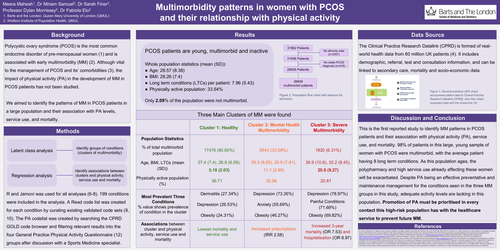
We aimed to identify the patterns of MM in PCOS patients in a large population and their association with PA levels, service use, and mortality.
Methods
Latent class analysis was used to identify groups of conditions (clusters of multimorbidity).
Regression analysis was used to identify associations between clusters and physical activity, service use and mortality.
R and Jamovi was used for all analyses (6-8). 199 conditions were included in the analysis. A Read code list was created for each condition by curating existing validated code sets (9, 10). The PA codelist was created by searching the CPRD GOLD code browser and filtering relevant results into the four General Practice Physical Activity Questionnaire (12) groups after discussion with a Sports Medicine specialist.
Data Source
The Clinical Practice Research Datalink (CPRD) is formed of real-world health data from 60 million UK patients (4). It includes demographic, referral, test and consultation information, and can be linked to secondary care, mortality and socio-economic data.
Results
PCOS patients are young, multimorbid and inactive. Only 2.09% of the population were not multimorbid.
28839 patients were included from an initial 31962 patients. Exclusion reasons include lack of ethnicity data and no viable PCOS diagnosis.
Whole population statistics (mean (SD)):
● Age: 28.57 (8.38)
● BMI: 28.26 (7.4)
● Long term conditions (LTCs) per patient: 7.96 (5.43)
● Physically active population: 33.54%
Three main clusters of multimorbidity were found, ranging from a healthy group with an average of 5 long term conditions per patient, to a severely multimorbid group with over 20 long term conditions on average per patient.
Discussion and Conclusion
This was the first study to identify MM patterns in PCOS patients and their association with physical activity (PA), service use, and mortality. 98% of patients in this large, young sample of women with PCOS were multimorbid, with the average patient having 8 long term conditions. As this population ages, the polypharmacy and high service use already affecting these women will be exacerbated. Despite PA being an effective preventative and maintenance management for the conditions seen in the three MM groups in this study, adequate activity levels are lacking in this population. Promotion of PA must be prioritised in every contact this high-risk population has with the healthcare service to prevent future MM.
References
(1) Escobar-Morreale HF. Polycystic ovary syndrome: definition, aetiology, diagnosis and treatment. Nat Rev Endocrinol. 2018 May;14(5):270–84.
(2) Mani H et al. High prevalence of multimorbidity in overweight and obese women with Polycystic Ovary Syndrome (PCOS). Endocr Abstr [Internet]. 2017 Oct 20
(3) Teede HJ et al. Recommendations from the international evidence-based guideline for the assessment and management of polycystic ovary syndrome. Fertil Steril. 2018 Aug;110(3):364–79.
(4) Data | CPRD [Internet]. Available from: https://www.cprd.com/data
(5) Safeguarding patient data | CPRD [Internet]. Available from: https://www.cprd.com/safeguarding-patient-data
(6) King T, Butcher S, Zalewski L. Apocrita - High Performance Computing Cluster For Queen Mary University Of London. 2017 Mar 24; Available from: https://zenodo.org/record/438045
(7) The jamovi project (2021). jamovi. (Version 1.6) [Computer Software]. Retrieved from https://www.jamovi.org.
(8) R Core Team (2020). R: A Language and environment for statistical computing. (Version 4.0) [Computer software]. Retrieved from https://cran.r-project.org. (R packages retrieved from MRAN snapshot 2020-08-24).
(9) Denaxas S, Gonzalez-Izquierdo A, Direk K, Fitzpatrick NK, Fatemifar G, Banerjee A, et al. UK phenomics platform for developing and validating electronic health record phenotypes: CALIBER. J Am Med Inform Assoc JAMIA. 2019 Dec 1;26(12):1545–59
(10) Kuan V, Denaxas S, Gonzalez- Izquierdo A, Direk K, Bhatti O, Husain S, et al. A chronological map of 308 physical and mental health conditions from 4 million individuals in the English National Health Service. Lancet Digit Health. 2019 Jun 1;1(2):e63–77.
(11) Physical Activity Policy, Health Improvement Directorate. The General Practice Physical Activity Questionnaire (GPPAQ): A screening tool to assess adult physical activity levels, within primary care. 2009 May