1,830 posters, 67 videos, 75 audios, 29 topics, 22 sessions, 4,727 authors, 1,697 institutions
ePostersLive by SciGen Technologies S.A. All rights reserved.
RCOG World Congress 2023
June 12 - 14, 2023 | London, UK

EP.0429
A review of the impact of greenspace on female reproductive health outcomes
Part of Topic
Lifestyle Medicine in Woman's Health
Abstract title: A review of the impact of greenspace on female reproductive health outcomes throughout the lifespan
Authors: Miss Valerie Cai, Ms Alice Cornwell, Dr Laura Currin Salter
Subject category: Lifestyle medicine
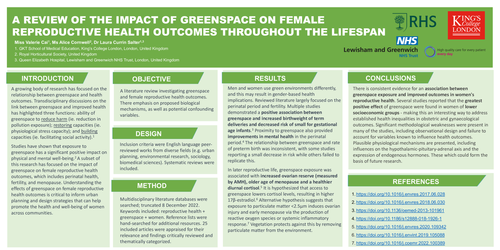
Objective: Literature review investigating access to greenspace and female reproductive health outcomes. There was a particular emphasis on proposed biological mechanisms, as well as potential confounding variables.
Design: Inclusion criteria were English language peer-reviewed works from diverse fields (e.g. urban planning, environmental research, sociology, biomedical sciences). Systematic reviews were included.
Method: Pubmed; Scopus; Cochrane; MEDLINE; Embase; PsycInfo databases were searched. Search was truncated 8 December 2022. Keywords included: reproductive health + greenspace + women. Reference lists were hand-searched for additional resources. 25 included articles were appraised for their relevance and findings critically reviewed and thematically categorized.
Results: It is known that men and women use green environments differently, and this may result in gender-based health implications. Reviewed literature largely focused on the perinatal period and fertility. Multiple studies demonstrated a positive association between greenspace access and increased birthweight of term deliveries and decreased risk of small for gestational age infants. Proximity to greenspace also provided improvements in mental health in the perinatal period. The relationship between greenspace and rate of preterm birth was inconsistent, with some studies reporting a small decrease in risk while others failed to replicate this.
In later reproductive life, greenspace exposure was associated with increased ovarian reserve (measured by AMH), older age of menopause and a healthier diurnal cortisol. It is hypothesized that access to greenspace lowers cortisol levels, resulting in higher 17β-estradiol levels. Another hypothesis suggests that exposure to particulate matter <2.5μm induces ovarian injury and early menopause via the production of reactive oxygen species or systemic inflammatory response. Vegetation in greenspace removes particulate matter from the environment, and may therefore some protection from tissue injury.
Conclusions: There is consistent evidence for an association between greenspace exposure and improved outcomes in women's reproductive health. Several studies reported that the greatest positive effect of greenspace were found in women of lower socioeconomic groups - making this an interesting way to address established health inequalities in obstetric and gynaecological outcomes. Significant methodological weaknesses were present in many of the studies, including observational design and failure to account for variables known to influence health outcomes. Plausible physiological mechanisms are proposed, including influences on the hypothalamic-pituitary-adrenal axis and the expression of endogenous hormones. These findings could form the basis of future research.