1,830 posters, 67 videos, 75 audios, 29 topics, 22 sessions, 4,727 authors, 1,697 institutions
ePostersLive by SciGen Technologies S.A. All rights reserved.
RCOG World Congress 2023
June 12 - 14, 2023 | London, UK

EP.0416
Postpartum iliopsoas abscess following spontaneous vaginal delivery
Poster Presenter
Authors
Affiliations
Part of Topic
Women’s Health and Policies
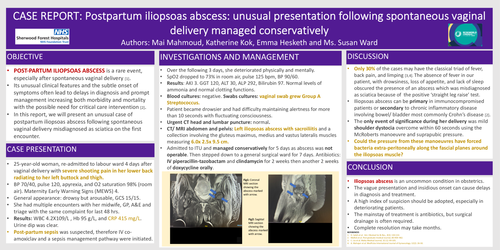
CASE REPORT: Postpartum iliopsoas abscess: unusual presentation following spontaneous vaginal delivery managed conservatively
Objective:
•POST-PARTUM ILIOPSOAS ABSCESS is a rare event, especially after spontaneous vaginal delivery.
•Its unusual clinical features and the subtle onset of symptoms often lead to delays in diagnosis and prompt management increasing both morbidity and mortality with the possible need for critical care intervention.
•In this report, we will present an unusual case of postpartum iliopsoas abscess following spontaneous vaginal delivery misdiagnosed as sciatica on the first encounter.
Case presentation:
•25-year-old woman, re-admitted to labour ward 4 days after vaginal delivery with severe shooting pain in her lower back radiating to her left buttock and thigh.
•BP 70/40, pulse 120, apyrexia, and O2 saturation 98% (room air). Maternity Early Warning Signs (MEWS) 4.
•General appearance: drowsy but arousable, GCS 15/15.
•She had multiple encounters with her midwife, GP, A&E and triage with the same complaint for last 48 hrs.
•Results: WBC 4.2X10⁹/L , Hb 95 g/L, and CRP 415 mg/L. Urine dip was clear.
Post-partum sepsis was suspected, therefore IV co-amoxiclav and a sepsis management pathway were initiated.
Investigations and Management:
•Over the following 3 days, she deteriorated physically and mentally.
•SpO2 dropped to 73% in room air, pulse 125 bpm, BP 90/60.
•Results: AKI 3. GGT 120, ALT 30, ALP 292, Bilirubin 97. Normal levels of ammonia and normal clotting functions.
•Blood cultures: negative. Swabs cultures: vaginal swab grew Group A Streptococcus.
•Patient became drowsier and had difficulty maintaining alertness for more than 10 seconds with fluctuating consciousness.
•Urgent CT head and lumbar puncture: normal.
•CT/ MRI abdomen and pelvis: Left iliopsoas abscess with sacroiliitis and a collection involving the gluteus maximus, medius and vastus lateralis muscles measuring 6.0x 2.5x 9.5 cm.
•Admitted to ITU and managed conservatively for 5 days as abscess was not operable. Then stepped down to a general surgical ward for 7 days. Antibiotics: IV piperacillin-tazobactam and clindamycin for 2 weeks then another 2 weeks of doxycycline orally.
Discussion:
•Only 30% of the cases may have the classical triad of fever, back pain, and limping. The absence of fever in our patient, with drowsiness, loss of appetite, and lack of sleep obscured the presence of an abscess which was misdiagnosed as sciatica because of the positive ‘straight leg raise’ test.
•Iliopsoas abscess can be primary in immunocompromised patients or secondary to chronic inflammatory disease involving bowel/ bladder most commonly Crohn’s disease [2].
•The only event of significance during her delivery was mild shoulder dystocia overcome within 60 seconds using the McRoberts manoeuvre and suprapubic pressure.
•Could the pressure from these manoeuvres have forced bacteria extra-peritoneally along the fascial planes around the iliopsoas muscle?
Conclusion:
•Iliopsoas abscess is an uncommon condition in obstetrics.
•The vague presentation and insidious onset can cause delays in diagnosis and treatment.
•A high index of suspicion should be adopted, especially in deteriorating patients.
•The mainstay of treatment is antibiotics, but surgical drainage is often required.
•Complete resolution may take months.