1,830 posters, 67 videos, 75 audios, 29 topics, 22 sessions, 4,727 authors, 1,697 institutions
ePostersLive by SciGen Technologies S.A. All rights reserved.
RCOG World Congress 2023
June 12 - 14, 2023 | London, UK

EP.0270
Barriers to and Effectiveness of Interventions to Increase the Uptake of CervicalCancerScreening
Poster Presenter
Authors
Affiliations
Part of Topic
Women’s Health and Policies
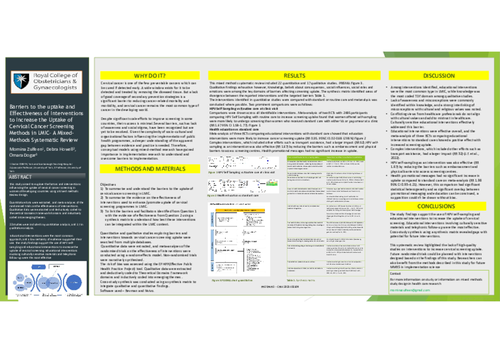
Barriers to the uptake and Effectiveness of Interventions to Increase the Uptake of Cervical Cancer Screening Methods in LMIC– A MixedMethods Systematic Review Momina Zulfeen1, Debra Howell2, Omara Dogar3
1 Doctor OBGYN, York and Scarborough Teaching Hospital 2 Associate Professor, University of York, 3 Professor, University of York
ABSTRACT
This study aimed to explore the factors and interventions influencing the uptake of cervical cancer screening in women of developing countries using a Mixed methods Review design.
Quantitative data were extracted, and meta-analyses of the randomised trials on the effectiveness of interventions. Qualitative data were extracted and deductively coded to Theoretical Domains Framework domains and inductively coded into emerging themes.
22 studies were included in quantitative analysis, and 17 in qualitative analysis.
Educational interventions were the most common
approach, and a low certainty of evidence supported their use. The study findings support the use of HPV selfsampling and educational interventions to increase the uptake of cervical screening. Educational interventions involving culturally sensitive materials and telephonic follow-up were the most effective
INTRODUCTION
Cervical cancer is one of the few preventable cancers which can be cured if detected early. A wide window exists for it to be detected and treated by removing the diseased tissue. But a lack of good coverage of secondary prevention strategies is a significant barrier to reducing cancer-related mortality and morbidity, and cervical cancer remains the most common type of cancer in the developing world.
Despite significant scale efforts to improve screening in some countries, their success is minimal. Several barriers, such as lack of awareness and social stigma, have been recognized but are yet to be resolved. Given the complexity of socio-cultural and organizational factors influencing the implementation of public health programmes, a deeper understanding of the apparent gap between evidence and practice is needed. Therefore, conceptual models using mixed-method research have gained importance in implementation research to understand and overcome barriers to implementation.
METHODS AND MATERIALS
Objectives
1) To summarise and understand the barriers to the uptake of cervical cancer screening in LMIC.
2) To summarise the evidence on the effectiveness of interventions used to enhance/promote uptake of cervical screening programmes in LMIC.
Quantitative and qualitative studies exploring barriers and interventions towards cervical cancer screening uptake were searched from multiple databases.
Quantitative data were extracted, and meta-analyses of the randomised trials on the effectiveness of interventions were conducted using a random effects model. Non-randomised trials were narratively synthesised.
The risk of bias was assessed using the EPHPP(Effective Public Health Practice Project) tool. Qualitative data were extracted and deductively coded to Theoretical Domains Framework domains and inductively coded into emerging themes .
Cross-study synthesis was conducted using a synthesis matrix to integrate qualitative and quantitative findings.
Software used – Revman and Nvivo.
RESULTS
This mixed methods systematic review included 22 quantitative and 17 qualitative studies. PRISMA Figure 3 . Qualitative findings exhaustive however, Knowledge, beliefs about consequences, social influences, social roles and emotions were among the key domains of barriers affecting screening uptake. The synthesis matrix identified areas of divergence between the reported interventions and the targeted barriers Table 1.
The interventions identified in quantitative studies were compared with standard or routine care and metanalysis was conducted where possible. Two prominent comparisons were as follows:
HPV Self Sampling vs Routine care at clinic visit
Comparisons were drawn across all identifiable interventions. Meta-analysis of two RCTs with 2485 participants comparing HPV Self Sampling with routine care to increase screening uptake found that women offered self-sampling were more likely to undergo screening than women who received standard care with either VA or pap smear at a clinic (RR 1.67 95% CI 1.58-1.77). Figure 1
Health education vs standard care
Meta-analysis of three RCTs comparing educational interventions with standard care showed that education interventions were more likely to increase cancer screening uptake (RR 0.35. 95%CI 0.02-0.68 I2 98%) Figure 2
Complex interventions, which included other efforts such as transport assistance, had a larger impact (RR 32).HPV self-sampling as an intervention was also effective (RR 1.67) by reducing the barriers such as embarrassment and physical barriers to access screening centres. Health promotional messages had no significant increase in uptake.
DISCUSSION
The study findings support the use of HPV self-sampling and educational interventions to increase the uptake of cervical screening. Educational interventions involving culturally sensitive materials and telephonic follow-up were the most effective. Cross-study synthesis using a synthesis matrix revealed gaps with potential for future interventions.
This systematic review highlighted the lack of high-quality studies on interventions to increase cervical screening uptake. Future randomised trials could be planned with interventions designed based on the findings of this study. Researchers can also benefit from the methods described in this study for future MMRS in implementation science
Contact
For more information on study or information on mixed methods study design in health care research
mominazulfeen@gmail.com