1,830 posters, 67 videos, 75 audios, 29 topics, 22 sessions, 4,727 authors, 1,697 institutions
ePostersLive by SciGen Technologies S.A. All rights reserved.
RCOG World Congress 2023
June 12 - 14, 2023 | London, UK

PP.0108
Accessing Maternal Health Care in a Hostile Environment.
Poster Presenter
Part of Topic
Women’s Health and Policies
Accessing Maternal Health Care in a Hostile Environment
Pierce, P.1, Adil, H.1, Bazinet, D.2, Cooke C.2, Kwok T.3, Hillman S.4,5, Roll, K.2
1Medical School, Faculty of Medical Sciences, University College London, London, United Kingdom, 2UCL Institute for Innovation and Public Purpose, London, United Kingdom, 3UCL Science, Technology, Engineering and Public Policy, London, United Kingdom, 4Women’s Health Division, Elizabeth Garrett Anderson Wing, University College London Hospital NHS Foundation Trust, London, United Kingdom, 5Department of Maternal and Fetal Medicine, EGA Institute for Women’s Health, University College London, London, United Kingdom.
Background
Over the past decade, forced and voluntary migration has been increasing whilst becoming more complex. The London Borough of Camden has historically been home to many refugees, people seeking asylum, and undocumented migrants (RASU), and it has witnessed a rise in the population of migrant groups but also changes to the barriers they face in accessing basic services, including quality maternal healthcare. Numerous barriers are directly tied to the UK’s so-called hostile environment immigration policies.
There is a movement to tackle the poor maternal health outcomes for the most vulnerable groups, including RASU. Recent UK maternity reports revealed that 26% of women who died during or after pregnancy in 2020 were born outside the UK, with 36% of these women not having UK citizenship, or being from a refugee/migrant background.
Research Question
“How does the relationship between immigration status and related policies affect the access, provision, and delivery of maternal health services for refugees, people seeking asylum, and undocumented migrants (RASU)?”
Methods
31 interviews were conducted with two key groups of stakeholders: healthcare professionals (HCPs) at UCLH, and community organisations (COs) within Camden. Transcripts were thematically analysed and coded using Dedoose.
The interview questions were curated to discover the intricacies and nuances of the collective and individual experiences on how immigration status affects maternity services, with a focus on the hostile environment policies.
Results
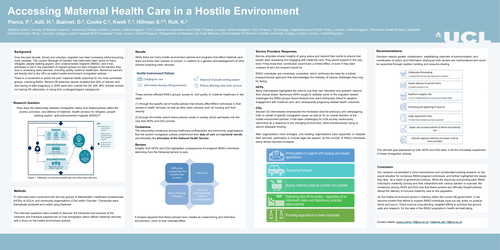
While there are many hostile environment policies and programs that affect maternal care, there are three main policies of concern, in addition to a general acknowledgement of other policies impacting basic services.
These policies affected RASU groups’ access to, and quality of, maternal healthcare in two ways:
(1) through the specific set of hostile policies that directly affect RASU individuals in their access to health services, as well as other basic services such as housing and food security
(2) through the hostile culture these policies create in society, which permeates into the care that HCPs and COs provide.
Consensus
The resounding consensus among healthcare professionals and community organisations that the current immigration policies undermined their duty of care and personal morals, and ultimately the principles of the National Health Service.
Barriers
Insights from HCPs and COs highlighted consequences for pregnant RASU individuals, stemming from the following barriers to care:
It became apparent that these policies have created an unwelcoming and restrictive environment, much to their intended effect.
Service Providers Responses
Service providers shared insights of going above and beyond their remits to ensure that people were accessing and engaging with maternity care. They would support in this way even if they knew their contribution would have a limited effect, or even if they were unaware of who the recipient would be.
RASU individuals are immensely vulnerable, which reinforces the need for a holistic biopsychosocial approach that acknowledges the interplay of various challenges they may be facing.
HCPs
Many interviewees highlighted the need to use their own discretion and goodwill, beyond their clinical duties. Numerous HCPs sought to address some of the migration-related challenges the RASU groups faced because they were intrinsically linked to people’s engagement with maternal care, and consequently
pregnancy-related health outcomes.
COs
Several CO interviewees emphasized the increased need for advocacy and campaigning, both on behalf of specific immigration cases, as well as for an overall abolition of the hostile environment policies. It has been challenging for COs as they continuously reprioritise as a response to the changing environment, while simultaneously trying to secure adequate funding.
New organizations have emerged, and existing organizations have expanded or adapted their services, particularly to include legal aid support, as the number of RASU individuals being denied services increases.
Recommendations
Solutions require greater collaboration, establishing channels of communication, and coordination of action and information sharing as both sectors are overburdened and could be supported through coalition building and resource sharing.
The ultimate goal expressed by both HCPs and COs alike, is for the immediate suspension of these immigration policies.
Conclusion
Our research consolidated a priori assumptions and corroborated existing research on the unjust situation for numerous RASU pregnant individuals, and further highlighted the issues they face as a result of government policies. While the discourse surrounding each RASU individual’s maternity journey and their interactions with various barriers is nuanced, the consensus among HCPs and COs was that these punitive and ethically fraught policies disrupt the delivery of humane maternity care to this population.
As the hostile environment grows in intensity within the current UK government, it has become evident that efforts to support RASU individuals must not rely solely on political terms and buy-in. There must be long-standing, targeted efforts to prioritize the ground work and research, for the sake of the RASU population’s health and well-being.
Contact details: poppy.pierce.19@ucl.ac.uk, haleema.adil.19@ucl.ac.uk