1,830 posters, 67 videos, 75 audios, 29 topics, 22 sessions, 4,727 authors, 1,697 institutions
ePostersLive by SciGen Technologies S.A. All rights reserved.
RCOG World Congress 2023
June 12 - 14, 2023 | London, UK

PP.0032
Prediction of spontaneous preterm birth from routinely collected clinical data
Part of Topic
Risk Management
Audio
Prediction of spontaneous preterm birth from routinely collected clinical data
Ruta Margelyte1, Gbenga A. Kayode1, Amy Howell1, Christy Burden1, Dilly O. C. Anumba2, Basky Thilaganathan3, Andrew Judge1,
Erik Lenguerrand1, on behalf of the RCM-RCOG Tommy’s National Centre for Maternity Improvement
1 Translational Health Sciences, Bristol Medical School, University of Bristol, Bristol, UK; 2 Academic Unit of Reproductive and Developmental Medicine, University of Sheffield, Sheffield, UK;
3 Fetal Medicine Unit, St George's University Hospitals NHS Foundation Trust, London, UK
Background
Preterm birth (PTB) is a major cause of perinatal and neonatal mortality and morbidity: 50,000 cases/year in the UK [1,2].
Existing tools to identify PTB risk limited to symptomatic or high-risk asymptomatic women [3].
Poor predictive performance of tools for spontaneous PTB (sPTB), especially for nulli- or multiparous women with no adverse obstetric history [4].
Objective
Develop and validate a model using routinely collected data to predict spontaneous delivery before 37 weeks gestation in women with singleton pregnancies (at 10 to 15 weeks).
Methods
Design: population-based cohort study.
Primary outcome: occurrence of sPTB before 37 weeks gestation.
Statistical analysis:
• Logistic regression (LR) with backward selection, regularised logistic regression (RLR), random forests (RF), extreme gradient boosting (XGB), and neural nets (NN) used to develop the models in the training datasets.
• Internal validation in the test datasets.
• Calibration methods + Area Under the Receiver Operating Curve (AUROC) used to assess model performance.
Data Sources
National Maternity and Perinatal Audit (NMPA) across 131 NHS Trusts in England (Apr 2015 – Mar 2017): maternal characteristics, obstetric history, and care provider details.
A single NHS Trust in England (Jun 2018 – May 2022): same as NMPA + more detailed obstetric history and 1st trimester combined screening results.
Results
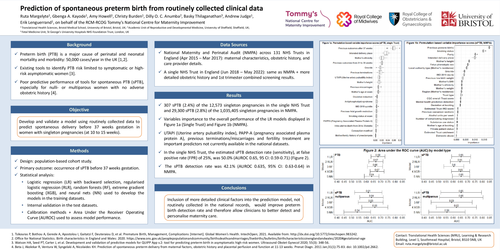
307 sPTB (2.4%) of the 12,573 singleton pregnancies in the single NHS Trust and 29,300 sPTB (2.8%) of the 1,035,405 singleton pregnancies in NMPA.
Variables importance to the overall performance of the LR models displayed in Figure 1a (Single Trust) and Figure 1b (NMPA).
UTAPI (Uterine artery pulsatility index), PAPP-A (pregnancy associated plasma protein A), previous terminations/miscarriages and fertility treatment are important predictors not currently available in the national datasets.
In the single NHS Trust, the estimated sPTB detection rate (sensitivity), at false positive rate (FPR) of 25%, was 50.0% (AUROC 0.65, 95 CI: 0.59-0.71) (Figure 2).
The sPTB detection rate was 42.1% (AUROC 0.635, 95% CI: 0.63-0.64) in NMPA.
Conclusions
Inclusion of more detailed clinical factors into the prediction model, not routinely collected in the national records, would improve preterm birth detection rate and therefore allow clinicians to better detect and personalise maternity care.
References
1. Tsikouras P, Bothou A, Gerede A, Apostolou I, Gaitatzi F, Deuteraiou D, et al. Premature Birth, Management, Complications [Internet]. Global Women’s Health. IntechOpen; 2021. Available from: http://dx.doi.org/10.5772/intechopen.983242.
2. Office for National Statistics. Birth characteristics in England and Wales: 2020. https://www.ons.gov.uk/peoplepopulationandcommunity/birthsdeathsandmarriages/livebirths/bulletins/birthcharacteristicsinenglandandwales/2020#gestational-age
3. Watson HA, Seed PT, Carter J, et al. Development and validation of predictive models for QUiPP App v.2: tool for predicting preterm birth in asymptomatic high-risk women. Ultrasound Obstet Gynecol 2020; 55(3): 348-56.
4. Beta J, Akolekar R, Ventura W, Syngelaki A, Nicolaides KH. Prediction of spontaneous preterm delivery from maternal factors, obstetric history and placental perfusion and function at 11-13 weeks. Prenat Diagn. 2011 Jan;31(1):75-83. doi: 10.1002/pd.2662.
Contact: Translational Health Sciences (MRU), Learning & Research Building, Level 1, Southmead Hospital, Bristol, BS10 5NB, UK
Email: ruta.margelyte@bristol.ac.uk