1,830 posters, 67 videos, 75 audios, 29 topics, 22 sessions, 4,727 authors, 1,697 institutions
ePostersLive by SciGen Technologies S.A. All rights reserved.
RCOG World Congress 2023
June 12 - 14, 2023 | London, UK

EP.0433
Ongoing clinical themes from Early Notification Scheme cases
Poster Presenter
Authors
Katherine Barton, Lucy Maudlin, Lynn Tilley, Catherine Vaughan
Affiliations
Part of Topic
Risk Management
Ongoing clinical themes from Early Notification Scheme cases
Objective: The Early Notification (EN) Scheme was established by NHS Resolution to improve claims resolution but also to support learning from incidents. Ongoing clinical themes from EN cases includes delay in birth, problems with fetal monitoring, vaginal breech births, suspected intrapartum infection and uterine rupture during vaginal birth after caesarean section (VBAC.)
Design: We reviewed a cohort of incidents occurring in Year 2 of the Early Notification Scheme. These incidents occurred between 1 April 2018 and 31 March 2019. We randomly selected 100 cases referred to NHS Resolutions commissioned panel of solicitors with an instruction to undertake a liability investigation. 7 cases were excluded as they were duplicates which led to 93 cases being analysed.
Method: Incidents were referred to panel for independent expert review where there was evidence of suboptimal care identified by the trust or NHS Resolutions EN clinical review. The aim of this analysis was to provide a systems based understanding of why harm may have occurred and to look for any common themes.
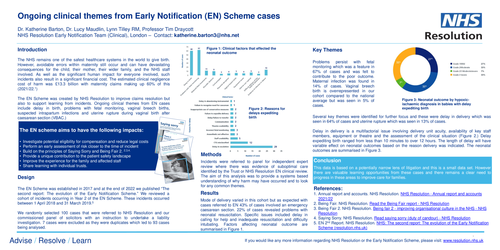
Results: Mode of delivery varied in this cohort but as expected with cases referred to EN 43% of cases involved an emergency caesarean section. 22% of cases revealed problems with neonatal resuscitation. Specific issues included delay in calling for help and inadequate resuscitation and difficulty intubating. Delay in birth was found in 64% of cases. Problems persist with fetal monitoring and 67% of cases had this is a contributing factor to poor outcomes. The incidence of maternal infection was found in 14% of cases and vaginal breech birth is overrepresented in our cohort compared to the national average but was seen in 5% of cases. 80% of these woman were primiparous with 60% being planned breech deliveries and the remaining 40% were woman who expressed a preference for caesarean section but this was delayed and led to unplanned vaginal breech deliveries.
Conclusions: This data is based on a potentially narrow lens of litigation and this is a small data set. However there are valuable learning opportunities from these cases and there remains a clear need to progress in these areas to improve care for families.