1,830 posters, 67 videos, 75 audios, 29 topics, 22 sessions, 4,727 authors, 1,697 institutions
ePostersLive by SciGen Technologies S.A. All rights reserved.
RCOG World Congress 2023
June 12 - 14, 2023 | London, UK

EP.0492
Interpretation Services within a Central London Maternity Unit - a Mixed Methods Evaluation
Poster Presenter
Part of Topic
Risk Management
Interpretation Services within a Central London Maternity Unit - a Mixed Methods Evaluation
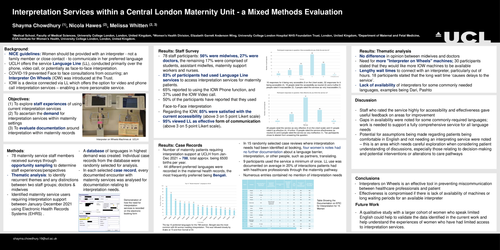
Objectives:
(1) To explore staff experiences of using current interpretation services
(2) To ascertain the demand for interpretation services within maternity settings
(3) To evaluate documentation around interpretation within maternity records
Design:
A mixed methods study conducted in a central London teaching hospital maternity service.
Methods:
78 maternity service staff members received surveys through opportunity sampling. Multiple choice, Likert scale and free text questions were analysed to determine staff experiences and perspectives. A thematic analysis was undertaken to identify recurrent themes and any distinctions between the two groups.
Electronic health records systems (EHRS) were analysed to identify maternity service users requiring interpretation support between January-December 2021. A database of languages in highest demand was created. Individual case records from the database were randomly selected for analysis. In each selected case record, every documented encounter with maternity services was analysed for documentation relating to interpretation needs.
Results:
Of the 78 staff participants, 83% had used Language Line services to access interpretation services for maternity patients, 85% were satisfied with the current accessibility and 95% viewed it as effective for communication. Thematic analysis identified a need for more "Interpreter on Wheels" machines; sometimes lengthy wait times to connect with an interpreter, particularly out of hours, and a lack of availability of interpreters for some commonly needed languages.
Language Line services at UCLH provide interpretation in over 240 languages for telephone interpreting, and 41 languages are available for video calls.
The number of maternity patients who were listed as requiring interpretation support at UCLH from Jan-Dec 2021 was 788, in a service with around 6500 births per year. 44 different preferred languages were recorded in the maternal health records, the most frequently preferred being Bengali.
Analysis of individual case records for women with interpretation needs identified that documentation regarding use of, or availability of interpretation, occurred only 20% of the time. Out of 15 detailed case reviews, eight had occasions where family/staff members were used as interpreters, and four had no records of interpretation services being used at all.
Conclusions
Maternity staff found current interpretation service provisions to be a valuable asset in the delivery of high-quality care. Key service improvements were identified in relation to 24-hour service provision, in order to prevent delays in delivering care and ensure the safety of women during their pregnancy. Learning was identified around documentation of use of and availability of interpretation services within maternity records.