1,830 posters, 67 videos, 75 audios, 29 topics, 22 sessions, 4,727 authors, 1,697 institutions
ePostersLive by SciGen Technologies S.A. All rights reserved.
RCOG World Congress 2023
June 12 - 14, 2023 | London, UK

EP.1643
Dying from Rectovaginal Deeply Infiltrating Endometriosis? – the answer: DIE-NO-gest!
Poster Presenter
Authors
Affiliations
Part of Topic
Endometriosis and Uterine Disorders
Introduction
Vaginal neoplasms that belong to the group of rectovaginal Deeply Infiltrating Endometriosis (DIE), as intimidating as they might appear, are not malignant and may not even necessitate surgical resection with appropriate treatment.
Rectovaginal endometriosis remains a therapeutic enigma due to its relatively low incidence and widely differing opinions on the standard of its treatment. At present, there is no definitive treatment for endometriosis (1,2). It is characterized by a progressive disease course with worsening symptoms if not appropriately managed. Minimising disease progression and alleviating symptoms such as chronic pelvic pain are hence cornerstones of management of endometriosis. (2) Dienogest is a relatively novel therapy for endometriosis, and presents major therapeutic potential in the treatment of DIE.
This report describes a success story of rectovaginal endometriosis treated with Dienogest and its well-tolerated side effects.
Case preentation
This is a case of a 36-year-old lady who presented to the urogynaecology clinic with postcoital bleeding and a vaginal mass. She had a history of open myomectomy, removal of rectovaginal cysts and endometriotic deposits from the Pouch of Douglas 1 year earlier, with no treatment from then till this presentation.
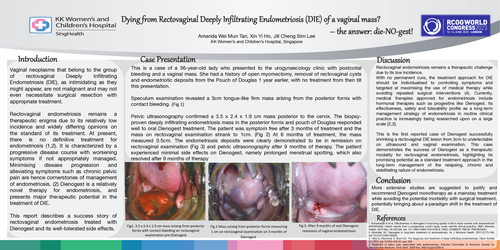
Speculum examination revealed a 3cm tongue-like firm mass arising from the posterior fornix with contact bleeding. (Fig 1)
Pelvic ultrasonography confirmed a 3.5 x 2.4 x 1.9 cm mass posterior to the cervix. The biopsy-proven deeply infiltrating endometriosis mass in the posterior fornix and pouch of Douglas responded well to oral Dienogest treatment. The patient was symptom free after 3 months of treatment and the mass on rectovaginal examination shrank to 1cm. (Fig 2) At 6 months of treatment, the mass measured 0.5cm. The endometriosis deposits were clearly demonstrated to be in remission on rectovaginal examination (Fig 3) and pelvic ultrasonography after 9 months of therapy. The patient experienced minimal side effects on Dienogest, namely prolonged menstrual spotting, which also resolved after 9 months of therapy.
Discussion
Rectovaginal endometriosis remains a therapeutic challenge due to its low incidence.
With no permanent cure, the treatment approach for DIE should be individualised to controlling symptoms and targeted at maximising the use of medical therapy while avoiding repeated surgical interventions (4). Currently, medical therapies approved for endometriosis include hormonal therapies such as progestins like Dienogest. Its effectiveness, safety and tolerability profile as a long-term management strategy of endometriosis in routine clinical practice is increasingly being researched upon on a large scale [2,3].
This is the first reported case of Dienogest successfully shrinking a rectovaginal DIE lesion from 3cm to undetectable on ultrasound and vaginal examination. This case demonstrates the success of Dienogest as a therapeutic modality for rectovaginal endometriosis, highlighting its promising potential as a standard treatment approach in the long-term management of the relapsing, chronic and debilitating nature of endometriosis.
Conclusion
More extensive studies are suggested to justify and recommend Dienogest monotherapy as a mainstay treatment while avoiding the potential morbidity with surgical treatment, potentially bringing about a paradigm shift in the treatment of DIE.