1,830 posters, 67 videos, 75 audios, 29 topics, 22 sessions, 4,727 authors, 1,697 institutions
ePostersLive by SciGen Technologies S.A. All rights reserved.
RCOG World Congress 2023
June 12 - 14, 2023 | London, UK

EP.1419
Laparoscopic Treatment of Abdominal Wall Endometriosis: A Retrospective Analysis of 8 Cases
Poster Presenter
Authors
Jinbo Li, Xiao Li, Taicheng Zhou, Lingbing Chou, Shuqin Chen
Affiliations
Part of Topic
Endometriosis and Uterine Disorders
Laparoscopic Treatment of Abdominal Wall Endometriosis: A Retrospective Analysis of 8 Cases
Jinbo Li1, Xiao Li1, Taicheng Zhou2, Lingbing Chou1, Shuqin Chen1
(1: Department of Gynecology, The Six Affiliated Hospital, Sun Yat-Sen University, Guangzhou 510080,China. 2: Department of Gastroenterological Surgery and Hernia Center, The Sixth Affiliated Hospital, Sun Yat-Sen University, Guangzhou 510080, China)
Correspondence to:Shuqin Chen,E-mail:chshqin@mail.sysu.edu.cn
Abstract
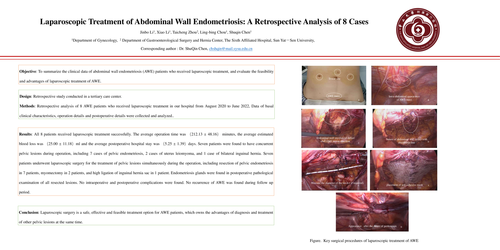
Objective: To summarize the clinical data of abdominal wall endometriosis (AWE) patients who received laparoscopic treatment, and evaluate the feasibility and advantages of laparoscopic treatment of AWE.
Methods: Retrospective analysis of 8 AWE patients who received laparoscopic treatment in our hospital from August 2020 to June 2022, Data of basal clinical characteristics, operation details and postoperative details were collected and analyzed.
Results: All 8 patients received laparoscopic treatment successfully. The average operation time was (212.13 ± 48.16) minutes, the average estimated blood loss was (25.00 ± 11.18)ml and the average postoperative hospital stay was (5.25 ± 1.39)days. Seven patients were found to have concurrent pelvic lesions during operation, including 7 cases of pelvic endometriosis, 2 cases of uterus leiomyoma, and 1 case of bilateral inguinal hernia. Seven patients underwent laparoscopic surgery for the treatment of pelvic lesions simultaneously during the operation, including resection of pelvic endometriosis in 7 patients, myomectomy in 2 patients, and high ligation of inguinal hernia sac in 1 patient. Endometriosis glands were found in postoperative pathological examination of all resected lesions. No intraoperative and postoperative complications were found. No recurrence of AWE was found during follow up period. Conclusion: Laparoscopic surgery is a safe, effective and feasible treatment option for AWE patients, which owns the advantages of diagnosis and treatment of other pelvic lesions at the same time.