1,830 posters, 67 videos, 75 audios, 29 topics, 22 sessions, 4,727 authors, 1,697 institutions
ePostersLive by SciGen Technologies S.A. All rights reserved.
RCOG World Congress 2023
June 12 - 14, 2023 | London, UK

EP.1215
Endometrioma Recurrences After Laparoscopic Cystectomy and Laparoscopic Drainage Are Not Significantly Different
Part of Topic
Endometriosis and Uterine Disorders
Endometrioma Recurrences After Laparoscopic Cystectomy and Laparoscopic Drainage Are Not Significantly Different
M Luky Satria Syahbana Marwali1,3; Artha Falentin Putri Susilo2; Malvin Emeraldi1; Cynthia Agnes Susanto3; Kevin Dominique Tjandraprawira2; Agus Surur As’adi1
1Department of Obstetrics and Gynecology, Fatmawati General Hospital, Jakarta, Indonesia
2Department of Obstetrics and Gynecology, Faculty of Medicine, Universitas Padjadjaran – Dr. Hasan Sadikin General Hospital, Bandung, Indonesia
3Bocah Indonesia Fertility Center, Jakarta, Indonesia
Objective
This study is to determine endometrioma recurrence rate after laparoscopic cystectomy and laparoscopic drainage.
Design
Retrospective cohort study.
Methods
This retrospective cohort study took place at public tertiary hospital and Bocah Indonesia Fertility Center in Jakarta, Indonesia with patient recruitment between 01/01/2021 and 31/12/2021. Patients with endometrioma were all recruited. Excluded were those declining to participate and with incomplete case notes. Patients were allocated into laparoscopic cystectomy or laparoscopic aspiration and absorbable haemostat (SURGICELÒ) group on a non-randomised manner at the clinician’s discretion. Pre- and post-operative antimullerian hormone (AMH) levels and pain severity levels of symptoms were recorded. Recurrence is recorded.
Results
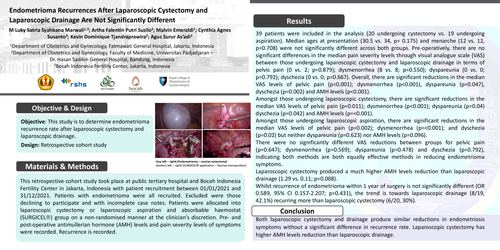
39 patients were included in the analysis (20 undergoing cystectomy vs. 19 undergoing aspiration). Median ages at presentation (30.5 vs. 34, p= 0.175) and menarche (12 vs. 12, p=0.708) were not significantly different across both groups. Pre-operatively, there are no significant differences in the median pain severity levels through visual analogue scale (VAS) between those undergoing laparoscopic cystectomy and laparoscopic drainage in terms of pelvic pain (0 vs. 2; p=0.879); dysmenorrhea (8 vs. 8; p=0.550); dyspareunia (0 vs. 0; p=0.792); dyschezia (0 vs. 0; p=0.667). Overall, there are significant reductions in the median VAS levels of pelvic pain (p<0.001); dysmenorrhea (p<0.001), dyspareunia (p=0.047), dyschezia (p=0.002) and AMH levels (p<0.001).
Amongst those undergoing laparoscopic cystectomy, there are significant reductions in the median VAS levels of pelvic pain (p=0.011); dysmenorrhea (p<0.001); dyspareunia (p=0.04) dyschezia (p=0.042) and AMH levels (p=<0.001).
Amongst those undergoing laparoscopic aspiration, there are significant reductions in the median VAS levels of pelvic pain (p=0.002); dysmenorrhea (p=<0.001); and dyschezia (p=0.02) but neither dyspareunia (p=0.623) nor AMH levels (p=0.096).
There were no significantly different VAS reductions between groups for pelvic pain (p=0.647); dysmenorrhea (p=0.569); dyspareunia (p=0.478) and dyschezia (p=0.792), indicating both methods are both equally effective methods in reducing endometrioma symptoms.
Laparoscopic cystectomy produced a much higher AMH levels reduction than laparoscopic drainage (1.29 vs. 0.11; p=0.008).
Whilst recurrence of endometrioma within 1 year of surgery is not significantly different (OR 0.589, 95% CI 0.157-2.207; p=0.431), the trend is towards laparoscopic drainage (8/19, 42.1%) recurring more than laparoscopic cystectomy (6/20, 30%).
Conclusions
Both laparoscopic cystectomy and drainage produce similar reductions in endometriosis symptoms without a significant difference in recurrence rate. Laparoscopic cystectomy has higher AMH levels reduction than laparoscopic drainage.