1,830 posters, 67 videos, 75 audios, 29 topics, 22 sessions, 4,727 authors, 1,697 institutions
ePostersLive by SciGen Technologies S.A. All rights reserved.
RCOG World Congress 2023
June 12 - 14, 2023 | London, UK

EP.1189
Case report: A Functioning Non-communicating Rudimentary Uterine Horn; Laparoscopic Excision.
Poster Presenter
Authors
Affiliations
Part of Topic
Endometriosis and Uterine Disorders
A Functioning Non-communicating Rudimentary Uterine Horn; Laparoscopic Excision.
Dr. Hany Akef A. Omar and Dr. Sultan Qayoum Khan
Beni-Suef Faculty of Medicine, Egypt and Dibba Hospital Al Fujairah,UAE
Background
Non-communicating rudimentary horn with hematometra is a rare condition (1 in 35 of unicornuate uterus), where the prevalence of unicornuate uterus is estimated in 0.1% to 0.5% of women.
Diagnosis is usually made in adolescence due to the blood retention and severe dysmenorrhea. Delayed diagnosis may be associated the development of endometriosis and pelvic adhesions with its subsequent consequences.
Case Report
A 14-year-old nulligravid girl, who presented complaining of severe dysmenorrhea. She reported progressive dysmenorrhea minimally relieved with analgesics for the last 14 months.
Pelvic ultrasound scan revealed left adnexal mass with walls being isoechoic to the myometrium and contained hyperechoic material. MRI revealed an anomalous uterine cavity with a single right-sided horn communicating with the cervix, pushed to the right by a distended left-sided rudimentary horn with intracavitary fluid signal intensity indicating hematometra in the rudimentary horn, No other malformation was present.
An informed consent was obtained for a laparoscopic rudimentary horn excision under general anesthesia.
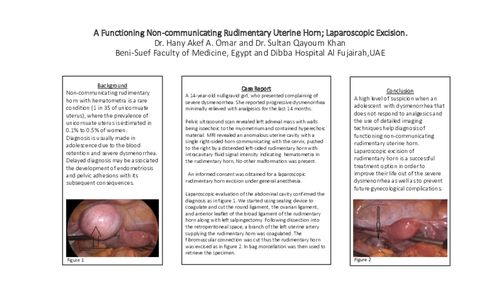
Laparoscopic evaluation of the abdominal cavity confirmed the diagnosis as in figure 1. We started using sealing device to coagulate and cut the round ligament, the ovarian ligament, and anterior leaflet of the broad ligament of the rudimentary horn along with left salpingectomy. Following dissection into the retroperitoneal space, a branch of the left uterine artery supplying the rudimentary horn was coagulated. The fibromuscular connection was cut thus the rudimentary horn was excised as in figure 2. In bag morcellation was then used to retrieve the specimen.
Conclusion
A high level of suspicion when an adolescent with dysmenorrhea that does not respond to analgesics and the use of detailed imaging techniques help diagnosis of functioning non-communicating rudimentary uterine horn.
Laparoscopic excision of rudimentary horn is a successful treatment option in order to improve their life out of the severe dysmenorrhea as well as to prevent future gynecological complications.