1,830 posters, 67 videos, 75 audios, 29 topics, 22 sessions, 4,727 authors, 1,697 institutions
ePostersLive by SciGen Technologies S.A. All rights reserved.
RCOG World Congress 2023
June 12 - 14, 2023 | London, UK

EP.1141
Necrotizing fasciitis following episiotomy in a woman with Hailey-Hailey disease
Poster Presenter
Part of Topic
Risk Management
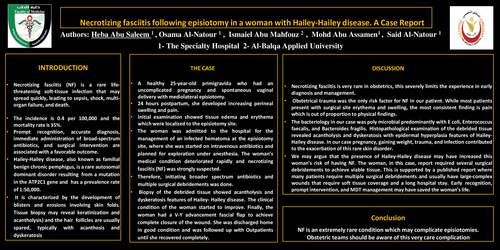
Necrotizing fasciitis following episiotomy in a woman with Hailey-Hailey disease. A Case Report
Authors: Heba Abu Saleem 1 , Osama Al-Natour 1 , Ismaiel Abu Mahfouz 2 , Mohd Abu Assamen1 , Said Al-Natour 1
1- The Specialty Hospital 2- Al-Balqa Applied University
INTRODUCTION
- Necrotizing fasciitis (NF) is a rare life-threatening soft-tissue infection that may spread quickly, leading to sepsis, shock, multi-organ failure, and death.
- The incidence is 0.4 per 100,000 and the mortality rate is 35%.
- Prompt recognition, accurate diagnosis, immediate administration of broad-spectrum antibiotics, and surgical intervention are associated with a favorable outcome.
- Hailey-Hailey disease, also known as familial benign chronic pemphigus, is a rare autosomal dominant disorder resulting from a mutation in the ATP2C1 gene and has a prevalence rate of 1:50,000.
- It is characterized by the development of blisters and erosions involving skin folds. Tissue biopsy may reveal keratinization and acantholysis) and the hair follicles are usually spared, typically with acanthosis and dyskeratosis
THE CASE
- A healthy 25-year-old primigravida who had an uncomplicated pregnancy and spontaneous vaginal delivery with mediolateral episiotomy.
- 24 hours postpartum, she developed increasing perineal swelling and pain.
- Initial examination showed tissue edema and erythema which were localized to the episiotomy site.
- The woman was admitted to the hospital for the management of an infected hematoma at the episiotomy site, where she was started on intravenous antibiotics and planned for exploration under anesthesia. The woman’s medical condition deteriorated rapidly and necrotizing fasciitis (NF) was strongly suspected.
- Therefore, initiating broader spectrum antibiotics and multiple surgical debridements was done.
- Biopsy of the debrided tissue showed acantholysis and dyskeratosis features of Hailey- Hailey disease. The clinical condition of the woman started to improve. Finally, the woman had a V-Y advancement fascial flap to achieve complete closure of the wound. She was discharged home in good condition and was followed up with Outpatients until she recovered completely.
DISCUSSION
- Necrotizing fasciitis is very rare in obstetrics, this severely limits the experience in early diagnosis and management.
- Obstetrical trauma was the only risk factor for NF in our patient. While most patients present with surgical site erythema and swelling, the most consistent finding is pain which is out of proportion to physical findings.
- The bacteriology in our case was poly microbial predominantly with E coli, Enterococcus faecalis, and Bacteroides fragilis. Histopathological examination of the debrided tissue revealed acantholysis and dyskeratosis with epidermal hyperplasia features of Hailey- Hailey disease. In our case pregnancy, gaining weight, trauma, and infection contributed to the exacerbation of this rare skin disorder.
- We may argue that the presence of Hailey-Hailey disease may have increased this woman’s risk of having NF. The woman, in this case, report required several surgical debridements to achieve viable tissue. This is supported by a published report where many patients require multiple surgical debridements and usually have large-complex wounds that require soft tissue coverage and a long hospital stay. Early recognition, prompt intervention, and MDT management may have saved the woman’s life.
Conclusion
NF is an extremely rare condition which may complicate episiotomies. Obstetric teams should be aware of this very care complication