1,830 posters, 67 videos, 75 audios, 29 topics, 22 sessions, 4,727 authors, 1,697 institutions
ePostersLive by SciGen Technologies S.A. All rights reserved.
RCOG World Congress 2023
June 12 - 14, 2023 | London, UK

EP.1134
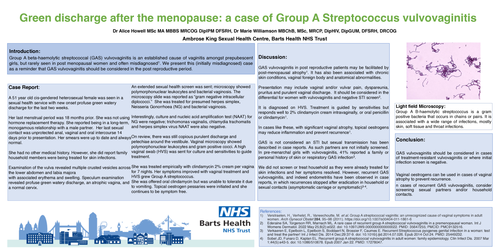
Green discharge after the menopause: a case of Group A Strep vulvovaginitis
Poster Presenter
Authors
Affiliations
Part of Topic
Post Reproductive Health
Green discharge after the menopause: a case of Group A Streptococcus vulvovaginitis
Dr Alice Howell MSc MA MBBS MRCOG DipIPM DFSRH, Dr Marie Williamson MBChB, MSc, MRCP, DipHIV, DipGUM, DFSRH, DRCOG
Ambrose King Sexual Health Centre, Barts Health NHS Trust
Introduction:
Group A beta-haemolytic streptococcal (GAS) vulvovaginitis is an established cause of vaginitis amongst prepubescent girls, but rarely seen in post menopausal women and often misdiagnosed1. We present this (initially misdiagnosed) case as a reminder that GAS vulvovaginitis should be considered in the post reproductive period.
Case Report:
A 51 year old cis-gendered heterosexual female was seen in a sexual health service with new onset profuse green watery discharge for the last two weeks.
Her last menstrual period was 18 months prior. She was not using hormone replacement therapy. She reported being in a long-term, monogamous relationship with a male partner. Her last sexual contact was unprotected anal, vaginal and oral intercourse 14 days prior to presentation. Her smears were up to date and always normal.
She had no other medical history. However, she did report family household members were being treated for skin infections.
Examination of the vulva revealed multiple crusted vesicles across the lower abdomen and labia majora
with associated erythema and swelling. Speculum examination revealed profuse green watery discharge, an atrophic vagina, and a normal cervix.
An extended sexual health screen was sent; microscopy showed polymorphonuclear leukocytes and bacterial vaginosis. The microscopy slide was reported as “gram negative intracellular diplococci.” She was treated for presumed herpes simplex, Neisseria Gonorrhoea (NG) and bacterial vaginosis.
Interestingly, culture and nucleic acid amplification test (NAAT) for NG were negative; trichomonas vaginalis, chlamydia trachomatis and herpes simplex virus NAAT were also negative.
On review, there was still copious purulent discharge and petechiae around the vestibule. Vaginal microscopy showed polymorphonuclear leukocytes and gram positive cocci. A high vaginal swab (HVS) was sent for culture and sensitivities to guide treatment.
She was treated empirically with clindamycin 2% cream per vagina for 7 nights. Her symptoms improved with vaginal treatment and HVS grew Group A streptococcus.
She was offered oral clindamycin but was unable to tolerate it due to vomiting. Topical oestrogen pessaries were initiated and she continues to be symptom free.
Discussion:
GAS vulvovaginitis in post reproductive patients may be facilitated by post-menopausal atrophy1. It has also been associated with chronic skin conditions, vaginal foreign body and anatomical abnormalities.
Presentation may include vaginal and/or vulvar pain, dyspareunia, pruritus and purulent vaginal discharge. It should be considered in the differential for women with vulvovaginitis and negative STI screen2.
It is diagnosed on HVS. Treatment is guided by sensitivities but responds well to 2% clindamycin cream intravaginally, or oral penicillin or clindamycin1.
In cases like these, with significant vaginal atrophy, topical oestrogens may reduce inflammation and prevent recurrence1.
GAS is not considered an STI but sexual transmission has been described in case reports. As such partners are not initially screened. In pre-menarchal girls with vulvovaginitis, 41% reported a family or personal history of skin or respiratory GAS infection3.
We did not screen or treat household as they were already treated for skin infections and her symptoms resolved. However, recurrent GAS vulvovaginitis, and indeed endometritis have been observed in case reports, in which recurrences stopped after eradication in household or sexual contacts (asymptomatic carriage or symptomatic)3-4.
Light field Microscopy:
Group A B-haemolytic streptococcus is a gram positive bacteria that occurs in chains or pairs. It is associated with a wide range of infections, mostly skin, soft tissue and throat infections.
Conclusion:
GAS vulvovaginitis should be considered in cases of treatment-resistant vulvovaginitis or where initial infection screen is negative.
Vaginal oestrogens can be used in cases of vaginal atrophy to prevent recurrence.
In cases of recurrent GAS vulvovaginitis, consider screening sexual partners and/or household contacts.
References: