1,830 posters, 67 videos, 75 audios, 29 topics, 22 sessions, 4,727 authors, 1,697 institutions
ePostersLive by SciGen Technologies S.A. All rights reserved.
RCOG World Congress 2023
June 12 - 14, 2023 | London, UK

EP.1027
Ten years data review on Cervical endometriosis, ex post facto
Poster Presenter
Authors
Affiliations
Part of Topic
Endometriosis and Uterine Disorders
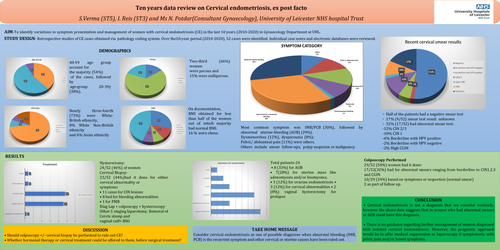
Aim :To identify variations in symptom presentation and management of women with cervical endometriosis (CE) in the last 10 years (2010-2020) in Gynaecology Department at UHL.
STUDY DESIGN : Retrospective studies of CE cases obtained via pathology coding system. Over the10-year period (2010-2020), 52 cases were identified. Individual case notes and electronic databases were reviewed.
Results:
· 54% of cases were in the 40-59 y age group and 38 % in the 20-39y age group. Nearly, three-fourths of women were white British ethnicity (73%).
· The most common symptom was intermenstrual (IMB)/ post-coital bleeding (PCB) (30%), followed by abnormal uterine bleeding (AUB) (29%). Dysmenorrhea, dyspareunia (12%), and pelvic/ abdominal pain (11%) were others.
· One-third of women (33%) had abnormal smears.
· 29/52 (56%) women underwent Colposcopy for either abnormal smears (44.8%) or suspicious symptoms (27.5%).
· 23/52 (44%) had an initial cervical biopsy for either cervical abnormality or symptoms, which confirmed the diagnosis of CE.
· 25/52 (48%) had CE diagnosed on a hysterectomy specimen. The reasons for hysterectomy were AUB (36%); fibroids/adenomyosis (28%); ovarian endometriosis (12%); cervical abnormalities (12%); UV prolapse (8%), and others (4%).
DISCUSSION: Should colposcopy +/- cervical biopsy be performed to rule out CE? Whether hormonal therapy or cervical treatment could be offered to them, before surgical treatment?
CONCLUSION: Cervical endometriosis is not a diagnosis that we consider routinely, however the above data suggests that in women who had abnormal smears or AUB could have this diagnosis. There is no guidance regarding further management of women diagnosed with isolated cervical endometriosis. However, the pragmatic approach would be to offer medical suppression or laparoscopy if symptomatic with pelvic pain and/or bowel symptoms.
TAKE HOME MESSAGE :Consider cervical endometriosis as one of possible diagnoses when abnormal bleeding (IMB, PCB) is the recurrent symptom and other cervical or uterine causes have been ruled out.