296 posters, 7 videos, 13 audios, 14 topics, 10 sessions, 1,019 authors, 260 institutions
ePostersLive by SciGen Technologies S.A. All rights reserved.
RCOphth Annual Congress 2026
18 - 21 May, 2026 | Manchester Central, Manchester

P233
The use of 3D anatomy software as an adjunct to prosections for teaching ocular anatomy: a mixed-method study of undergraduate medical students
Poster Presenter
Authors
Part of Topic
Miscellaneous
The use of 3D anatomy software as an adjunct to prosections for teaching ocular anatomy: a mixed-method study of undergraduate medical students
Authors: Maya Dudko 1, Anju Albert1, Kat Sanders2
Affiliations:1. Hull York Medical School 2. The University of Sydney
Introduction: Anatomy underpins clinical practice, traditionally taught using cadaveric prosections, which remain the “gold standard” due to their realism, tactile experience, and ability to develop spatial understanding and professional skills. However, their use is limited by ethical, logistical, financial, and visualisation challenges - particularly in complex regions such as the head, neck, and ocular anatomy. Advances in educational technology have led to increasing use of 3D anatomy software, which offers flexible, accessible, and interactive visualisation of anatomical structures, with potential benefits for engagement and spatial learning. Despite this, current evidence on its effectiveness is inconsistent, with limited research on optimal implementation, long-term learning outcomes, and its use in challenging anatomical regions. This study addresses these gaps by evaluating the role of 3D anatomy software (Complete Anatomy) as an adjunct to prosections in teaching ocular anatomy, including its impact on student performance, perceptions, and methods of integration into medical curricula.
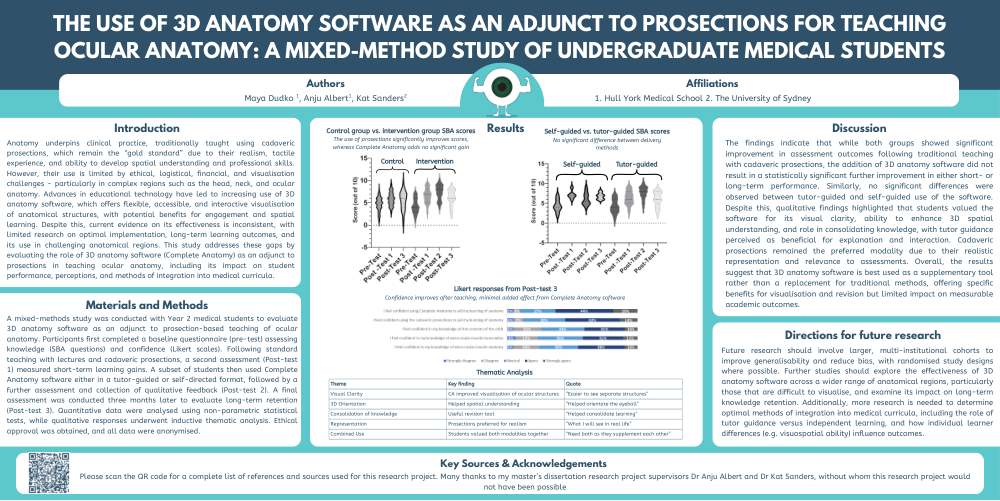
Materials and Methods: A mixed-methods study was conducted with Year 2 medical students to evaluate 3D anatomy software as an adjunct to prosection-based teaching of ocular anatomy. Participants first completed a baseline questionnaire (pre-test) assessing knowledge (SBA questions) and confidence (Likert scales). Following standard teaching with lectures and cadaveric prosections, a second assessment (Post-test 1) measured short-term learning gains. A subset of students then used Complete Anatomy software either in a tutor-guided or self-directed format, followed by a further assessment and collection of qualitative feedback (Post-test 2). A final assessment was conducted three months later to evaluate long-term retention (Post-test 3). Quantitative data were analysed using non-parametric statistical tests, while qualitative responses underwent inductive thematic analysis. Ethical approval was obtained, and all data were anonymised.
Results and Discussion: The findings indicate that while both groups showed significant improvement in assessment outcomes following traditional teaching with cadaveric prosections, the addition of 3D anatomy software did not result in a statistically significant further improvement in either short- or long-term performance. Similarly, no significant differences were observed between tutor-guided and self-guided use of the software. Despite this, qualitative findings highlighted that students valued the software for its visual clarity, ability to enhance 3D spatial understanding, and role in consolidating knowledge, with tutor guidance perceived as beneficial for explanation and interaction. Cadaveric prosections remained the preferred modality due to their realistic representation and relevance to assessments. Overall, the results suggest that 3D anatomy software is best used as a supplementary tool rather than a replacement for traditional methods, offering specific benefits for visualisation and revision but limited impact on measurable academic outcomes.
Directions for future research: Future research should involve larger, multi-institutional cohorts to improve generalisability and reduce bias, with randomised study designs where possible. Further studies should explore the effectiveness of 3D anatomy software across a wider range of anatomical regions, particularly those that are difficult to visualise, and examine its impact on long-term knowledge retention. Additionally, more research is needed to determine optimal methods of integration into medical curricula, including the role of tutor guidance versus independent learning, and how individual learner differences (e.g. visuospatial ability) influence outcomes.