296 posters, 7 videos, 13 audios, 14 topics, 10 sessions, 1,019 authors, 259 institutions
ePostersLive by SciGen Technologies S.A. All rights reserved.
RCOphth Annual Congress 2026
18 - 21 May, 2026 | Manchester Central, Manchester

P213
Benchmarking Emerging Patient Information Sources: Assessing Accuracy, Safety, Completeness, and Readability of Ophthalmic Advice Generated by Large Language Models
Part of Topic
Miscellaneous
Clinical leaflets vs AI: Benchmarking eye health advice from generative artificial intelligence in terms of factual accuracy, safety, comprehensiveness and readability
Aleksander Stupnicki¹, Bernardo Souza Mendes¹, Maxwell J.B. Reinstein¹, Ariel Yuhan Ong²·³, Andrew Malem⁴·⁵, Pearse A. Keane²·³, Arun J. Thirunavukarasu⁶
INTRODUCTION
BACKGROUND
- 32% of adults use generative AI (genAI) for healthcare advice¹, and 25% of ChatGPT users ask health questions weekly²
- On-demand, tailored responses from genAI chatbots can improve patients' health literacy and engagement³·⁴
- However, general-purpose genAI chatbots lack regulatory approval for medical use, and significant risks have been raised in the literature⁵·⁶
- Prior evaluations in ophthalmology focus on exam performance, evidence on patient-facing advice quality is limited⁷
AIM
- Can leading general-purpose LLMs produce eye health advice of comparable 'quality' to clinical patient information leaflets?
- Aim: Benchmark GPT-5 and Gemini 3 against NHS ophthalmology patient information leaflets across four domains: accuracy, comprehensiveness, safety, and readability
METHODOLOGY
DATASET
- Control arm: Patient information leaflets (NHS Manchester Royal Eye Hospital)
- Eye diseases evaluated (n = 9): age-related macular degeneration (AMD), cataract, Charles Bonnet syndrome (CBS), diabetic retinopathy (DR), dry eye disease, glaucoma, nystagmus, posterior vitreous detachment (PVD), and retinal detachment (RD)
BENCHMARK
- Source material: Patient information leaflets (by the Royal College of Ophthalmologists (RCOphth) and the Royal National Institute of Blind People (RNIB))⁷
- Benchmark development: The benchmark was manually derived from RCOphth/RNIB leaflets by translating each statement into a checklist point
GENERATIVE AI ADVICE GENERATION
- Models: GPT-5 (OpenAI, USA) and Gemini 3.0 (Google DeepMind, UK); latest, most popular models at the time of study; default settings
- Prompts:Outputs were generated using NHS leaflet subheadings as verbatim prompts with word-count constraints to match control text length
- Example: "What is age-related macular degeneration (AMD)? Restrict your answer to 154 words"
EVALUATION
- Scoring framework: Comprehensiveness, accuracy, safety evaluation framework (CASEF); -2 to +2 bidirectional scale to quantify concordance between benchmark and genAI / NHS leaflet text
- Factual accuracy: Normalised total CASEF scores (-100% to +100%)
- Comprehensiveness: Number of omissions (CASEF score = 0)
- Safety: Number of checklist items with negative CASEF scores (-1, -2) + qualitative evaluation by a senior ophthalmology resident (AYO) and a consultant ophthalmologist (AM)
- Readability: Simple Measure of Gobbledygook (SMOG) Index, Flesch-Kincaid Grade Level (FKGL), and Automated Readability Index (ARI)
- Scoring panel: Hybrid, semi-automated panel of 5 LLMs and 1 human evaluator (LLM-as-a-judge methodology)
- Inter-rater reliability: Intraclass correlation coefficient (ICC(2,1)) and preferential scoring were evaluated → ICC=0.843; no preferential scoring
RESULTS
ACCURACY & COMPREHENSIVENESS
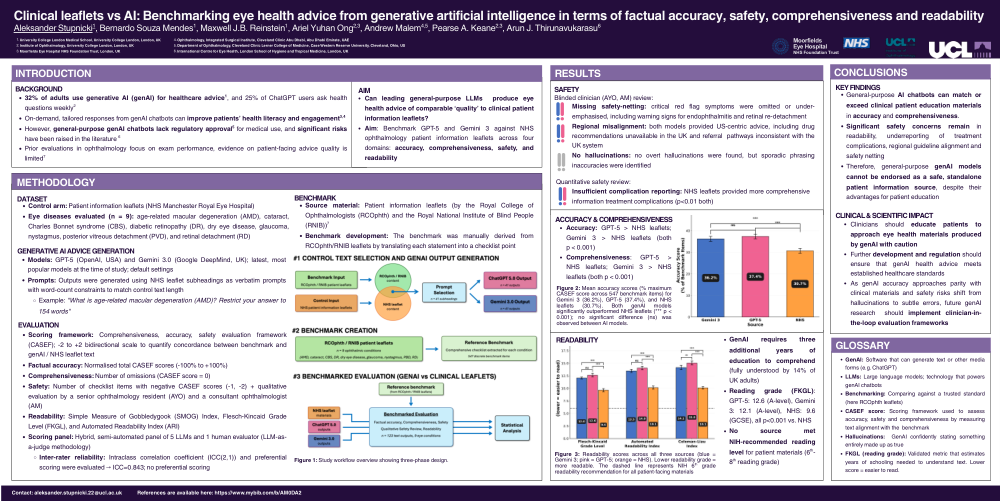
- Accuracy: GPT-5 > NHS leaflets; Gemini 3 > NHS leaflets (both p < 0.001)
- Comprehensiveness: GPT-5 > NHS leaflets; Gemini 3 > NHS leaflets (both p < 0.001)
Figure 2: Mean accuracy scores (% maximum CASEF score across 547 benchmark items) for Gemini 3 (36.2%), GPT-5 (37.4%), and NHS leaflets (30.7%). Both genAI models significantly outperformed NHS leaflets (*** p < 0.001); no significant difference was observed between AI models (ns).
SAFETY
Blinded clinician (AYO, AM) review:
- Missing safety-netting: critical red flag symptoms were omitted or underemphasised, including warning signs for endophthalmitis and retinal redetachment
- Regional misalignment: both models provided US-centric advice, including drug recommendations unavailable in the UK and referral pathways inconsistent with the UK system
- No hallucinations: no overt hallucinations were found, but sporadic phrasing inaccuracies were identified
Quantitative safety review:
- Insufficient complication reporting: NHS leaflets provided more comprehensive information treatment complications (p<0.01 both)
READABILITY
- Reading grade: GPT-5: 12.6 (A-level), Gemini 3: 12.1 (A-level), NHS: 9.6 (GCSE), all p<0.001 vs. NHS (FKGL)
- GenAI requires 3 additional years of education to comprehend (only understood by 14% of UK adults)
- No source met NIH-recommended grade 6–8 reading level for patient materials
CONCLUSIONS
KEY FINDINGS
- General-purpose AI chatbots can match or exceed clinical patient education materials in factual accuracy and comprehensiveness.
- Significant safety concerns remain in readability, underreporting of treatment complications, regional guideline alignment and safety netting
- Therefore, general-purpose genAI cannot be endorsed as a safe, standalone patient information source, despite its advantages for patient education
CLINICAL & SCIENTIFIC IMPACT
- Clinicians should educate patients to approach eye health materials produced by genAI with caution
- Further development and regulation should ensure that genAI health advice meets established healthcare standards
- As genAI accuracy approaches parity with clinical materials and safety risks shift from hallucinations to subtle errors, future genAI research should implement clinician-in-the-loop evaluation frameworks
GLOSSARY
- GenAI: Software that can generate text or other media forms (e.g. ChatGPT)
- LLM: Large language models; technology that powers genAI chatbots
- Benchmarking: Comparing against a trusted standard (here RCOphth leaflets)
- CASEF score: Scoring framework used to assess accuracy, safety and comprehensiveness by measuring text alignment with the benchmark
- Hallucinations: GenAI confidently stating something entirely made up as true
- FKGL (reading grade): Validated metric that estimates years of schooling needed to understand text. Lower score = easier to read.
References are available here: https://www.mybib.com/b/AM0DA2
Contact: aleksander.stupnicki.22@ucl.ac.uk