296 posters, 7 videos, 13 audios, 14 topics, 10 sessions, 1,019 authors, 260 institutions
ePostersLive by SciGen Technologies S.A. All rights reserved.
RCOphth Annual Congress 2026
18 - 21 May, 2026 | Manchester Central, Manchester

P230
RCOphthGPT: a custom-trained AI companion for the new RCOphth 2024 curriculum and exams, supporting trainees and trainers with progression from Levels 1 to 4
Poster Presenter
Authors
Mohaimen Al-Zubaidy, Haidar Jafar, William Purcell, Zaid Alsafi, Yashin Ramkissoon
Affiliations
Royal Victoria Infirmary, Newcastle upon Tyne Hospitals NHS Foundation Trust, Newcastle upon Tyne, UK, University of Sheffield, Sheffield, UK, University of Liverpool, Liverpool, UK, Moorfields Eye Hospital NHS Foundation Trust, London, UK, Royal Hallamshire Hospital, Sheffield Teaching Hospitals NHS Foundation Trust, Sheffield, UK
Part of Topic
Miscellaneous
RCOphthGPT: a custom-trained AI companion for the new RCOphth 2024 curriculum and exams, supporting trainees and trainers with progression from Levels 1 to 4.
M. Al-Zubaidy, H. Jafar, W. Purcell, Z. Alsafi, Y. Ramkissoon.
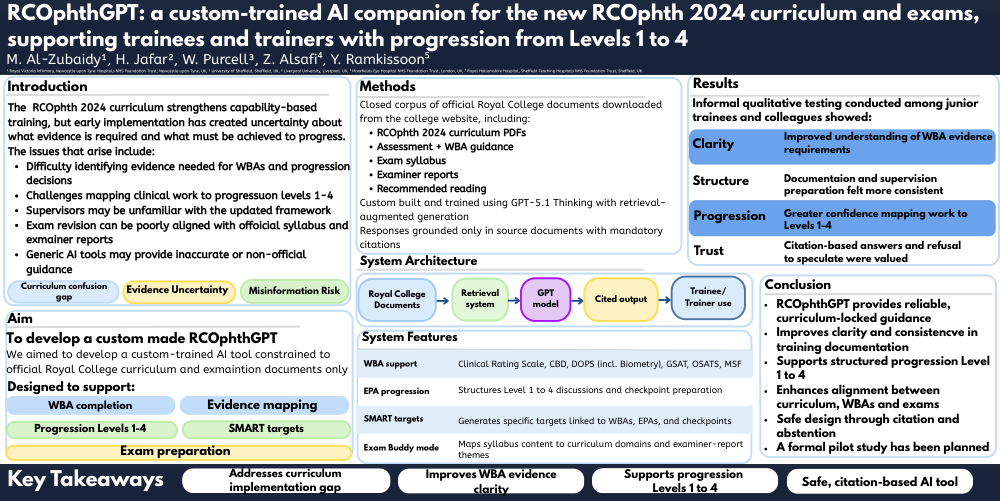
Introduction: The RCOphth 2024 curriculum strengthens capability-based ophthalmology training, but early implementation has created uncertainty about what evidence is required and what trainees must achieve to progress. Key challenges include identifying appropriate evidence for workplace-based assessments and progression decisions, mapping clinical work to progression Levels 1 to 4, supervisor familiarity with the updated framework, aligning examination revision with the official syllabus and examiner reports, and avoiding inaccurate or non-official guidance from generic AI tools.
Aim: To develop RCOphthGPT, a custom-trained AI tool constrained to official Royal College of Ophthalmologists curriculum and examination documents, designed to support trainees and trainers with workplace-based assessments, evidence mapping, progression Levels 1 to 4, SMART targets, and exam preparation.
Methods: A closed corpus of official Royal College documents was downloaded from the college website, including RCOphth 2024 curriculum PDFs, assessment and WBA guidance, examination syllabus documents, examiner reports, and recommended reading. The system was custom built using GPT-5.1 Thinking with retrieval-augmented generation. Responses were designed to be grounded only in source documents, with mandatory citations and refusal to speculate when evidence was insufficient. The system architecture included Royal College documents, retrieval system, GPT model, cited output, and trainee or trainer use.
System features: RCOphthGPT provides WBA support for Clinical Rating Scale, CBD, DOPS including biometry, GSAT, OSATS, and MSF. It supports EPA progression by structuring Level 1 to 4 discussions and checkpoint preparation. It generates SMART targets linked to WBAs, EPAs, and checkpoints. Exam Buddy mode maps syllabus content to curriculum domains and examiner-report themes.
Results: Informal qualitative testing among junior trainees and colleagues suggested improved understanding of WBA evidence requirements, more consistent documentation and supervision preparation, greater confidence mapping clinical work to Levels 1 to 4, and value from citation-based answers with refusal to speculate.
Conclusion: RCOphthGPT provides reliable, curriculum-locked guidance, improves clarity and consistency in training documentation, supports structured progression from Level 1 to Level 4, enhances alignment between curriculum, WBAs and examinations, and promotes safer AI use through citation and abstention. A formal pilot study is planned.
Keywords: RCOphth 2024 curriculum, ophthalmology training, artificial intelligence, AI in medical education, workplace-based assessments, WBAs, EPAs, ophthalmology exams, FRCOphth, trainee progression, trainer support, evidence mapping, SMART targets, curriculum implementation, retrieval-augmented generation.