296 posters, 7 videos, 13 audios, 14 topics, 10 sessions, 1,019 authors, 260 institutions
ePostersLive by SciGen Technologies S.A. All rights reserved.
RCOphth Annual Congress 2026
18 - 21 May, 2026 | Manchester Central, Manchester

P217
Defining retinal phenotypes in cerebral malaria using unsupervised clustering
Poster Presenter
Authors
Kyle Wilson, Owen Banda, Tusekile Phiri, Harold Nkume, Terrie Taylor, Nicole O'Brien, Karl Seydel, Chrstopher Moxon, Nicholas Beare
Affiliations
null,
Part of Topic
Miscellaneous
Defining retinal phenotypes in cerebral malaria using unsupervised clustering
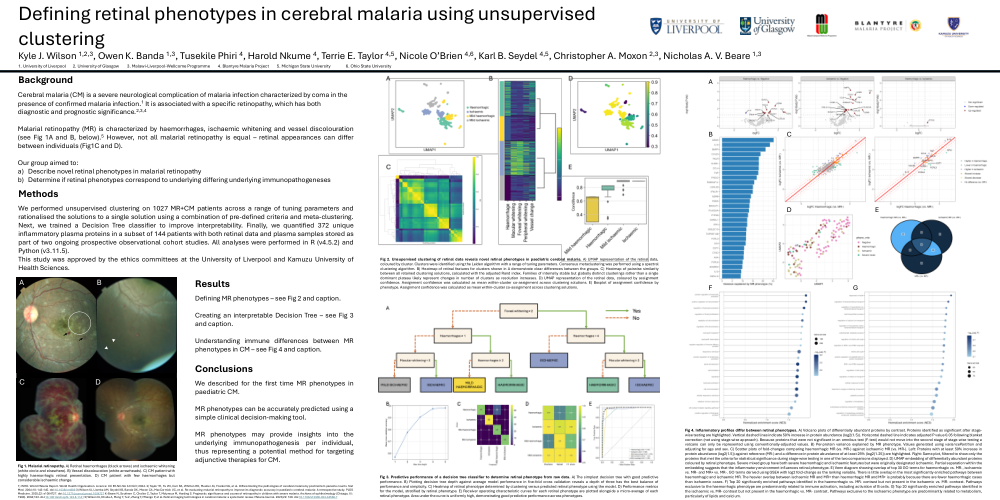
Cerebral malaria (CM) is a severe neurological complication of malaria infection characterized by coma in the presence of confirmed malaria infection.1 It is associated with a specific retinopathy, which has both diagnostic and prognostic significance.2,3,4
Malarial retinopathy (MR) is characterized by haemorrhages, ischaemic whitening and vessel discolouration (see Fig 1A and B, below).5 However, not all malarial retinopathy is equal – retinal appearances can differ between individuals (Fig1C and D).
Our group aimed to:
a)Describe novel retinal phenotypes in malarial retinopathy
b)Determine if retinal phenotypes correspond to underlying differing underlying immunopathogeneses
We performed unsupervised clustering on 1027 MR+CM patients across a range of tuning parameters and rationalised the solutions to a single solution using a combination of pre-defined criteria and meta-clustering. Next, we trained a Decision Tree classifier to improve interpretability. Finally, we quantified 372 unique inflammatory plasma proteins in a subset of 144 patients with both retinal data and plasma samples stored as part of two ongoing prospective observational cohort studies. All analyses were performed in R (v4.5.2) and Python (v3.11.5).
This study was approved by the ethics committees at the University of Liverpool and Kamuzu University of Health Sciences.
We described for the first time MR phenotypes in paediatric CM.
MR phenotypes can be accurately predicted using a simple clinical decision-making tool.
MR phenotypes may provide insights into the underlying immunopathogenesis per individual, thus representing a potential method for targeting adjunctive therapies for CM.