296 posters, 7 videos, 13 audios, 14 topics, 10 sessions, 1,019 authors, 260 institutions
ePostersLive by SciGen Technologies S.A. All rights reserved.
RCOphth Annual Congress 2026
18 - 21 May, 2026 | Manchester Central, Manchester

P013
How well do we write for patients? A longitudinal analysis of the readability and complexity of 4.6 million ophthalmic clinical letters
Poster Presenter
Part of Topic
Audit and clinical governance
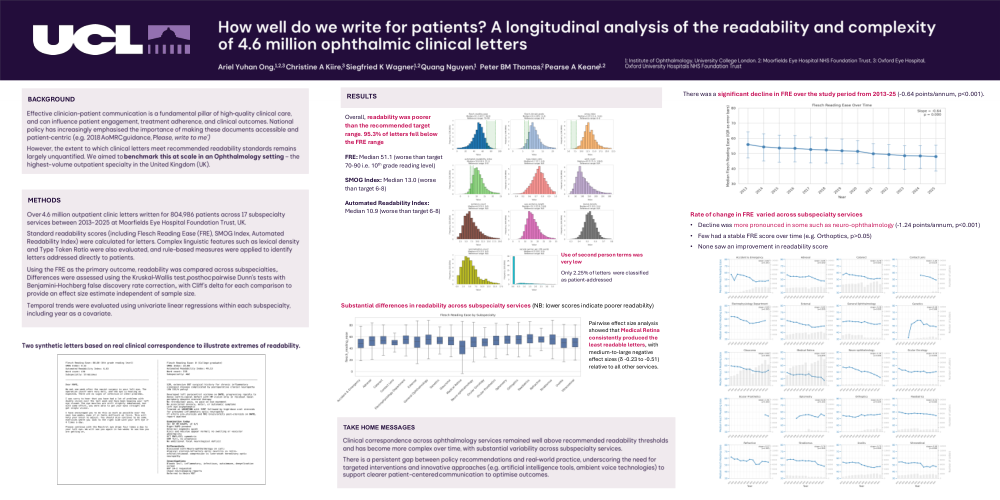
Background: Effective clinician-patient communication is a fundamental pillar of high-quality clinical care, and can influence patient engagement, treatment adherence, and clinical outcomes. However, the extent to which clinical letters meet recommended readability standards remains largely unquantified. We aimed to benchmark this at scale in an Ophthalmology setting - the highest-volume outpatient specialty in the United Kingdom (UK) healthcare service.
Methods: Standard readability scores (including Flesch Reading Ease (FRE), SMOG Index, Automated Readability Index) were calculated for letters written between 2013-2025 at Moorfields Eye Hospital Foundation Trust, UK. Complex linguistic features such as lexical density and Type Token Ratio were also evaluated, and rule-based measures were applied to identify letters addressed directly to patients. Using the FRE as the primary outcome, readability was compared across subspecialties, and temporal trends were evaluated.
Results: Over 4.6 million outpatient clinic letters written for 804,986 patients across 17 subspecialty services were included. The median FRE was 51.1 (IQR 41.9-58.5), indicating college-level readability which was substantially poorer than recommended for patient-facing materials. Overall, 95.3% of letters were less readable than recommended, and these patterns extended across all readability metrics evaluated. Readability varied across subspecialty services (p<0.001), with limited association with sociodemographic covariates such as age and ethnicity. There was a significant decline in FRE over the study period (-0.64 points/annum, p<0.001). Rate of change varied across subspecialty services, and were more pronounced in some such as neuro-ophthalmology (-1.24 points/annum, p<0.001), with few being stable (Orthoptics, p>0.05). The use of second person terms was very low (median 0 per 100 words, IQR 0.0-1.1). There was a small annual increase in the likelihood of letters being addressed directly to patients (OR 1.123, 95%CI 1.121-1.25), although the proportion remained low overall (2.25%).
Conclusion: Clinical correspondence remained well above recommended readability thresholds and has become more complex over time, with substantial variability across subspecialty services. These findings highlight a persistent gap between policy recommendations and real-world practice, underscoring the need for targeted interventions and innovative approaches (e.g. artificial intelligence tools, ambient voice technologies) to support clearer patient-centered communication to optimise patient outcomes.