296 posters, 7 videos, 13 audios, 14 topics, 10 sessions, 1,019 authors, 259 institutions
ePostersLive by SciGen Technologies S.A. All rights reserved.
RCOphth Annual Congress 2026
18 - 21 May, 2026 | Manchester Central, Manchester

P005
Audit of the appropriateness of follow-up appointments from the Emergency Eye Clinic at East Lancashire Hospitals NHS Trust
Poster Presenter
Authors
Part of Topic
Audit and clinical governance
Audit of the appropriateness of follow-up appointments from the Emergency Eye Clinic at East Lancashire Hospitals NHS Trust.
Reham Shehada, Chintan Sanghvi
Introduction
- The Emergency Eye (A&E) Clinic manages acute ophthalmic presentations. Once patients are stabilised, they should either be discharged with appropriate safety-netting or referred to the relevant subspecialty clinic for ongoing follow-up.
- Unnecessary A&E follow-up appointments increase pressure on the service, add stress for staff, and reduce capacity for patients with true ophthalmic emergencies.
- Ensuring that follow-up decisions are appropriate is therefore important for both patient safety and service efficiency.
- This audit aimed to assess whether follow-up decisions from Emergency Eye Clinic visits were appropriate and in keeping with local practice, and to identify opportunities to reduce unnecessary A&E review appointments.
Methods
- A retrospective case-note audit was conducted of all weekday Emergency Eye (A&E) clinics over an 11-day period (12 clinics, 29 September–9 October).
- All attendances were identified from clinic lists.
-
- Exclusion criteria were:
- repeated attendances for the same problem, and
- cases where the clinic letter was not available on the system, so the diagnosis, outcome or follow-up plan could not be reliably determined.
- Data collected included:
- patient type (new / follow-up),
- diagnosis,
- subspecialty category,
- outcome (discharge, referral, or A&E follow-up),
-
- and number of A&E visits for the same problem.
- Each outcome was judged as appropriate or inappropriate against consultant-agreed standards, including:
- discharge with safety-netting when safe,
- direct subspecialty referral where indicated,
-
- and restricting A&E follow-up to short-term review only.
- Exclusion criteria were:
Results
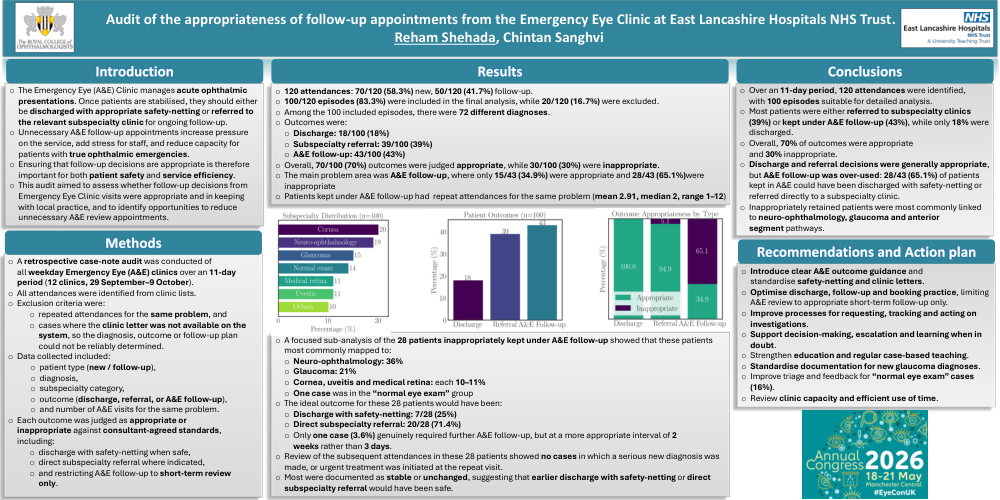
- There were 120 attendances during the study period: 70/120 (58.3%) new, 50/120 (41.7%) follow-up.
- 100/120 episodes (83.3%) were included in the final analysis, while 20/120 (16.7%) were excluded.
- Among the 100 included episodes, there were 72 different diagnoses.
- Outcomes were:
- Discharge: 18/100 (18%)
- Subspecialty referral: 39/100 (39%)
- A&E follow-up: 43/100 (43%)
- Overall, 70/100 (70%) outcomes were judged appropriate, while 30/100 (30%) were inappropriate.
- The main problem area was A&E follow-up, where only 15/43 (34.9%) were appropriate and 28/43 (65.1%)were inappropriate
- Patients kept under A&E follow-up had repeat attendances for the same problem (mean 2.91, median 2, range 1–12)
- A focused sub-analysis of the 28 patients inappropriately kept under A&E follow-up showed that these patients most commonly mapped to:
- Neuro-ophthalmology: 36%
- Glaucoma: 21%
- Cornea, uveitis and medical retina: each 10–11%
- One case was in the “normal eye exam” group
- The ideal outcome for these 28 patients would have been:
- Discharge with safety-netting: 7/28 (25%)
- Direct subspecialty referral: 20/28 (71.4%)
- Only one case (3.6%) genuinely required further A&E follow-up, but at a more appropriate interval of 2 weeks rather than 3 days.
- Review of the subsequent attendances in these 28 patients showed no cases in which a serious new diagnosis was made or urgent treatment was initiated at the repeat visit.
- Most were documented as stable or unchanged, suggesting that earlier discharge with safety-netting or direct subspecialty referral would have been safe.
Conclusions
- Over an 11-day period, 120 attendances were identified, with 100 episodes suitable for detailed analysis.
- Most patients were either referred to subspecialty clinics (39%) or kept under A&E follow-up (43%), while only 18% were discharged.
- Overall, 70% of outcomes were appropriate and 30% inappropriate.
- Discharge and referral decisions were generally appropriate, but A&E follow-up was over-used: 28/43 (65.1%) of patients kept in A&E could have been discharged with safety-netting or referred directly to a subspecialty clinic.
- Inappropriately retained patients were most commonly linked to neuro-ophthalmology, glaucoma and anterior segment pathways.
Recommendations / Action Plan
- Introduce clear A&E outcome guidance and standardise safety-netting and clinic letters.
- Optimise discharge, follow-up and booking practice, limiting A&E review to appropriate short-term follow-up only.
- Improve processes for requesting, tracking and acting on investigations.
- Support decision-making, escalation and learning when in doubt.
- Strengthen education and regular case-based teaching.
- Standardise documentation for new glaucoma diagnoses.
- Improve triage and feedback for “normal eye exam” cases (16%).
- Review clinic capacity and efficient use of time.