358 posters, 97 topics, 122 sessions, 958 authors, 239 institutions
ePostersLive by SciGen Technologies S.A. All rights reserved.
79th PostGraduate Assembly in Anesthesiology 2025
December 12 - 15, 2025 | New York City

2121
Substantial Gastric Retention in a Patient on GLP-1 Agonist Therapy Despite Preventative Measures
Poster Presenter
Part of Topic
Fundamentals of Anesthesiology - Perioperative Management
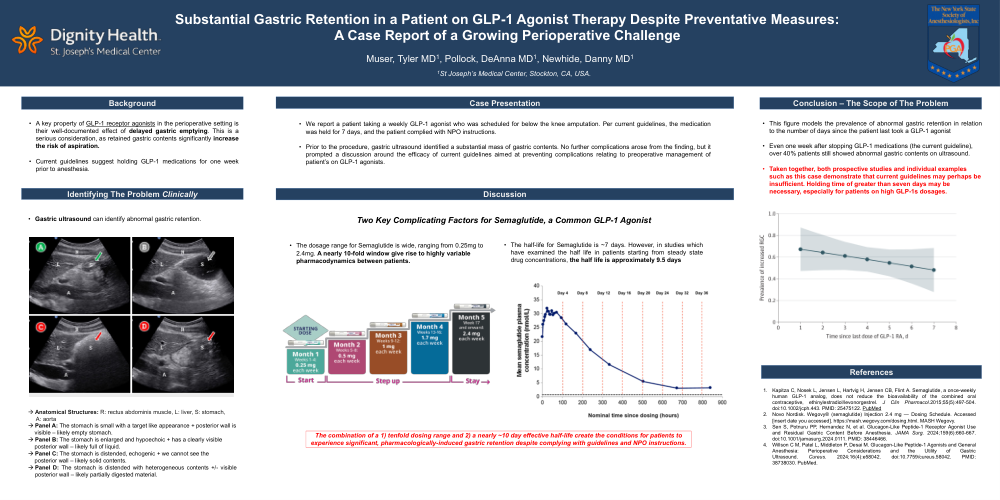
A key property of GLP-1 receptor agonists in the perioperative setting is their well-documented effect of delayed gastric emptying. This is a serious consideration, as retained gastric contents significantly increase the risk of aspiration.
Current guidelines suggest holding GLP-1 medications for one week prior to anesthesia.
Gastric ultrasound can identify abnormal gastric retention.
We report a patient taking a weekly GLP-1 agonist who was scheduled for below the knee amputation. Per current guidelines, the medication was held for 7 days, and the patient complied with NPO instructions.
Prior to the procedure, gastric ultrasound identified a substantial mass of gastric contents. No further complications arose from the finding, but it prompted a discussion around the efficacy of current guidelines aimed at preventing complications relating to preoperative management of patient’s on GLP-1 agonists.
The dosage range for Semaglutide is wide, ranging from 0.25mg to 2.4mg. A nearly 10-fold window give rise to highly variable pharmacodynamics between patients.
The half-life for Semaglutide is ~7 days. However, in studies which have examined the half life in patients starting from steady state drug concentrations, the half life is approximately 9.5 days
The combination of a 1) tenfold dosing range and 2) a nearly ~10 day effective half-life create the conditions for patients to experience significant, pharmacologically-induced gastric retention despite complying with guidelines and NPO instructions.
This figure models the prevalence of abnormal gastric retention in relation to the number of days since the patient last took a GLP-1 agonist. Even one week after stopping GLP-1 medications (the current guideline), over 40% patients still showed abnormal gastric contents on ultrasound. Taken together, both prospective studies and individual examples such as this case demonstrate that current guidelines may perhaps be insufficient. Holding time of greater than seven days may be necessary, especially for patients on high GLP-1s dosages.