358 posters, 97 topics, 122 sessions, 958 authors, 239 institutions
ePostersLive by SciGen Technologies S.A. All rights reserved.
79th PostGraduate Assembly in Anesthesiology 2025
December 12 - 15, 2025 | New York City

2179
Maneuvering the Anesthetic Minefield: A Multimodal Approach in a Patient with Mitochondrial Disease, Malignant Hyperthermia Risk, and Myasthenia Gravis
Poster Presenter
Authors
Affiliations
Part of Topic
Fundamentals of Anesthesiology - Perioperative Management
Maneuvering the Anesthetic Minefield: A Multimodal Approach in a Patient with Mitochondrial Disease, Malignant Hyperthermia Risk, and Myasthenia Gravis
Issac Jin, B.S.1, Tyler Karras D.O.2, Kinga Klimowicz M.D.2
1Drexel University College of Medicine, 2Allegheny General Hospital, Allegheny Health Network
Introduction
• Mitochondrial disorders are a rare group of inherited conditions that impair energy generation via oxidative phosphorylation1.
• Mitochondrial disorders affect approximately 1 in 4,000 individuals and interfere with high-energy-demand organs such as the brain, muscles, and heart.
• Affected patients have increased sensitivity to anesthetics, risk of metabolic crises, hypersensitivity to anesthetic agents (e.g.: propofol, volatile agents), and unpredictable drug responses to neuromuscular blockers2.
• Common anesthetics such as propofol and volatile agents are associated with mitochondrial toxicity and are potentially dangerous.
• Long-chain acyl-CoA dehydrogenase (LCAD) deficiency, a fatty acid oxidation disorder, compounds this anesthetic risk, especially with lipid-based agents.
• This case highlights the importance of tailored anesthesia management in a high-risk patient with mitochondrial disease and multiple comorbidities.
Case Summary
• 71-year-old female with complex past medical history of mitochondrial disorder, LCAD deficiency, pulmonary hypertension, COPD, GERD, hypothyroidism, rheumatoid arthritis, seronegative myasthenia gravis, and migraines.
• Scheduled for open reduction internal fixation (ORIF) of right 5th metatarsal with Jones screws.
• Genetics team recommendations were to avoid propofol, etomidate, volatile anesthetics, succinylcholine, and lactated Ringer’s (risk of lactic acidosis) while encouraging use of D5NS to prevent hypoglycemia and maintenance of IV fluids post-operatively until oral intake tolerated with preparation of dantrolene as precaution.
Anesthetic Management
Preoperative:
• Started on D5NS, patient kept NPO
• Two peripheral IV lines placed
Regional Anesthesia:
• Popliteal nerve block and adductor canal nerve block using 0.5% ropivacaine
Sedation:
• Monitored anesthesia care with midazolam (anxiolysis), fentanyl (analgesia), and ketamine (sedation and maintenance of spontaneous ventilation)
Airway Management:
• No intubation required
• Spontaneous respiration and airway reflexes preserved
Outcome:
• Procedure completed successfully
• Hemodynamically stable throughout
• No signs of respiratory distress or metabolic complications postoperatively
• The use of propofol and etomidate was avoided, as they are lipid-based agents that rely on mitochondrial metabolism, which is impaired in mitochondrial disorders such as LCAD deficiency.
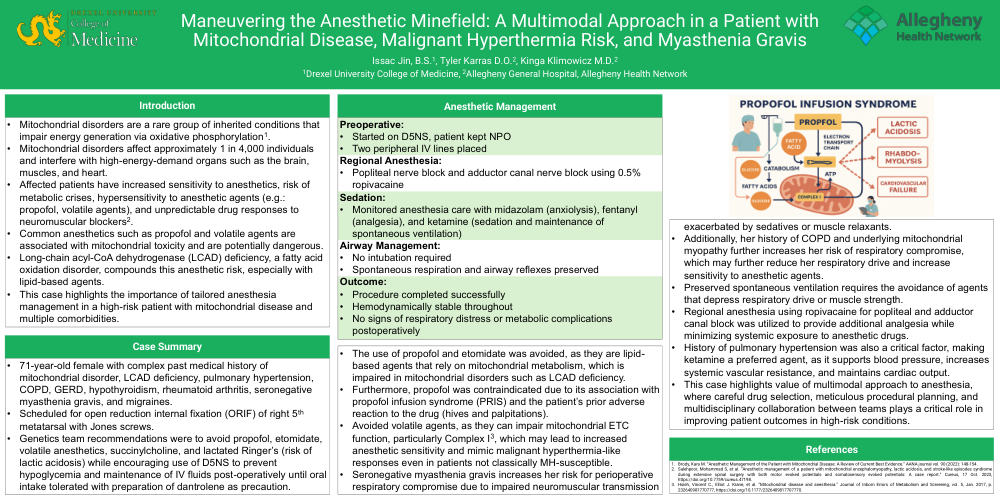
• Furthermore, propofol was contraindicated due to its association with propofol infusion syndrome (PRIS) and the patient’s prior adverse reaction to the drug (hives and palpitations).
• Avoided volatile agents, as they can impair mitochondrial ETC function, particularly Complex I3, which may lead to increased anesthetic sensitivity and mimic malignant hyperthermia-like responses even in patients not classically MH-susceptible.
• Seronegative myasthenia gravis increases her risk for perioperative respiratory compromise due to impaired neuromuscular transmission exacerbated by sedatives or muscle relaxants.
• Additionally, her history of COPD and underlying mitochondrial myopathy further increases her risk of respiratory compromise, which may further reduce her respiratory drive and increase sensitivity to anesthetic agents.
• Preserved spontaneous ventilation requires the avoidance of agents that depress respiratory drive or muscle strength.
• Regional anesthesia using ropivacaine for popliteal and adductor canal block was utilized to provide additional analgesia while minimizing systemic exposure to anesthetic drugs.
• History of pulmonary hypertension was also a critical factor, making ketamine a preferred agent, as it supports blood pressure, increases systemic vascular resistance, and maintains cardiac output.
• This case highlights value of multimodal approach to anesthesia, where careful drug selection, meticulous procedural planning, and multidisciplinary collaboration between teams plays a critical role in improving patient outcomes in high-risk conditions.
References
1. Brody, Kara M. “Anesthetic Management of the Patient with Mitochondrial Disease: A Review of Current Best Evidence.
” AANA journal vol. 90 (2022): 148-154.
2. Salehpoor, Mohammad S, et al. “Anesthetic management of a patient with mitochondrial encephalomyopathy, lactic acidosis, and stroke-like episodes syndrome
during extensive spinal surgery with both motor evoked potentials and somatosensory evoked potentials: A case report.” Cureus, 17 Oct. 2023, https://doi.org/10.7759/cureus.47198.
3. Hsieh, Vincent C., Elliot J. Krane, et al. “Mitochondrial disease and anesthesia. ”Journal of Inborn Errors of Metabolism and Screening, vol. 5, Jan. 2017, p.232640981770777, https://doi.org/10.1177/2326409817707770.