358 posters, 97 topics, 122 sessions, 958 authors, 239 institutions
ePostersLive by SciGen Technologies S.A. All rights reserved.
79th PostGraduate Assembly in Anesthesiology 2025
December 12 - 15, 2025 | New York City

2009
Anesthetic Management in Sickle Cell Anemia for Robotic-Assisted Abdominal Reconstruction
Poster Presenter
Authors
Affiliations
Part of Topic
Fundamentals of Anesthesiology - Perioperative Management
Learning Objective: Understand how the pathophysiology of Sickle Cell Anemia complicates anesthetic management during prolonged surgery, with emphasis on the physiologic risks and pharmacologic considerations in robotic-assisted abdominal reconstruction.
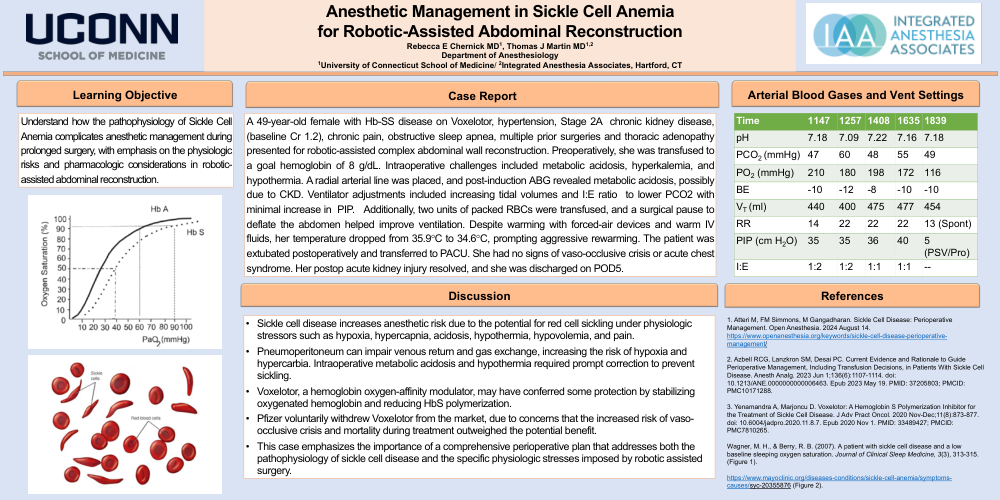
Case Report: A 49-year-old female with Hb-SS disease on Voxelotor, hypertension, Stage 2A chronic kidney disease, (baseline Cr 1.2), chronic pain, obstructive sleep apnea, multiple prior surgeries and thoracic adenopathy presented for robotic-assisted complex abdominal wall reconstruction. Preoperatively, she was transfused to a goal hemoglobin of 8 g/dL. Intraoperative challenges included metabolic acidosis, hyperkalemia, and hypothermia. A radial arterial line was placed, and post-induction ABG revealed metabolic acidosis, possibly due to CKD. Ventilator adjustments included increasing tidal volumes and I:E ratio to lower PCO2 with minimal increase in PIP. Additionally, two units of packed RBCs were transfused, and a surgical pause to deflate the abdomen helped improve ventilation. Despite warming with forced-air devices and warm IV fluids, her temperature dropped from 35.9°C to 34.6°C, prompting aggressive rewarming. The patient was extubated postoperatively and transferred to PACU. She had no signs of vaso-occlusive crisis or acute chest syndrome. Her postop acute kidney injury resolved, and she was discharged on POD5.
Discussion:
• Sickle cell disease increases anesthetic risk due to the potential for red cell sickling under physiologic stressors such as hypoxia, hypercapnia, acidosis, hypothermia, hypovolemia, and pain.
• Pneumoperitoneum can impair venous return and gas exchange, increasing the risk of hypoxia and hypercarbia. Intraoperative metabolic acidosis and hypothermia required prompt correction to prevent sickling.
• Voxelotor, a hemoglobin oxygen-affinity modulator, may have conferred some protection by stabilizing oxygenated hemoglobin and reducing HbS polymerization.
• Pfizer voluntarily withdrew Voxelotor from the market, due to concerns that the increased risk of vaso-occlusive crisis and mortality during treatment outweighed the potential benefit.
• This case emphasizes the importance of a comprehensive perioperative plan that addresses both the pathophysiology of sickle cell disease and the specific physiologic stresses imposed by robotic assisted surgery.