358 posters, 97 topics, 122 sessions, 958 authors, 239 institutions
ePostersLive by SciGen Technologies S.A. All rights reserved.
79th PostGraduate Assembly in Anesthesiology 2025
December 12 - 15, 2025 | New York City

4031
The Effect of Eliminating Preemptive Intraoperative Opioids on Discharge Times for Lower Extremity Arthroplasties
Poster Presenter
Authors
Affiliations
Part of Topic
Medical Education
Introduction :
-Rapid discharges for lower extremity arthroplasties are difficult due to uncontrolled pain, nausea, vomiting, somnolence, etc. (many of these caused by opioids)
-No established protocols to guide administration of perioperative opioid use in lower extremity arthroplasties
OBJECTIVE:
- Establish a perioperative protocol for total hip and total knee arthroplasties to minimize use of opioid medications and decrease phase 1 and phase 2 recovery discharge times
Methods:
-Single center study
-557 patients over a 4 month span
-If no contraindication, patients underwent spinal anesthesia as the primary anesthetic and received tylenol, celebrex and regional anesthesia (PENG nerve block for THA and adductor canal, genicular and IPACK for TKA) in preoperative area
-284 patients in control group who received intraoperative opioids at the discretion of anesthesia provider in OR
-272 patients in intervention group only received intraoperative opioids if spinal anesthetic wore off (min dose opioid used)
-Both groups in PACU had opioid medications titrated to patients’ needs.
-Outcomes include phase 1 and 2 discharge times, opioid doses received perioperatively and pain scores
Results:
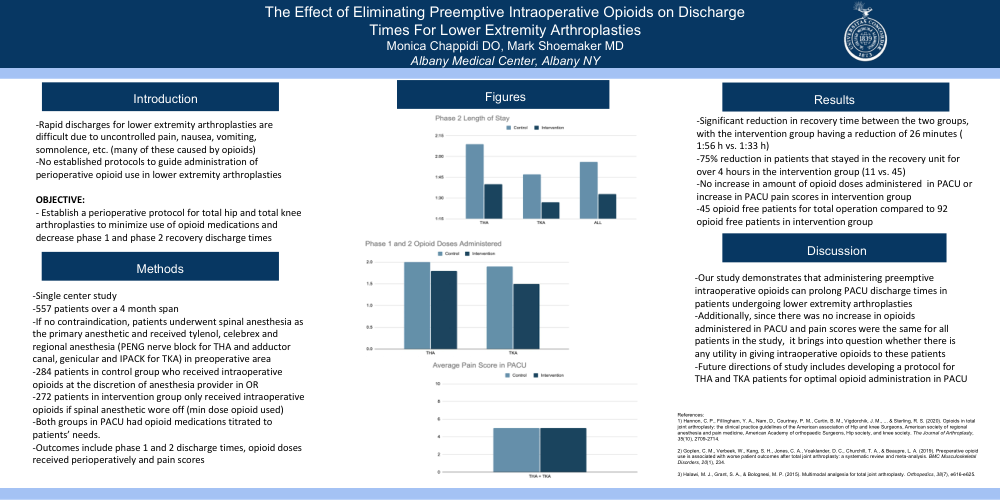
-Significant reduction in recovery time between the two groups, with the intervention group having a reduction of 26 minutes ( 1:56 h vs. 1:33 h)
-75% reduction in patients that stayed in the recovery unit for over 4 hours in the intervention group (11 vs. 45)
-No increase in amount of opioid doses administered in PACU or increase in PACU pain scores in intervention group
-45 opioid free patients for total operation compared to 92 opioid free patients in intervention group
Discussion:
-Our study demonstrates that administering preemptive intraoperative opioids can prolong PACU discharge times in patients undergoing lower extremity arthroplasties
-Additionally, since there was no increase in opioids administered in PACU and pain scores were the same for all patients in the study, it brings into question whether there is any utility in giving intraoperative opioids to these patients
-Future directions of study includes developing a protocol for THA and TKA patients for optimal opioid administration in PACU