358 posters, 97 topics, 122 sessions, 958 authors, 239 institutions
ePostersLive by SciGen Technologies S.A. All rights reserved.
79th PostGraduate Assembly in Anesthesiology 2025
December 12 - 15, 2025 | New York City

3025
A multicenter mixed method study to elaborate the concerns amongst Anesthesia faculty pertaining to students’ research.
Part of Topic
Medical Education - OTHER Faculty concerns related to research supervision.
INTRODUCTION
Research is important in medical education. Supervisors introduce research methodologies to students and uphold ethics. However, conducting research comes with its own physical and psychological burdens. Understanding thesis hardships for anesthesiology research supervisors and their impact on work-life balance and guide-student relationship is essential to know the scope for improvement. With little literature available on this topic, this study aimed at understanding the prevalence of apprehension in the anesthesiology faculty, impact on their well-being and suggested prospective changes.
METHODOLOGY
This was an observational study using mixed method approach. The study had two parts- Quantitative survey questionnaires followed by Qualitative in-depth interviews.
SURVEY TOOL:
Forty-five questions were retained in the survey, after validation and shortlisting based on relevance and appropriateness by 9 independent faculty using Delphi survey method. The questionnaire was in English & in a multiple choice format with close ended questions. It was distributed as a Google survey form, along with the participant information sheet.
CONDUCT OF THE SURVEY:
The study involved anesthesiology faculty who supervised student theses across various medical institutes across India (anonymity was maintained throughout the study). Completing and submitting the questionnaire implied participant consent.
CONDUCT OF THE INTERVIEWS:
Using purposive sampling method, 12 faculty members were interviewed from the survey participants who consented for enrolment. The interviews were semi-structured, with open-ended questions. They were conducted offline or online, as suitable. The Informed written consent forms with the participants’ signatures, were acquired digitally or as scanned documents, as feasible. During the interview, written notes or audio recordings were taken with prior permission from the participants.
ANALYSIS:
Demographic data was expressed as percentages. Responses to variables on stress related to supervision were grouped as positive, neutral, and negative replies and the data was denoted as percentages. Comparisons between various variables of stress related to supervision was performed using the pearson’s chi square‐test or fischer’s exact test, whichever was applicable. Statistical significance was assumed for P <0.05. The audio recordings of the interview were transcribed and analyzed using qualitative data analysis methods like Narrative analysis and thematic analysis. The participants anonymity was maintained, by addressing them with numbers randomly allocated. The data collected was compared, integrated and interpreted using the triangulation method.
RESULTS
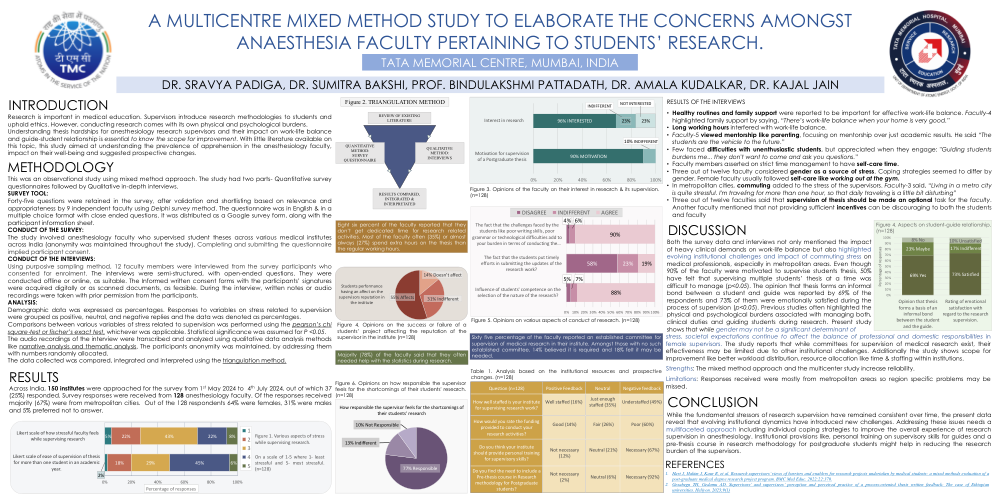
Across India, 150 institutes were approached for the survey from 1st May 2024 to 4th July 2024, out of which 37 (25%) responded. Survey responses were received from 128 anesthesiology faculty. Of the responses received majority (67%) were from metropolitan cities. Out of the 128 respondents 64% were females, 31% were males and 5% preferred not to answer. Eight six percent of the faculty reported that the don’t get dedicated time for Research related activities. Most of the faculty often (35%) or almost always (27%) spend extra hours on the thesis than the regular working hours. Majority (78%) of the faculty said that they often need help with the statistics during research. Sixty five percentage of the faculty reported an established committee for supervision of medical research in their institute. Amongst those with no such established committee, 14% believed it is required and 18% felt it may be needed.
RESULTS OF THE INTERVIEWS
Healthy routines and family support were reported to be important for effective work-life balance. Faculty-4highlighted family support by saying, “There’s work-life balance when your home is very good.”
Long working hours interfered with work-life balance.
Faculty-5 viewed mentorship like parenting, focusing on bonding over just academic results. He said “The students are the vehicle to the future.”
Few faced difficulties with unenthusiastic students, but appreciated when they engage: "Guiding students burdens me... they don't want to come and ask you questions.”
Faculty members asserted on strict time management to have self-care time.
Three out of twelve faculty considered gender as a source of stress. Coping strategies seemed to differ by gender. Female faculty usually followed self-care like working out at the gym
In metropolitan cities, commuting added to the stress of the supervisors. Faculty-3 said, “Living in a metro city is quite stressful. I'm traveling for more than one hour, so that daily traveling is a little bit disturbing”
Three out of twelve faculties said that supervision of thesis should be made an optional task for the faculty. Another faculty mentioned that not providing sufficient incentives can be discouraging to both the students and faculty
DISCUSSION
Both the survey data and interviews not only mentioned the impact of heavy clinical demands on work-life balance but also highlighted evolving institutional challenges and impact of commuting stress on medical professionals, especially in metropolitan areas. Even though 90% of the faculty were motivated to supervise students thesis, 50% have felt that supervising multiple students’ thesis at a time was difficult to manage (p<0.05). The opinion that thesis forms an informal bond between a student and guide was reported by 69% of the respondents and 73% of them were emotionally satisfied during the process of supervision (p<0.05). Previous studies often highlighted the physical and psychological burdens associated with managing both, clinical duties and guiding students during research. Present study shows that while gender may not be a significant determinant of stress, societal expectations continue to affect the balance of professional and domestic responsibilities in female supervisors. The study reports that while committees for supervision of medical research exist, their effectiveness may be limited due to other institutional challenges. Additionally the study shows scope for improvement like better workload distribution, resource allocation like time & staffing within institutions.
Strengths : The mixed method approach and the multicenter study increase reliability.
Limitations Responses received were mostly from metropolitan areas so region specific problems may be missed.
CONCLUSION
While the fundamental stressors of research supervision have remained consistent over time, the present data reveal that evolving institutional dynamics have introduced new challenges. Addressing these issues needs a multifaceted approach including individual coping strategies to improve the overall experience of research supervision in anesthesiology. Institutional provisions like, personal training on supervisory skills for guides and a pre-thesis course in research methodology for postgraduate students might help in reducing the research burden of the supervisors.
REFERENCES
1. Hart J, Hakim J, Kaur R, et al. Research supervisors’ views of barriers and enablers for research projects undertaken by medical students: a mixed methods evaluation of a post-graduate medical degree research project program. BMC Med Educ. 2022;22:370.
2. Gezahegn TH, Gedamu AD. Supervisors’ and supervisees’ perception and perceived practice of a process-oriented thesis written feedback: The case of Ethiopian universities. Heliyon. 2023;9(1)