358 posters, 97 topics, 122 sessions, 958 authors, 239 institutions
ePostersLive by SciGen Technologies S.A. All rights reserved.
79th PostGraduate Assembly in Anesthesiology 2025
December 12 - 15, 2025 | New York City

2186
Management of Neuraxial Anesthesia in a Patient With Shingles: Dermatologic Contraindications and Considerations
Poster Presenter
Authors
Affiliations
Part of Topic
Obstetrics - Regional and Acute Pain
| Management of Neuraxial Anesthesia in a Patient With Shingles: Dermatologic Contraindications and Considerations | |
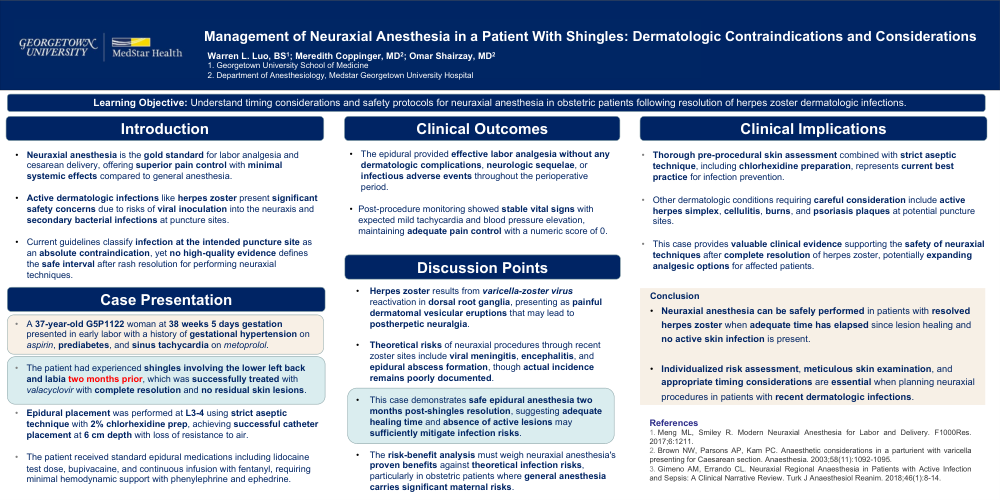
| Participants will understand timing considerations and safety protocols for neuraxial anesthesia in obstetric patients following resolution of herpes zoster dermatologic infections. | |
| A 37-year-old G5P2 at 38 weeks and 5 days gestation presented in early labor. Her medical history was significant for shingles involving the lower left back and labia two months prior, which was treated with valacyclovir and had completely resolved. Additional comorbidities included gestational hypertension, prediabetes, and sinus tachycardia. Labor epidural analgesia was successfully performed at L3-4 using standard sterile technique with 2% chlorhexidine preparation. No active skin lesions were present at insertion site. Patient received test dose of lidocaine with epinephrine, followed by preservative-free lidocaine and bupivacaine, with continuous infusion of bupivacaine-fentanyl. Hemodynamic support included phenylephrine and ephedrine. Post-procedure course was uncomplicated with effective pain control (numeric pain score 0), stable vital signs showing mild tachycardia and elevated systolic blood pressure consistent with baseline conditions. No perioperative complications, dermatologic recurrence, or neurologic adverse events occurred. | |
| Current guidelines contraindicate neuraxial procedures through active or healing herpes zoster lesions due to risks of viral inoculation, meningitis, encephalitis, or epidural abscess. However, no evidence-based recommendations exist for safe timing intervals following resolution. This creates clinical uncertainty when managing obstetric patients with recent zoster history who would benefit from neuraxial anesthesia's superior labor analgesia and rapid conversion capability for cesarean delivery. Our case demonstrates successful epidural placement two months post-antiviral treatment and complete lesion resolution without infectious or neurologic sequelae, suggesting adequate viral clearance intervals combined with thorough dermatologic assessment may safely permit neuraxial techniques. The comprehensive pre-procedural skin examination and strict aseptic protocols employed reflect best practices for minimizing infectious complications. This case contributes empirical evidence addressing a significant knowledge gap in perioperative management, supporting individualized risk-benefit analysis that considers resolution duration, anatomical distribution relative to puncture sites, and patient-specific factors. These findings inform clinical decision-making for anesthesiologists managing similar cases while highlighting the need for systematic investigation to establish evidence-based timing guidelines for neuraxial anesthesia following dermatologic viral infections in obstetric populations. | |
| 1. Meng ML, Smiley R. Modern Neuraxial Anesthesia for Labor and Delivery. F1000Res. 2017;6:1211. Published 2017 Jul 25. doi:10.12688/f1000research.11130.1 2. Brown NW, Parsons AP, Kam PC. Anaesthetic considerations in a parturient with varicella presenting for Caesarean section. Anaesthesia. 2003;58(11):1092-1095. doi:10.1046/j.1365-2044.2003.03442.x 3. Gimeno AM, Errando CL. Neuraxial Regional Anaesthesia in Patients with Active Infection and Sepsis: A Clinical Narrative Review. Turk J Anaesthesiol Reanim. 2018;46(1):8-14. doi:10.5152/TJAR.2018.12979 |