358 posters, 97 topics, 122 sessions, 958 authors, 239 institutions
ePostersLive by SciGen Technologies S.A. All rights reserved.
79th PostGraduate Assembly in Anesthesiology 2025
December 12 - 15, 2025 | New York City

3082
Impact of Anticoagulation Timing on Neuraxial Analgesia Safety in Pregnancy: A Systematic Review
Poster Presenter
Part of Topic
Obstetrics - Regional and Acute Pain
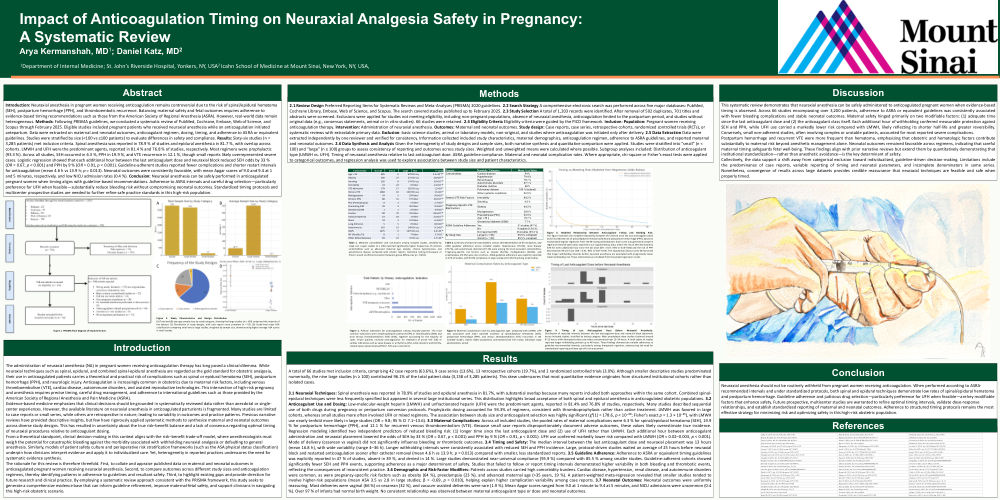
Introduction: Neuraxial anesthesia in pregnant women receiving anticoagulation remains controversial due to the risk of spinal/epidural hematoma (SEH), postpartum hemorrhage (PPH), and thromboembolic recurrence. Balancing maternal safety and fetal outcomes requires adherence to evidence-based timing recommendations such as those from the American Society of Regional Anesthesia (ASRA). However, real-world data remain heterogeneous. Methods: Following PRISMA guidelines, we conducted a systematic review of PubMed, Cochrane, Embase, Web of Science, and Scopus through February 2025. Eligible studies included pregnant patients who received neuraxial anesthesia while on anticoagulation initiated antepartum. Data were extracted on maternal and neonatal outcomes, anticoagulant regimen, dosing, timing, and adherence to ASRA or equivalent guidelines. Studies were stratified by size (<100 vs ≥100 patients) to evaluate differences in safety and compliance. Results: Sixty-six studies (n = 3,285 patients) met inclusion criteria. Spinal anesthesia was reported in 78.9 % of studies and epidural anesthesia in 81.7 %, with overlap across cohorts. LMWH and UFH were the predominant agents, reported in 81.4 % and 76.8 % of studies, respectively. Most regimens were prophylactic (93.3 %). Across all studies, SEH occurred in 6.3 %, PPH in 19.9 %, and VTE recurrence in 12.1 %, though small reports likely overrepresented severe cases. Logistic regression showed that each additional hour between the last anticoagulant dose and neuraxial block reduced SEH odds by 33 % (OR = 0.67, p < 0.001) and PPH by 9 % (OR = 0.91, p < 0.001). Guideline-adherent studies reported fewer complications and shorter restart intervals for anticoagulation (mean 4.6 h vs 13.9 h; p = 0.013). Neonatal outcomes were consistently favorable, with mean Apgar scores of 9.0 and 9.4 at 1 and 5 minutes, respectively, and low NICU admission rates (0.4 %). Conclusion: Neuraxialanesthesia can be safely performed in anticoagulated pregnant women when timing aligns with guideline-based recommendations. Adherence to ASRA intervals and careful drug selection—particularly preference for UFH when feasible—substantially reduce bleeding risk without compromising neonatal outcomes. Standardized timing protocols and multicenter prospective studies are needed to further refine safe practice standards in this high-risk population.
The administration of neuraxial anesthesia (NA) in pregnant women receiving anticoagulation therapy has long posed a clinical dilemma. While neuraxial techniques such as spinal, epidural, and combined spinal-epidural anesthesia are regarded as the gold standard for obstetric analgesia, their use in anticoagulated patients carries a theoretical and practical risk of complications such as spinal or epidural hematoma (SEH), postpartum hemorrhage (PPH), and neurologic injury. Anticoagulation is increasingly common in obstetrics due to maternal risk factors, including venous thromboembolism (VTE), cardiac disease, autoimmune disorders, and assisted reproductive technologies. This intersection of high-risk pregnancy and anesthesia requires precise timing, careful drug management, and adherence to international guidelines such as those provided by the American Society of Regional Anesthesia and Pain Medicine (ASRA).
Evidence-based medicine emphasizes that clinical decisions should be grounded in systematically reviewed data rather than anecdotal or single-center experiences. However, the available literature on neuraxial anesthesia in anticoagulated parturients is fragmented. Many studies are limited to case reports or small series, while others are retrospective in nature, leading to variability in outcomes and practice patterns. Previous narrative reviews have provided descriptive insights, but few have rigorously applied systematic methods to synthesize maternal and neonatal outcomes across diverse study designs. This has resulted in uncertainty about the true risk–benefit balance and a lack of consensus regarding optimal timing of neuraxial procedures relative to anticoagulant dosing.
From a theoretical standpoint, clinical decision-making in this context aligns with the risk–benefit trade-off model, where anesthesiologists must weigh the potential for catastrophic bleeding against the morbidity associated with withholding neuraxial analgesia or defaulting to general anesthesia. Similarly, models of patient safety culture and perioperative risk stratification frameworks (such as the ASA physical status classification) underpin how clinicians interpret evidence and apply it to individualized care. Yet, heterogeneity in reported practices underscores the need for systematic evidence synthesis.
The rationale for this review is therefore threefold. First, to collate and appraise published data on maternal and neonatal outcomes in anticoagulated pregnant women receiving neuraxial anesthesia. Second, to compare outcomes across different study sizes and anticoagulation regimens, thereby identifying patterns in adherence to guidelines and resultant safety. Third, to highlight existing gaps and provide direction for future research and clinical practice. By employing a systematic review approach consistent with the PRISMA framework, this study seeks to generate a comprehensive evidence base that can inform guideline refinement, improve maternal-fetal safety, and support clinicians in navigating this high-risk obstetric scenario.
Methods
2.1 Review Design Preferred Reporting Items for Systematic Reviews and Meta-Analyses (PRISMA) 2020 guidelines. 2.2 Search Strategy A comprehensive electronic search was performed across five major databases: PubMed, Cochrane Library, Embase, Web of Science, and Scopus. The search covered studies published up to February 2025. 2.3 Study Selection A total of 1,203 records were identified. After removal of 502 duplicates, 701 titles and abstracts were screened. Exclusions were applied for studies not meeting eligibility, including non-pregnant populations, absence of neuraxial anesthesia, anticoagulation limited to the postpartum period, and studies without original data (e.g., consensus statements, animal or in vitro studies). 66 studies were retained. 2.4 Eligibility Criteria Eligibility criteria were guided by the PICO framework. Inclusion: Population: Pregnant women receiving anticoagulation therapy. Intervention: Administration of neuraxial anesthesia. Outcomes: Maternal and neonatal outcomes. Study design: Case reports, case series, retrospective cohorts, randomized controlled trials (RCTs), or systematic reviews with extractable primary data. Exclusion: basic science studies, animal or laboratory models, non-original, and studies where anticoagulation was initiated only after delivery. 2.5 Data Extraction Data were extracted independently by one reviewer and verified for consistency. Information collected included study characteristics, maternal demographics, anticoagulation regimen, adherence to ASRA guidelines, and reported maternal and neonatal outcomes. 2.6 Data Synthesis and Analysis Given the heterogeneity of study designs and sample sizes, both narrative synthesis and quantitative comparison were applied. Studies were stratified into “small” (n < 100) and “large” (n ≥ 100) groups to assess consistency of reporting and outcomes across study sizes. Weighted and unweighted means were calculated where possible. Subgroup analyses included: Distribution of anticoagulant type (LMWH vs. UFH). Timing of neuraxial anesthesia relative to last anticoagulant dose. ASRA guideline compliance. Maternal and neonatal complication rates. Where appropriate, chi-square or Fisher’s exact tests were applied to categorical outcomes, and regression analysis was used to explore associations between study size and patient characteristics.
Results
A total of 66 studies met inclusion criteria, comprising 42 case reports (63.6%), 9 case series (13.6%), 13 retrospective cohorts (19.7%), and 2 randomized controlled trials (3.0%). Although smaller descriptive studies predominated numerically, the nine large studies (n ≥ 100) contributed 96.1% of the total patient data (3,158 of 3,285 patients). This skew underscores that most quantitative evidence originates from structured institutional cohorts rather than isolated cases.
3.1 Neuraxial Techniques: Spinal anesthesia was reported in 78.9% of studies and epidural anesthesia in 81.7%, with substantial overlap because many reports included both approaches within the same cohort. Combined spinal-epidural techniques were less frequently specified but appeared in several large institutional series. This distribution highlights broad acceptance of both spinal and epidural anesthesia in anticoagulated obstetric populations. 3.2 Anticoagulant Use and Dosing: Low-molecular-weight heparin (LMWH) and unfractionated heparin (UFH) were the predominant agents, reported in 81.4% and 76.8% of studies, respectively. Many studies described sequential use of both drugs during pregnancy or peripartum conversion protocols. Prophylactic dosing accounted for 93.3% of regimens, consistent with thromboprophylaxis rather than active treatment. LMWH was favored in large cohorts, whereas small studies more often involved UFH or mixed regimens. The association between study size and anticoagulant selection was highly significant (χ²(1) = 178.6, p < 10⁻⁴⁰; Fisher’s exact p = 1.3 × 10⁻²⁵), with LMWH use nearly tenfold more likely in large studies (OR = 9.8; 95 % CI 7.1–13.6). 3.3 MaternalComplications: Across all included studies, the pooled rates of maternal complications were 6.3 % for spinal/epidural hematoma (SEH), 19.9 % for postpartum hemorrhage (PPH), and 12.1 % for recurrent venous thromboembolism (VTE). Because small case reports disproportionately document adverse outcomes, these values likely overestimate true incidence. Regression modeling identified two independent predictors of reduced bleeding risk: (1) longer time since the last anticoagulant dose and (2) use of UFH rather than LMWH. Each additional hour between anticoagulant administration and neuraxial placement lowered the odds of SEH by 33 % (OR = 0.67, p < 0.001) and PPH by 9 % (OR = 0.91, p < 0.001). UFH use conferred markedly lower risk compared with LMWH (OR ≈ 0.02–0.003, p < 0.001). Mode of delivery (cesarean vs vaginal) did not significantly influence bleeding or thrombotic outcomes. 3.4 Timing and Safety: The median interval between the last anticoagulant dose and neuraxial placement was 13 hours (mean 16.8 h), with wide variability (range 4–36 h). Longer withholding intervals were consistently associated with reduced SEH and PPH incidence. Large, protocol-driven studies waited an average of 25 hours before neuraxial block and restarted anticoagulation sooner after catheter removal (mean 4.6 h vs 13.9 h; p = 0.013) compared with smaller, less standardized reports. 3.5 Guideline Adherence:Adherence to ASRA or equivalent timing guidelines was explicitly reported in 47 % of studies, absent in 39 %, and denied in 14 %. Large studies demonstrated near-universal compliance (95.9 %) compared with 85.5 % among smaller studies. Guideline-adherent cohorts showed significantly fewer SEH and PPH events, supporting adherence as a major determinant of safety. Studies that failed to follow or report timing intervals demonstrated higher variability in both bleeding and thrombotic events, reflecting the consequences of inconsistent practice. 3.6 Demographic and Risk-Factor Modifiers: Patients across studies carried high comorbidity burdens. Cardiac disease, hypertension, renal disease, and autoimmune disorders were common, as were pregnancy-specific risk factors such as obesity (64 %), preeclampsia (23 %), and advanced maternal age (>35 years, 19 %). A patient-weighted meta-regression revealed that smaller studies tended to involve higher-risk populations (mean ASA 3.5 vs 2.8 in large studies; β = -0.69, p = 0.010), helping explain higher complication variability among case reports. 3.7 Neonatal Outcomes: Neonatal outcomes were uniformly reassuring. Most deliveries were vaginal (66 %) or cesarean (32 %), and vacuum-assisted deliveries were rare (1.9 %). Mean Apgar scores ranged from 9.0 at 1 minute to 9.4 at 5 minutes, and NICU admissions were uncommon (0.4 %). Over 97 % of infants had normal birth weight. No consistent relationship was observed between maternal anticoagulant type or dose and neonatal outcomes.
Discussion
This systematic review demonstrates that neuraxial anesthesia can be safely administered to anticoagulated pregnant women when evidence-based timing is observed. Across 66 studies encompassing over 3,200 patients, adherence to ASRA or equivalent guidelines was consistently associated with fewer bleeding complications and stable neonatal outcomes. Maternal safety hinged primarily on two modifiable factors: (1) adequate time since the last anticoagulant dose and (2) the anticoagulant class itself. Each additional hour of withholding conferred measurable protection against SEH and PPH, while UFH use carried a markedly lower risk compared with LMWH, likely reflecting its shorter half-life and greater reversibility. Conversely, small non-adherent studies, often involving complex or unstable patients, accounted for most reported severe complications.
Postpartum hemorrhage and recurrent VTE were more frequent than hematoma, emphasizing that obstetric and hematologic factors contribute substantially to maternal risk beyond anesthetic management alone. Neonatal outcomes remained favorable across regimens, indicating that careful maternal timing safeguards fetal well-being. These findings align with prior narrative reviews but extend them by quantitatively demonstrating that institutional standardization—rather than anesthetic avoidance—is the key determinant of safety.
Collectively, the data support a shift away from categorical exclusion toward individualized, guideline-driven decision-making. Limitations include the predominance of case reports, variable reporting of timing and neonatal parameters, and incomplete denominators in some series. Nonetheless, convergence of results across large datasets provides credible reassurance that neuraxial techniques are feasible and safe when properly timed.
Conclusion
Neuraxial anesthesia should not be routinely withheld from pregnant women receiving anticoagulation. When performed according to ASRA-recommended intervals and under standardized protocols, both spinal and epidural techniques demonstrate low rates of spinal/epidural hematoma and postpartum hemorrhage.Guideline adherence and judicious drug selection—particularly preference for UFH when feasible—are key modifiable factors that enhance safety. Future prospective, multicenter studies are warranted to refine optimal timing intervals, validate dose-response relationships, and establish standardized reporting of maternal and neonatal outcomes. Adherence to structured timing protocols remains the most effective strategy for minimizing risk and optimizing safety in this high-risk obstetric population.