358 posters, 97 topics, 122 sessions, 958 authors, 239 institutions
ePostersLive by SciGen Technologies S.A. All rights reserved.
79th PostGraduate Assembly in Anesthesiology 2025
December 12 - 15, 2025 | New York City

3032
Serum Cortisol as a Marker of Stress in Pediatric Surgical Patients: A Comparison Between Inhalational and Intravenous Anesthetic Induction
Poster Presenter
Authors
Affiliations
Part of Topic
Pediatric
Introduction:
Despite advances in both intravenous and inhalatory anesthesia techniques, surgical procedures remain a significant source of stress for pediatric patients. This stress activates neuroendocrine responses, particularly involving the hypothalamic-pituitary-adrenal axis, resulting in elevated cortisol levels. This study hypothesizes that the choice of anesthetic induction technique influences serum cortisol levels and aims to determine which method—intravenous or inhalational—is associated with lower physiological stress.
Methods:
This was a cross-sectional analytical study conducted at a pediatric surgical center. A total of 148 children aged 2 to 10 years, classified as ASA I or II, undergoing elective surgeries between November 2023 and May 2024, were included. Patients were divided into two groups: one received intravenous induction, and the other underwent inhalational induction. Serum cortisol samples were collected at two time points: at venous puncture and 15 minutes after induction. Anesthesia records and demographic/clinical data were analyzed. Statistical tests included Student’s t-test, Mann-Whitney, and effect size calculations (Cohen’s d and rank-biserial correlation) to assess differences between groups.
Results:
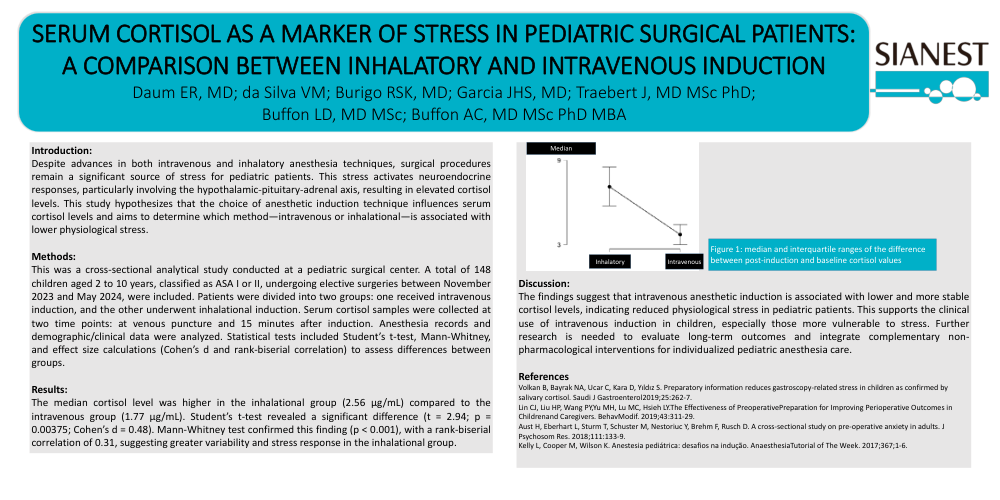
The median cortisol level was higher in the inhalational group (2.56 µg/mL) compared to the intravenous group (1.77 µg/mL). Student’s t-test revealed a significant difference (t = 2.94; p = 0.00375; Cohen’s d = 0.48). Mann-Whitney test confirmed this finding (p < 0.001), with a rank-biserial correlation of 0.31, suggesting greater variability and stress response in the inhalational group.
Discussion:
The findings suggest that intravenous anesthetic induction is associated with lower and more stable cortisol levels, indicating reduced physiological stress in pediatric patients. This supports the clinical use of intravenous induction in children, especially those more vulnerable to stress. Further research is needed to evaluate long-term outcomes and integrate complementary non-pharmacological interventions for individualized pediatric anesthesia care.
References
Volkan B, Bayrak NA, Ucar C, Kara D, Yıldız S. Preparatory information reduces gastroscopy‑related stress in children as confirmed by salivary cortisol. Saudi J Gastroenterol2019;25:262-7.
Lin CJ, Liu HP, Wang PY,Yu MH, Lu MC, Hsieh LY.The Effectiveness of PreoperativePreparation for Improving Perioperative Outcomes in Childrenand Caregivers. BehavModif. 2019;43:311-29.
Aust H, Eberhart L, Sturm T, Schuster M, Nestoriuc Y, Brehm F, Rusch D. A cross-sectional study on pre-operative anxiety in adults. J Psychosom Res. 2018;111:133-9.
Kelly L, Cooper M, Wilson K. Anestesia pediátrica: desafios na indução. AnaesthesiaTutorial of The Week. 2017;367;1-6.