358 posters, 97 topics, 122 sessions, 958 authors, 239 institutions
ePostersLive by SciGen Technologies S.A. All rights reserved.
79th PostGraduate Assembly in Anesthesiology 2025
December 12 - 15, 2025 | New York City

3006
Applications of Artificial Intelligence in Pediatric Anesthesia: A Systematic Review
Part of Topic
Pediatric
Artificial Intelligence and Machine Learning in Pediatric Anesthesia: A Narrative Review
Authors
Patrick Fakhoury MS4¹, Aditya Shah MS3¹, Caleb Zimmerman BS¹, Aiman Almasnaah MS4¹, Kush Patel MS4¹, Deepti Sanku MS4¹, Kabir Mendiratta MD⁴, Wael Saasouh MD²˒³
¹ Central Michigan University College of Medicine, Saginaw, MI, USA
² Wayne State University School of Medicine, Detroit, MI, USA
³ Outcomes Research Consortium, Houston, TX, USA
⁴ Detroit Medical Center, Detroit, MI, USA
Background
-
Pediatric anesthesia is challenging due to small airways, rapid desaturation, limited physiologic reserve, and difficulty assessing pain and distress.
-
Traditional tools (age/weight formulas, simple vital-sign thresholds) can be imprecise.
-
AI and ML can integrate complex perioperative data to support individualized decision-making.
Objective: To synthesize current applications of AI/ML in pediatric anesthesia and describe their potential to augment perioperative care.
Methods
-
Narrative review of AI/ML in pediatric anesthesia using CINAHL, PubMed, Scopus, and Web of Science.
-
Included original studies in patients 0–18 years involving anesthesia or perioperative care and reporting clinical or predictive outcomes.
-
Excluded adult-only studies, mixed cohorts without pediatric data, and purely theoretical or simulation-only work.
-
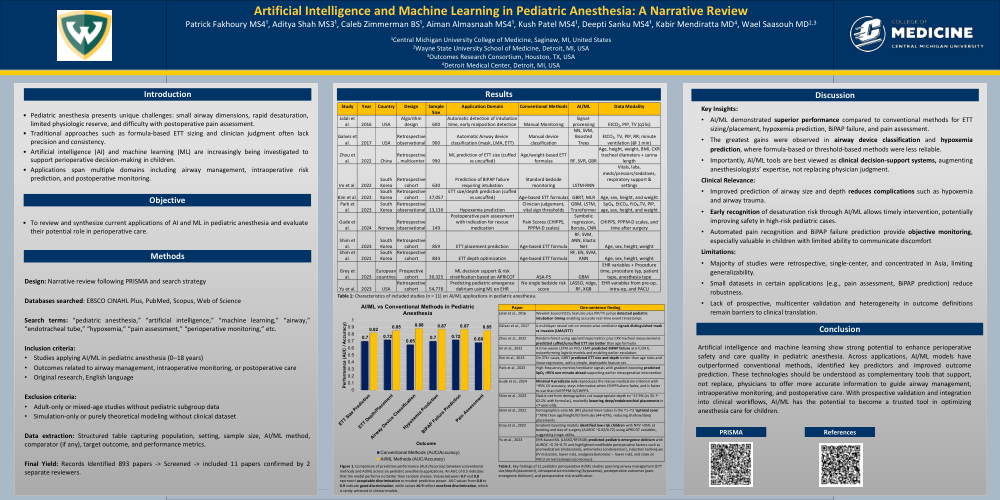
From 893 records screened, 11 studies met inclusion criteria.
Results
Key Domains of Application
-
Airway Management
-
ML models improved prediction of ETT size and depth vs conventional formulas.
-
Signal-based models accurately classified airway devices (mask, LMA, ETT) and detected intubation/malposition earlier.
-
-
Intraoperative Hypoxemia
-
Gradient boosting and deep learning using high-frequency monitor data predicted hypoxemia (e.g., SpO₂ < 95% within 1 min) more accurately than clinician judgment or fixed thresholds.
-
-
Noninvasive Ventilation Failure
-
Time-aware neural networks predicted BiPAP failure and need for intubation at 6–24 hours, outperforming logistic regression.
-
-
Postoperative Pain and Emergence Delirium
-
AI models reproduced or improved upon traditional pediatric pain scores when predicting need for rescue analgesia.
-
ML-based risk scores predicted emergence delirium with acceptable discrimination and highlighted modifiable perioperative factors.
-
-
Perioperative Risk Stratification
-
Gradient boosting models using demographic, ASA, and procedural variables identified low-risk pediatric patients with high negative predictive value for serious events.
-
Discussion
-
Across airway management, hypoxemia prediction, ventilatory support, pain assessment, delirium, and risk stratification, AI/ML generally outperformed rule-based methods and age-based formulas.
-
These tools function best as decision-support, not replacements for anesthesiologists, providing earlier warnings and more precise, patient-specific estimates.
-
Current evidence is limited by small sample sizes, single-center retrospective designs, and lack of robust external validation.
Conclusion
-
AI and ML show significant promise in enhancing safety and individualizing care in pediatric anesthesia.
-
Greatest benefits to date are seen in airway management and short-term physiologic risk prediction.
-
Future work should focus on multicenter prospective validation, integration into OR/EHR workflows, and evaluation of real-world impact on outcomes and clinician workload.