358 posters, 97 topics, 122 sessions, 958 authors, 239 institutions
ePostersLive by SciGen Technologies S.A. All rights reserved.
79th PostGraduate Assembly in Anesthesiology 2025
December 12 - 15, 2025 | New York City

3026
Impact of Cannabis Use on Benzodiazepine Requirements for Deep Sedation in Outpatient Plastic Surgery: A Retrospective Analysis
Part of Topic
Fundamentals of Anesthesiology - Perioperative Management
Impact of Cannabis Use on Benzodiazepine Requirements for Deep Sedation in Outpatient Plastic Surgery: A Retrospective Analysis
Emily Corigliano, BS1; Maxwell Kahn, JD, LL.M1; Aidan C. Eldridge, BS1; Rose S. Berkun, MD, FASA2; Nader D. Nader, MD, PhD2
1 Jacobs School of Medicine and Biomedical Sciences at the University at Buffalo
2 Department of Anesthesiology, Jacobs School of Medicine and Biomedical Sciences at the University at Buffalo
Introduction
The legalization and use of cannabis raises important questions for perioperative medicine. Prior studies suggest cannabis users have increased requirements for
propofol and fentanyl during general anesthesia. However, the impact of cannabis use has not been explored in the setting of deep sedation where benzodiazepines and nitric oxide are utilized. This study serves to evaluate whether cannabis use affects the midazolam and nitric oxide (N2O) requirements during deep sedation at a single outpatient plastic surgery site.
Methods
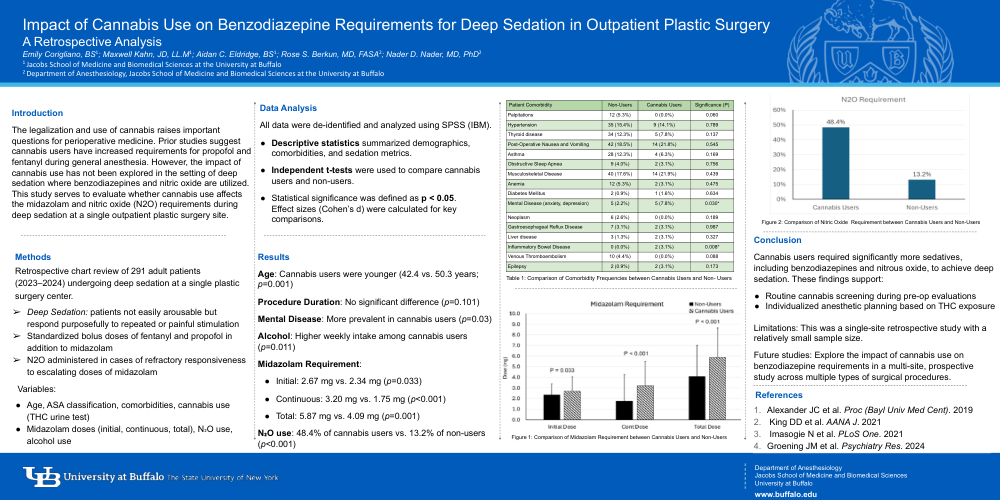
Retrospective chart review of 291 adult patients (2023–2024) undergoing deep sedation at a single plastic surgery center.
➢ Deep Sedation: patients not easily arousable but respond purposefully to repeated or painful stimulation
➢ Standardized bolus doses of fentanyl and propofol in addition to midazolam
➢ N2O administered in cases of refractory responsiveness to escalating doses of midazolam
Variables:
● Age, ASA classification, comorbidities, cannabis use (THC urine test)
● Midazolam doses (initial, continuous, total), N₂O use, alcohol use
Data Analysis
All data were de-identified and analyzed using SPSS (IBM).
● Descriptive statistics summarized demographics, comorbidities, and sedation metrics.
● Independent t-tests were used to compare cannabis users and non-users.
● Statistical significance was defined as p < 0.05. Effect sizes (Cohen’s d) were calculated for key comparisons
Results
Age: Cannabis users were younger (42.4 vs. 50.3 years; p=0.001)
Procedure Duration: No significant difference (p=0.101)
Mental Disease: More prevalent in cannabis users (p=0.03)
Alcohol: Higher weekly intake among cannabis users (p=0.011)
Midazolam Requirement:
● Initial: 2.67 mg vs. 2.34 mg (p=0.033)
● Continuous: 3.20 mg vs. 1.75 mg (p<0.001)
● Total: 5.87 mg vs. 4.09 mg (p=0.001)
N₂O use: 48.4% of cannabis users vs. 13.2% of non-users (p<0.001)
Conclusion
Cannabis users required significantly more sedatives, including benzodiazepines and nitrous oxide, to achieve deep sedation. These findings support:
● Routine cannabis screening during pre-op evaluations
● Individualized anesthetic planning based on THC exposure
Limitations: This was a single-site retrospective study with a relatively small sample size.
Future studies: Explore the impact of cannabis use on benzodiazepine requirements in a multi-site, prospective study across multiple types of surgical procedures.
References
1. Alexander JC et al. Proc (Bayl Univ Med Cent). 2019
2. King DD et al. AANA J. 2021
3. Imasogie N et al. PLoS One. 2021
4. Groening JM et al. Psychiatry Res. 2024