84 posters, 19 topics, 261 authors, 78 institutions
ePostersLive by SciGen Technologies S.A. All rights reserved.
25o Πανελλήνιο Ουρολογικό Συνέδριο
6 - 9 Οκτωβρίου, 2022 | Αθήνα, Ελλάδα
PP19
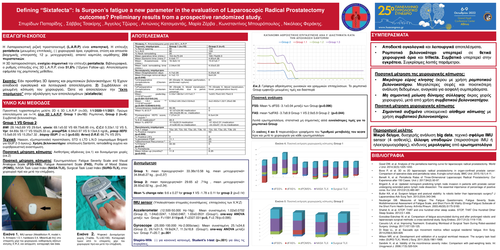
Defining “Sixtafecta”: Is Surgeon’s fatigue a new parameter in the evaluation of Laparoscopic Radical Prostatectomy outcomes? Preliminary results from a prospective randomized study.
Part of Topic
07 - Ενδοουρολογία - Λαπαροσκοπική Χειρουργική
Introduction and Objective
Laparoscopic Radical Prostatectomy (L.A.R.P) is a demanding surgical procedure, in terms of oncologic and functional outcomes. Achieving the pentafecta, which includes favorable complication and positive surgical margin rates combined with acceptable continence, potency and biochemical recurrence rates within a year from surgery, requires a strenuous learning curve of approximately 250 cases 1. Application of 3D-vision in conventional laparoscopy, significantly enhances the possibility of better intraoperative outcomes and pentafecta achievement2. Series of 3D Laparoscopic Radical Prostatectomies report a pentafecta achievement rate up to 51,6% of included patients at 12-month Follow-up, findings comparable to those in literature for Robotic surgery.3
Our objective is to identify whether acceptable outcomes in laparoscopy, can be achieved with the minimum effort from the surgeon, adding a sixth parameter in pentafecta. New technologies such as 3D enhanced surgical view and the use of Robotic needle-drivers may initiate the era of sixtafecta in laparoscopic treatment of prostate malignancies.
Methods
We prospectively designed a single-surgeon (N.F) series including 30 patients, who will have undergone 2D or 3D Laparoscopic Radical Prostatectomy in our department from 1/1/2020 to 1/1/2021. Herein, we present preliminary results regarding 14 patients who already underwent 3D procedures only. We performed extra peritoneal approach, using Hasson technique and balloon dilators. Conventional Laparoscopic or Robotic needle-driver was used for Santorini plexus ligation, bladder neck reconstruction (posterior placation technique) if necessary, urethral stitch and vesico-urethral anastomosis, all using barbed sutures. Limited or standard pelvic lymph node dissection was performed according to Briganti nomogram for ISUP grade 2-3 malignancies4. This study is approved by our hospital’s ethical committee.
Regarding preoperative data, 10 patients underwent 3D prostatectomy using robotic needle-driver (group 1), and 4 patients using conventional needle-driver (group 2). F-test for variance and t-test for comparison (p<0.05 for statistical significance) were used between groups. Mean B.M.I was 28.14±3,69 in the group 1 versus 29.6±4 in group 2 (p=0.26), mean age in years was 69.1±5.02 versus 69.75±6.85 (p=0.42), mean Charlson Comorbidity Index Score was 5.33±1.12 versus 5±0 (p=0.198) , mean preoperative prostate volume calculated with T.R.US was 64.89± 59.17 cc versus 55±25.33 (p=0.334), mean preoperative PSA was 6.94±3.97ng/dL versus 9.13±4,5 (p=0.19), mean preoperative IIEF5 score was 15.5±8.05 versus 15.25±7.32 (p=0.48), Median biopsy ISUP Grade was 2 versus 3 (p=0.03), 66.7% of patients in group 1 versus 25% of patients group 2 had positive digital rectal examination (D.R.E). The only statistically significant difference between two groups was biopsy ISUP Grade, which was higher for group 1.
For quantitative evaluation of surgical effort, we attached a properly orientated Inertial Measurement Unit (IMU) (MetaMotion R, model n. 5, firmware 1.5.1, hardware 0.4, serial number 048B04 by MbientLab Inc.) in the surgeon’s dominant hand, after defining three axes of motion (X,Y,Z) (Figure 1.). MetaBase application was used for Bluetooth data logging and IMU calibration. Raw data in.csv files were extracted for analysis. A digital Hand-Dynamometer (Trailite, TL-LSC100 Handheld Dynamometer), was also used for measuring dominant hand-grip strength in kilograms, pre and post operatively5(Figure 2.).
For qualitative assessment of fatigue we used the following questionnaires, answered by the surgeon pre and postoperatively: Fatigue Severity Scale and Visual Analogue Scale (FSS-VAS)6, Fatigue Assessment Scale (FAS)7, Profile of Mood States (POMS)8, NASA Task Load Index (NASA-TLX)9,10, Surgical Task Load Index (SURG-TLX)11.
Results
Technical, functional and oncologic outcomes are summarized in Table 1. Group 1 had significantly decreased mean drainage removal time, positive surgical margins, and trifecta achievement, while Group 2, had significantly decreased early incontinence. All other parameters showed no significant differences between groups. Incontinence medication such as Mirabegron 50mg/day alone or combined with Duloxetine 80mg/day, were administered only in Group 1, although medication had no significant difference in % change rate of Incontinence Severity Index (% dISI) (p=0,44).
Erectile Dysfunction (E.D) measured with International Index of Erectile Function (IIEF5) questionnaire score (p=0.31) and % change rate in IIEF5 (%dIIEF5) (p=0.44), had no significant differences between groups. E.D Medication administered in Group 1 was, Tadalafil 5mg/day enhanced with 20mg pre coitus, while E.D medication in Group 2 was, Tadalafil 5mg/day enhanced with 20mg pre coitus or Alprostadil cream 100mg-300mcg/twice weekly and Alprostadil injection 2.5mcg pre coitus. No significant difference in %dIIEF5 was found within groups regardless of receiving or not E.D medication (p=0.31 for Group 1, p=0.42 for Group 2). Overall mean Follow-up time was significantly increased for Group 1.
IMU sensor recorded data from the surgeon’s right upper limb for 4 patients (3 Group 1, 1 group 2).
Accelerometer analysis: IMU settings at 12.500-50.000 Hz-16g. Resultant acceleration (resolving acceleration from x, y, z) was calculated. Mean value was 1.02±0.0702 (coefficients of range and variation were 0.862 and 0.069) for Group 2. Mean values were 1.04±0.0247, 1.02±0.0467, 1.03±0.0531 (coefficients of range and variation were 0.44, 0.74, 0.9 and 0.023, 0.045, 0.05 respectively) for Group 1. Shapiro-Wilk normality test failed to confirm normal distribution due to very low p-values, although distribution histograms showed bell curves. Student’s t-test, comparing resolving forces between groups, showed significant difference (p<.001) for each comparison. One-way AN.O.VA showed significantly different variances after comparing recordings from Group 2 with each separate recordings from Group 1 (F=1591.819/p=0, F=2327.031/p=0) apart from 1 case (F=2.78/p=0.095). Distribution of resultant acceleration during needle-driver use, grouped in 5-minute intervals, is graphically presented (Figure 3.).
Gyroscope analysis: IMU settings at 25.000-100.000 Hz-2.000o/sec. Resultant angular acceleration (resolving angular acceleration from x, y, z) was calculated. Mean value was 25.1±34,6 for Group 2. Mean values were 26.1±31.5, 19.9±24,7, 11.3±18,8 for Group 1. Shapiro-Wilk normality test failed to confirm normal distribution due to very low p-values. Student’s t-test, comparing resolving angular acceleration between groups, showed significant difference (p<.001) for each comparison. Distribution of angular acceleration during needle-driver use, grouped in 5-minute intervals, is graphically presented (Figure). One-way AN.O.VA of these intervals recorded significant difference both among and within groups (F=20.7, p<.001).
Graphical representations of raw data recordings from accelerometer and gyroscope are presented for Group 1 (Figure 4.) and Group 2 (Figure 5.) as an attempt to depict surgeon’s motion during the period needle-holders were used.
Hand-held Dynamometer showed no significant differences neither for each separate group, pre and post operatively, or between groups, using F-test and t-test. Mean preoperative value was 33.38±10.58 kg and mean postoperative value was 34.84±8.27 kg for the group 1 (p=0,37). Mean preoperative value was 29.65±2.71kg and mean postoperative value was 28.93±2.02 kg for group 2 (p=0.34). Mean % change rate (%d) was 9.6±0.27 for group 1 versus -1.78±0.11 for group 2(p=0.14), showing a non-significant decrease in hand grip strength, following operations executed with conventional laparoscopic needle-driver.
Qualitative assessment outcomes are concisely presented with weighted-bar diagrams, depicting pre and post procedural % change rates for each questionnaire, regarding group 1 (Figure 6) and group2 (Figure 7) respectively.
We assessed the 9-question FSS, with a scale from 1 (disagree) to 7(agree). Mean preoperative score was 17.6± 0.52, mean postoperative score was 17.1±0.57 for group 1 (p=0.027), 17.25±0.5 and 17.75±0.5 for group 2 (p=0.103) respectively. Mean % dFSS was -3.1±0.04 for group 1 versus 1.55±0.05 for group 2 (p=0.096), suggesting a significant decrease in postoperative score for the robotic needle-driver group. VAS score was significantly higher only in group 2 after surgery (p=0.04) indicative of increased postoperative fatigue.
Assessment of the 10-question FAS, using a scale from 1(never) to 5(always), showed that although no statistically significant differences in pre and postoperative scores were found for each individual group, mean score was decreased after surgery, for group 1 (18.5±0.71 versus 17.6±1.64, p=0.069). Interestingly, a comparison of % change rates between groups, showed a significantly decreased change rate for group 1 (mean %dFAS -3.7±8.9 versus mean % dFAS 2.9±5.9, p=0.044).
Evaluation of the 40-question POMS, with a scale from not at all to extremely (4 points)assessing different mood states, showed no statistically significant differences for each and between groups, although mean % dPOMS rate (3.8±8,5 versus -0.5±6.7) was lower for group 2. We used numbers to evaluate weighted scales in the 6-question NASA-TLX (1=low to 18=high) and Surgical-TLX (1=very low to 20=very high). No significant differences were found among groups, although robotic needle-driver arm had lower mean scores for each (26.9±2.28 versus 28.75±4.27 and 22.3± 2.21versus 23±2.44). Finding indicative of non-significantly decreased fatigue for Group 1.
Conclusions
IMU data analysis, showed comparable mean resultant instantaneous and angular accelerations between groups, but variability among and within groups showed significant difference. Interval analysis showed that Group 2 recorded higher dispersion of values during suturing times. Results were ambiguous and therefore inconclusive mainly due to extended dataset that led to maximization of non-significant differences.
Preliminary results showed decreased postoperative hand-grip strength and significantly increased subjective feeling of fatigue when using conventional laparoscopic needle-driver. These findings, combined with comparable overall and suturing times and better oncologic results such as significantly decreased positive margins and increased trifecta achievement for group 1, might suggest that 3D laparoscopic needle-driver could assist in more effortless and equally safe procedures. Outcomes are not conclusive and need to be further evaluated with larger series and advanced regression data analysis. Pending comparison with 2D series outcomes is also needed, for better evaluation of surgeon’s effort in laparoscopy.
Limitations in our study were: small patient sample although only preliminary results were included, big data that made statistical analysis and visualization of outcomes a strenuous procedure with ambiguous results, technical IMU failure that did not allow us to download or retrieve raw data in all cases, unavailability of proper infrastructure such as more IMUs and electromyography sensors, which could have allowed a more accurate description of the surgeon’s posture or overall effort, and risk of bias deriving from the qualitative assessment using questionnaires.