215 posters, 5 topics, 22 sessions, 596 authors, 283 institutions
ePostersLive by SciGen Technologies S.A. All rights reserved.
Obstetric Anaesthesia Annual Scientific Meeting 2025
May 15 - 16, 2025 | ICC, 2 Lanyon Place, Belfast BT1 3WH

6779109
Balancing measures: removing ethyl chloride spray without compromising epidural monitoring for neurological complications
Poster Presenter
Part of Topic
Quality Improvement
Balancing measures: removing ethyl chloride spray without compromising epidural monitoring for neurological complications
Balancing measures: removing ethyl chloride spray without compromising epidural monitoring for neurological complications
The need for balancing measures, while limiting ethyl chloride spray promotes sustainability,
it must not compromise epidural neurological monitoring.
AUTHORS
Dr G Grounds - ST6 Anaesthetist
Dr P Sathiyamurthi - SAS Anaesthetist
Dr D Dyamanna - Consultant Anaesthetist
AFFILIATIONS
Tunbridge Wells Hospital
Introduction
Monitoring patients with epidurals is essential to ensure optimal analgesia, while enabling early identification of neurological complications.
- The NICE and Obstetric Anaesthetists’ Association Guidelines emphasise the importance of monitoring both sensory levels and motor block in patients with labour epidurals [1-2].
- As part of the `NHS net zero plan, our hospital limited the use of ethyl chloride spray to reduce its carbon footprint, which we believe may have led to reduced assessment of epidural sensory levels.
Objective
Primary aim:
Improve neurological monitoring of labour epidurals on delivery suite
Secondary aims:
- Enhance early detection of complications
- Promote patient satisfaction
Methodology
- QIP approval by the Trust
-
Baseline audit: Epidural monitoring documentation comparing with NICE Guideline NG235
Midwife questionnaire: assessing epidural monitoring practices & awareness of current guideline
Intervention:Implemented a monthly midwife teaching session on epidural monitoring
Procurement of additional ColdSticks®
Follow-up questionnaire:
Re-evaluated progress & identified further improvement strategies
Results
Baseline audit
The audit of 50 epidurals found 96% had no sensory level recorded and 98% lacked motor block documentation post epidural insertion. Blood pressure (BP), cardiotocography (CTG) and patient satisfaction were well documented.
- Hourly monitoring documentation was poor with 0% for sensory level and 6% motor block.
- Midwife questionnaire
Midwife questionnaire
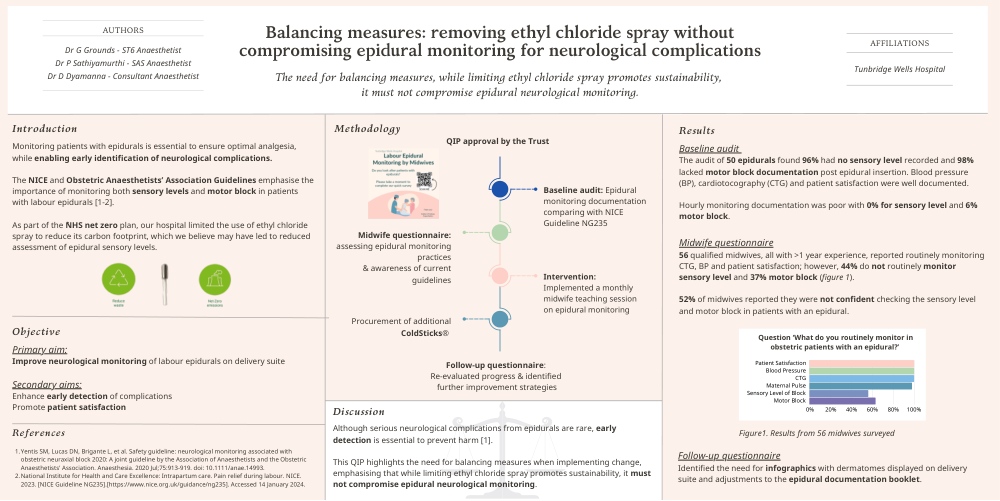
56 qualified midwives, all with >1 year experience, reported routinely monitoring CTG, BP and patient satisfaction; however, 44% do not routinely monitor sensory level and 37% motor block (figure 1).
52% of midwives reported they were notconfident checking the sensory level and motor block in patients with an epidural.
Figure1. Results from 56 midwives surveyed
Follow-up questionnaire
Identified the need for infographics with dermatomes displayed on delivery suite and adjustments to the epidural documentation booklet.
Discussion
Although serious neurological complications from epidurals are rare, early detection is essential to prevent harm [1]. This QIP highlights the need for balancing measures when implementing change, emphasising that while limiting ethyl chloride spray promotes sustainability, it must not compromise epidural neurological monitoring.
References
- Yentis SM, Lucas DN, Brigante L, et al. Safety guideline: neurological monitoring associated with obstetric neuraxial block 2020: A joint guideline by the Association of Anaesthetists and the Obstetric Anaesthetists' Association. Anaesthesia. 2020 Jul;75:913-919. doi: 10.1111/anae.14993.
- National Institute for Health and Care Excellence: Intrapartum care. Pain relief during labour. NICE. 2023. [NICE Guideline NG235].[https://www.nice.org.uk/guidance/ng235]. Accessed 14 January 2024.