215 posters, 5 topics, 22 sessions, 596 authors, 283 institutions
ePostersLive by SciGen Technologies S.A. All rights reserved.
Obstetric Anaesthesia Annual Scientific Meeting 2025
May 15 - 16, 2025 | ICC, 2 Lanyon Place, Belfast BT1 3WH

6762078
Promoting Maternal safety:Anaesthetists' and Midwives' perspectives on oral intake in labour and its impact on general anaesthesia for delivery
Poster Presenter
Authors
Affiliations
Part of Topic
Quality Improvement
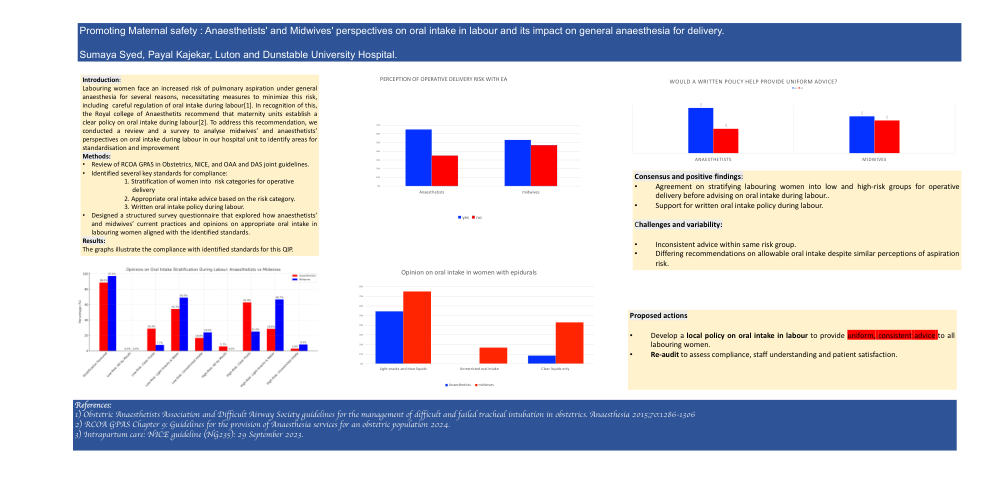
Promoting Maternal safety : Anaesthetists' and Midwives' perspectives on oral intake in labour and its impact on general anaesthesia for delivery.
Introduction:
Labouring women face an increased risk of pulmonary aspiration under general anaesthesia for several reasons, necessitating measures to minimize this risk, including careful regulation of oral intake during labour[1]. In recognition of this, the Royal college of Anaesthetits recommend that maternity units establish a clear policy on oral intake during labour[2]. To address this recommendation, we conducted a review and a survey to analysemidwives’ and anaesthetists’ perspectives on oral intake during labour in our hospital unit to identify areas for standardisation and improvement
Methods:
a) Stratification of women into risk categories for operative
delivery
b) Appropriate oral intake advice based on the risk category.
c) Written oral intake policy during labour.
Results and Discussion:
To address these concerns, we aim to develop a local policy on oral intake in labour to provide uniform, consistent advice to all labouring women, followed by re-audit to assess compliance, staff understanding and patient satisfaction.