215 posters, 5 topics, 22 sessions, 596 authors, 283 institutions
ePostersLive by SciGen Technologies S.A. All rights reserved.
Obstetric Anaesthesia Annual Scientific Meeting 2025
May 15 - 16, 2025 | ICC, 2 Lanyon Place, Belfast BT1 3WH

6737816
Timing of drugs in anaesthetic theatres in Leeds Teaching Hospitals - are we following trust and NICE guidelines?
Poster Presenter
Authors
Affiliations
Part of Topic
Quality Improvement
Timing of drugs in anaesthetic theatres in Leeds Teaching Hospitals - are we following trust and NICE guidelines?
Dr Thomas Hussey – Leeds Teaching Hospitals Trust, Leeds, United Kingdom
Introduction
The appropriate timing of prophylactic oxytocin bolus in obstetric theatre is clearly described in new NICE guidelines [1]. This guidance exists to reduce the risk of post- partum haemorrhage (PPH). Further stimulus for this project was the fact the trust was an outlier in terms of rates of PPH. Discussion with other anaesthetists on the labour ward revealed a potential variation in practice from these guidelines. Trust guidelines also clearly state that antibiotics should be given before knife to skin in all caesarean sections (LSCS) and after birth for assisted vaginal delivery, again with anecdotal variation in practice. This difference in drug timings reflects striking a balance between the risk of uteroplacental transfer of harmful drugs to the foetus against risk of infection to the mother.
Methods
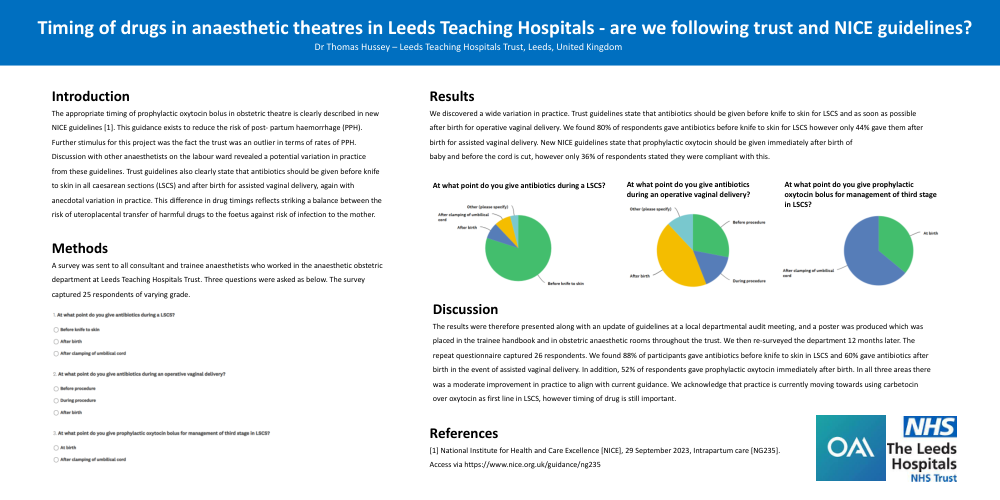
A survey was sent to all consultant and trainee anaesthetists who worked in the anaesthetic obstetric department at Leeds Teaching Hospitals Trust. Three questions were asked as below. The survey captured 25 respondents of varying grade.
Results
We discovered a wide variation in practice. Trust guidelines state that antibiotics should be given before knife to skin for LSCS and as soon as possible after birth for operative vaginal delivery. We found 80% of respondents gave antibiotics before knife to skin for LSCS however only 44% gave them after birth for assisted vaginal delivery. New NICE guidelines state that prophylactic oxytocin should be given immediately after birth of
baby and before the cord is cut, however only 36% of respondents stated they were compliant with this.
Discussion
The results were therefore presented along with an update of guidelines at a local departmental audit meeting, and a poster was produced which was placed in the trainee handbook and in obstetric anaesthetic rooms throughout the trust. We then re-surveyed the department 12 months later. The repeat questionnaire captured 26 respondents. We found 88% of participants gave antibiotics before knife to skin in LSCS and 60% gave antibiotics after birth in the event of assisted vaginal delivery. In addition, 52% of respondents gave prophylactic oxytocin immediately after birth. In all three areas there was a moderate improvement in practice to align with current guidance. We acknowledge that practice is currently moving towards using carbetocin over oxytocin as first line in LSCS, however timing of drug is still important.