215 posters, 5 topics, 22 sessions, 596 authors, 283 institutions
ePostersLive by SciGen Technologies S.A. All rights reserved.
Obstetric Anaesthesia Annual Scientific Meeting 2025
May 15 - 16, 2025 | ICC, 2 Lanyon Place, Belfast BT1 3WH

6778991
Critical care admission data for obstetric haemorrhage; a tertiary centre retrospective analysis
Poster Presenter
Authors
Ciara Luke, Amy Walsh, Czernecka Sabina, O' Riain Seosamh, Nicholas Barrett, Catherine Nix
Affiliations
Part of Topic
Service Evaluation
Authors: Luke C, Walsh A, Czernecka S, O’ Riain S, Nix CM, Barrett N
Background:
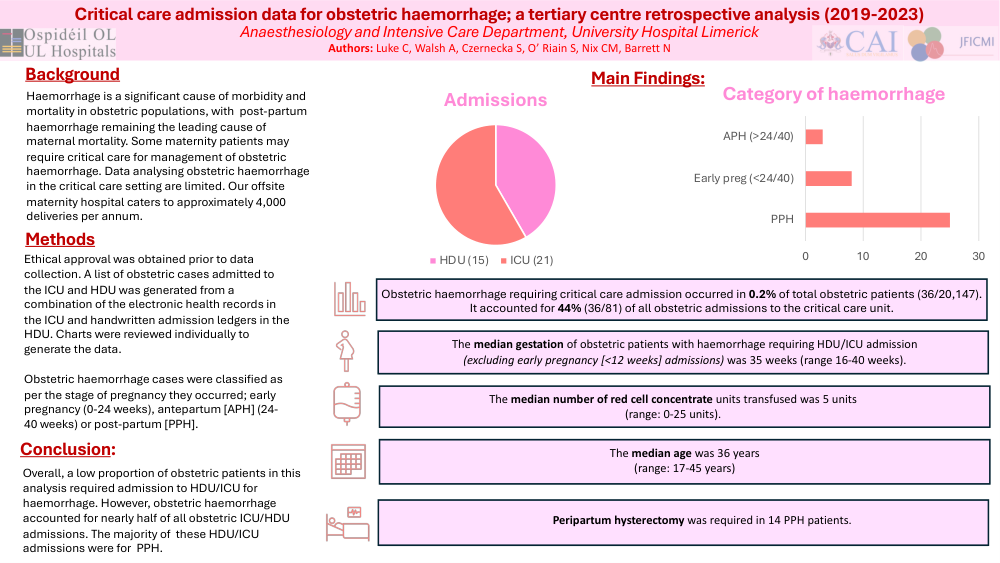
Haemorrhage is a significant cause of morbidity and mortality in obstetric populations and, globally, post-partum haemorrhage (PPH) remains the leading cause of maternal mortality1. Obstetric patients presenting with haemorrhage may require critical care. However, there are limited data analysing the incidence, timing and management of obstetric haemorrhage critical care admissions. Therefore, we performed a retrospective analysis of critical care admissions for the management of obstetric haemorrhage in a tertiary referral hospital.
Methods:
Ethical approval was obtained from the region’s ethics committee prior to data collection. A list of obstetric cases admitted to the intensive care unit (ICU) and high dependency unit (HDU) over a five year period (2019-2023) was generated from a combination of the electronic health records in the ICU and handwritten admission ledgers in the HDU. Charts were reviewed individually to generate the relevant data. Obstetric haemorrhage cases were classified as per the stage of pregnancy they occurred; early pregnancy (0-24 weeks), antepartum [APH] (24-40 weeks) or post-partum [PPH]. The study aimed to define the incidence of obstetric haemorrhage requiring critical care admission , the stage of gestation that haemorrhage occurred in, the number of blood products required and the level of care required (HDU or ICU).
Results:
A total of 20,147 obstetric patients were included in this analysis over the 5 year period. There were 81 patients (0.4%) requiring admission to ICU or HDU. Of these, haemorrhage accounted for 36 admissions, representing 0.2% of total obstetric patients but 44% of all obstetric critical care admissions. Of the 36 critical care admissions for obstetric haemorrhage, 15 (41.7%) were admitted to HDU and 21 (58.3%) were admitted to ICU. The majority of obstetric haemorrhages were due to PPH (25/36, 69.4%). Of these, 14 patients had placenta accreta spectrum (PAS). Haemorrhage in early pregnancy occurred in 8/36 patients (22.3%), 7 of which were due to ectopic pregnancy. The remaining 3 cases (8.3%) were classed as APH. For patients with obstetric haemorrhage, the median age was 36 years (range: 17-45 years). The median gestation of obstetric haemorrhage patients requiring HDU/ICU admission, excluding early pregnancy (<12 weeks) admissions, was 35 weeks (range 16-40 weeks). The median number of red cell concentrate units transfused was 5 units (range: 0-25 units). Peripartum hysterectomy was required in 14 PPH patients. There were no maternal deaths within this cohort.
Conclusion:
Overall, a low proportion of obstetric patients in this analysis required admission to HDU/ICU for haemorrhage. However, obstetric haemorrhage accounted for nearly half of all obstetric ICU/HDU admissions. The majority of HDU/ICU admissions for obstetric haemorrhage were for PPH.
1. WHO. Postpartum haemorrhage 2023. Available from: https://www.who.int/teams/sexual-and-reproductive-health-and-research-(srh)/areas-of-work/maternal-and-perinatal-health/postpartum-haemorrhage.