215 posters, 5 topics, 22 sessions, 596 authors, 283 institutions
ePostersLive by SciGen Technologies S.A. All rights reserved.
Obstetric Anaesthesia Annual Scientific Meeting 2025
May 15 - 16, 2025 | ICC, 2 Lanyon Place, Belfast BT1 3WH

6762706
Evaluation of a height - adjusted spinal dosing table for Caesarean section
Poster Presenter
Authors
Affiliations
Part of Topic
Service Evaluation
Evaluation of a height - adjusted spinal dosing table for Caesarean section
Dr Helen B.K. Brar. Consultant Anaesthetist. University Hospital of North Durham.
Approval for this audit has been obtained from the R&D department, the Audit department and the Caldicott Guardian.
Introduction
The author has developed a Caesarean section (CS) height–adjusted spinal dosing table (https://thedurhamtap.org.uk). This audit compares eight cohorts of parturients of gestation ≥36 weeks, receiving lumbar 3-4 spinal injection in the sitting position. Injection speed changes and small volume changes occurred in the different cohorts. Height was obtained directly from parturients in cohort 1 and from the notes in subsequent cohorts. A thoracic (T) dermatome T2-T4 block was regarded as a target block height.
Method
The following were audited: CS category, twin pregnancy, booking height, weight and body mass index (BMI), volume of Aspen 0.5% hyperbaric bupivacaine, spinal block height after urinary catheterisation (cohorts 1-2) and at 10mins (cohorts 3-8), opioid supplementation and conversion to general anaesthesia (GA).
Results
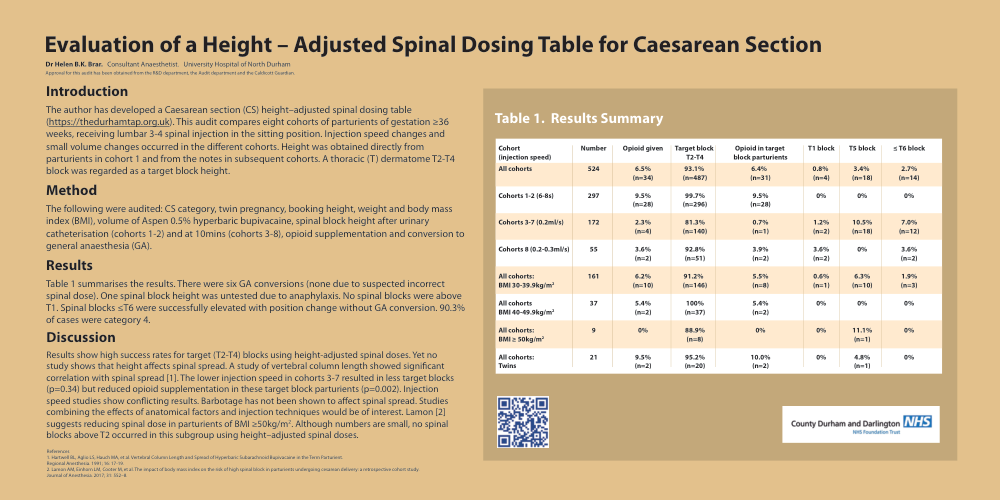
Table 1 summarises the results. There were six GA conversions (none due to suspected incorrect spinal dose). One spinal block height was untested due to anaphylaxis. No spinal blocks were above T1. Spinal blocks ≤T6 were successfully elevated with position change without GA conversion. 90.3% of cases were category 4.
Discussion
Results show high success rates for target (T2-T4) blocks using height-adjusted spinal doses. Yet no study shows that height affects spinal spread. A study of vertebral column length showed significant correlation with spinal spread [1]. The lower injection speed in cohorts 3-7 resulted in less target blocks (p=0.34) but reduced opioid supplementation in these target block parturients (p=0.002). Injection speed studies show conflicting results. Barbotage has not been shown to affect spinal spread. Studies combining the effects of anatomical factors and injection techniques would be of interest. Lamon [2] suggests reducing spinal dose in parturients of BMI ≥50kg/m2. Although numbers are small, no spinal blocks above T2 occurred in this subgroup using height–adjusted spinal doses.
References
1. Hartwell BL, Aglio LS, Hauch MA, et al. Vertebral Column Length and Spread of Hyperbaric Subarachnoid Bupivacaine in the Term Parturient. Regional Anesthesia. 1991; 16: 17-19.
2. Lamon AM, Einhorn LM, Cooter M, et al. The impact of body mass index on the risk of high spinal block in parturients undergoing cesarean delivery: a retrospective cohort study. Journal of Anesthesia. 2017; 31: 552–8.