215 posters, 5 topics, 22 sessions, 596 authors, 283 institutions
ePostersLive by SciGen Technologies S.A. All rights reserved.
Obstetric Anaesthesia Annual Scientific Meeting 2025
May 15 - 16, 2025 | ICC, 2 Lanyon Place, Belfast BT1 3WH

6765853
Labour Epidural Protocol Evaluation at Mater Mothers' Hospital: Transition to Programmed Intermittent Bolus and Low Concentration Local Anaesthesia
Poster Presenter
Part of Topic
Service Evaluation
Title:
Labour Epidural Protocol Evaluation at Mater Mothers’ Hospital: Transition to Programmed Intermittent Bolus and Low Concentration Local Anaesthesia
Introduction:
Epidural analgesia is the gold standard for managing labour pain1. In 2024 Mater Mother's Hospital (MMH) transitioned from continuous epidural infusion with patient-controlled epidural analgesia (CEI + PCEA) using 0.2% ropivacaine and 2mcg/ml fentanyl, to programmed intermittent epidural bolus (PIEB + PCEA) using 0.1% ropivacaine and 2mcg/ml fentanyl. PIEB + PCEA has been shown to have several key benefits, including improved maternal satisfaction1, particularly with lower concentrations of local anaesthetic2. However, practices vary across Australia. This study evaluates the impact of transitioning to PIEB at MMH on maternal satisfaction, obstetric outcomes, and resource use.
Methods:
Retrospective audit of MMH public patients who received labour epidurals and completed satisfaction surveys, identified from the Acute Pain Service database. Data was collected for a 3 month period before and after implementation of the PIEB + PCEA regime. Metrics included neuraxial technique (epidural vs. combined spinal-epidural), medication type and volume, pump settings (CEI vs. PIEB), pain management interventions (clinician reviews, boluses, unilateral blocks, catheter repositioning or replacement), Bromage score, block height, hypotension, infusion pauses, mode of delivery (MOD) and additional analgesia during caesarean section (CS).
Results:
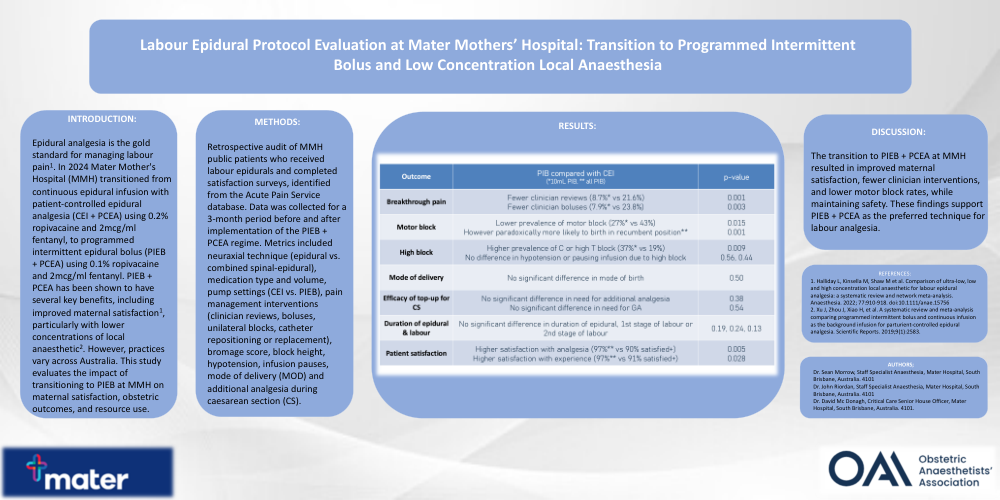
185 CEI and 195 PIEB patients were included. PIEB showed key benefits, including fewer clinician reviews (8.7% vs 21.6%, p = 0.001) and boluses for breakthrough pain (7.9% vs 23.8%, p = 0.003), and less motor block (27% vs. 43%, p = 0.015). Recumbent delivery rates were higher (p = 0.001) with more pruritus (22% vs. 13.3%, p = 0.041). Increased high sensory block (37% vs 19%, p = 0.009) was noted, with no significant differences in hypotension or infusion pauses (p = 0.56, p = 0.44). No significant differences occurred in MOD (vaginal, instrumental, or CS, p = 0.50). CS analgesia success was similar for both groups (p > 0.38). Maternal satisfaction was higher with PIEB for both analgesia (97% vs. 90%, p = 0.005) and overall experience (97% vs. 91%, p = 0.028). Safety was comparable, with no increase in adverse events.
Discussion:
The transition to PIEB + PCEA at MMH resulted in improved maternal satisfaction, fewer clinician interventions, and lower motor block rates, while maintaining safety. These findings support PIEB + PCEA as the preferred technique for labour analgesia.
Authors:
Dr. Sean Morrow, Staff Specialist Anaesthesia, Mater Hospital, South Brisbane, Australia. 4101
Dr. John Riordan, Staff Specialist Anaesthesia, Mater Hospital, South Brisbane, Australia. 4101
Dr. David Mc Donagh, Critical Care Senior House Officer, Mater Hospital, South Brisbane, Australia. 4101.
References:
- Halliday L, Kinsella M, Shaw M et al. Comparison of ultra-low, low and high concentration local anaesthetic for labour epidural analgesia: a systematic review and network meta-analysis. Anaesthesia. 2022; 77:910-918. doi:10.1111/anae.15756
- Xu J, Zhou J, Xiao H, et al. A systematic review and meta-analysis comparing programmed intermittent bolus and continuous infusion as the background infusion for parturient-controlled epidural analgesia. Scientific Reports. 2019;9(1):2583.