215 posters, 5 topics, 22 sessions, 596 authors, 283 institutions
ePostersLive by SciGen Technologies S.A. All rights reserved.
Obstetric Anaesthesia Annual Scientific Meeting 2025
May 15 - 16, 2025 | ICC, 2 Lanyon Place, Belfast BT1 3WH

6778938
Introduction of a Regional Anaesthetic Alert Bracelet to improve patient understanding of delayed neurological recovery following neuraxial analgesia
Poster Presenter
Part of Topic
Quality Improvement
Introduction of a Regional Anaesthetic Alert Bracelet to improve patient understanding of delayed neurological recovery following neuraxial analgesia
Authors: Dr Rupert T Lees, Dr James H P Wicker, Dr Rachel Mathers
Introduction
The 2020 joint Obstetric Anaesthetists’ Association/ Association of Anaesthetists guideline for monitoring of CNB recommends screening for prolonged motor block by assessing a patient’s ability to straight leg raise (SLR) within four hours of a CNB (1). To facilitate this, the concept of the Regional Anaesthetic Alert Bracelet (RA-AB) was developed, and has been introduced in over 50 Trusts across the UK and Ireland. Our project aimed to implement the RA-AB to help prompt patients to SLR at their unique four hour time. Patient understanding of the side effects of CNB was audited before and after the introduction of the RA-AB.
Methods
Study approval was granted by the hospital audit committee. Prior to the introduction of the RA-AB, women presenting for an elective Caesarean section at East Surrey Hospital (ESH) were asked to complete a four question survey following pre-assessment. Two months after the introduction of the RA-AB, a re-audit was undertaken using the same survey.
Results
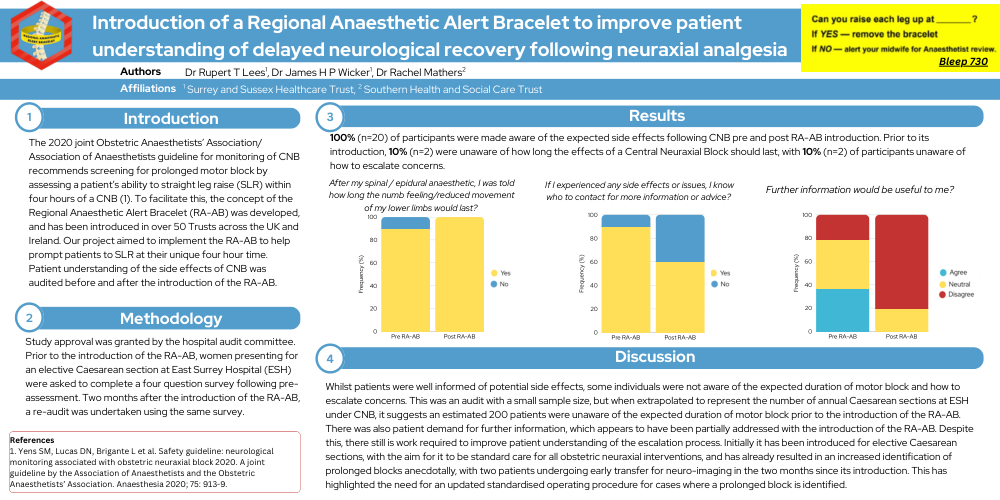
100% (n=20) of participants were made aware of the expected side effects following CNB pre and post RA-AB introduction. Prior to its introduction, 10% (n=2) were unaware of how long the effects of a Central Neuraxial Block should last, with 10% (n=2) of participants unaware of how to escalate concerns.
Discussion
Whilst patients were well informed of potential side effects, some individuals were not aware of the expected duration of motor block and how to escalate concerns. This was an audit with a small sample size, but when extrapolated to represent the number of annual Caesarean sections at ESH under CNB, it suggests an estimated 200 patients were unaware of the expected duration of motor block prior to the introduction of the RA-AB. There was also patient demand for further information, which appears to have been partially addressed with the introduction of the RA-AB. Despite this, there still is work required to improve patient understanding of the escalation process. Initially it has been introduced for elective Caesarean sections, with the aim for it to be standard care for all obstetric neuraxial interventions, and has already resulted in an increased identification of prolonged blocks anecdotally, with two patients undergoing early transfer for neuro-imaging in the two months since its introduction. This has highlighted the need for an updated standardised operating procedure for cases where a prolonged block is identified.