215 posters, 5 topics, 22 sessions, 596 authors, 283 institutions
ePostersLive by SciGen Technologies S.A. All rights reserved.
Obstetric Anaesthesia Annual Scientific Meeting 2025
May 15 - 16, 2025 | ICC, 2 Lanyon Place, Belfast BT1 3WH

6773136
Introducing a pain management pathway for medical termination of pregnancy
Poster Presenter
Authors
Affiliations
Part of Topic
Service Evaluation
Introducing a pain management pathway for medical termination of pregnancy
Dr Manvi Singhal, Dr Rina James, Dr Helen Richardson, Dr Yasmin Nawaz
INTRODUCTION AND OBJECTIVES
•Medical termination of pregnancy (TOP) has been offered in Royal Jubilee Maternity Hospital (RJMH) since the introduction of new legislation [Abortion (Northern Ireland) Regulations 2020].
•This includes pregnancies up to 24 weeks gestation and after 24 weeks gestation in certain circumstances.
•We sought to optimize the labour analgesia provided to women having a TOP in RJMH.
METHODS
•Approval - Belfast Trust Standards Quality & Audit Department
•Retrospective audit (labour analgesia for TOP, 2022)
•Regional online survey (current obstetric anaesthetic practice, 2023)
•Qualitative survey of women (TOP, 2024)
RESULTS
•In the first year following new legislation, 17 women had a TOP in RJMH.
•Most received simple analgesia, with 12 (70%) receiving IM opiate analgesia, nine using entonox and one patient having epidural analgesia.
•A small survey of five women having a TOP in 2024 showed that they were satisfied with their labour analgesia, but the majority would welcome the option of patient-controlled opioid analgesia (PCA).
•There were 13 respondents from all five NI healthcare trusts to an online survey of practice. This showed a range of current practice and support for developing an analgesia pathway for these patients.
DISCUSSION
•Patients having a TOP may experience a lengthy induction process followed by painful, often rapid, labour and delivery.
•Literature review shows that practice varies but safe, effective analgesia should always be offered. This includes regional analgesia and repeated doses of parenteral opioid [1].
•Epidural analgesia may not be effective in patients with short labours or may not be safe in those with underlying infection.
•IM opioid has a slow onset time and may preclude the use of IV opioid for several hours.
•Fentanyl PCA has a better maternal safety profile in this group compared with remifentanil PCA [2].
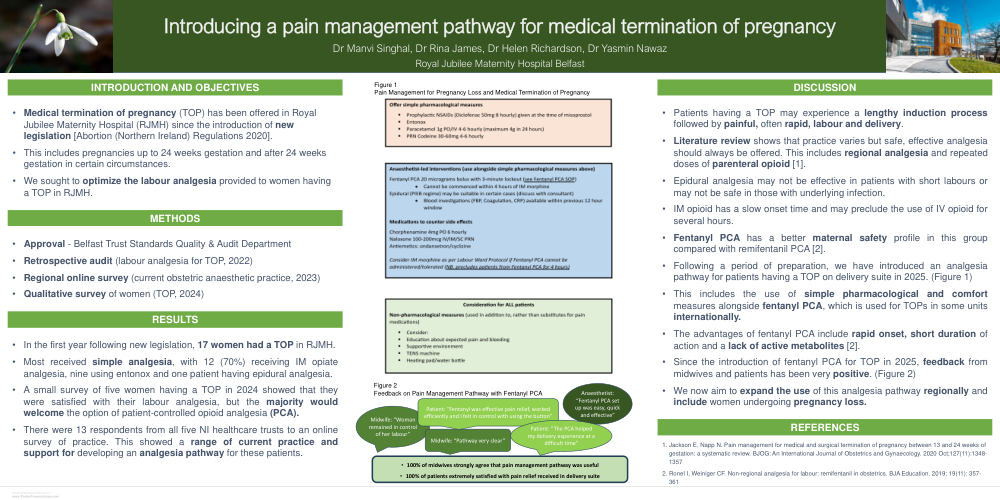
•Following a period of preparation, we have introduced an analgesia pathway for patients having a TOP on delivery suite in 2025. (Figure 1)
•This includes the use of simple pharmacological and comfort measures alongside fentanyl PCA, which is used for TOPs in some units internationally.
•The advantages of fentanyl PCA include rapid onset, short duration of action and a lack of active metabolites [2].
•Since the introduction of fentanyl PCA for TOP in 2025, feedback from midwives and patients has been very positive. (Figure 2)
We now aim to expand the use of this analgesia pathway regionally and include women undergoing pregnancy loss.
REFERENCES
1.Jackson E, Napp N. Pain management for medical and surgical termination of pregnancy between 13 and 24 weeks of gestation: a systematic review. BJOG: An International Journal of Obstetrics and Gynaecology. 2020 Oct;127(11):1348-1357
2.Ronel I, Weiniger CF. Non-regional analgesia for labour: remifentanil in obstetrics. BJA Education. 2019; 19(11): 357-361