215 posters, 5 topics, 22 sessions, 596 authors, 283 institutions
ePostersLive by SciGen Technologies S.A. All rights reserved.
Obstetric Anaesthesia Annual Scientific Meeting 2025
May 15 - 16, 2025 | ICC, 2 Lanyon Place, Belfast BT1 3WH

6773095
Widening access to epidural and analgesia patient information in maternity services
Poster Presenter
Authors
Alice Jones, Kayleigh Pigott, Sultan Sanaah, Bunce Alice, Amelia Banks
Affiliations
Part of Topic
Quality Improvement
Widening Access to Epidural and Analgesia Patient Information in Maternity Services
A. Jones, S. Sultan, K. Pigott, A. Bunce, A. Banks
Nottingham University Hospitals (NUH) Trust
INTRODUCTION
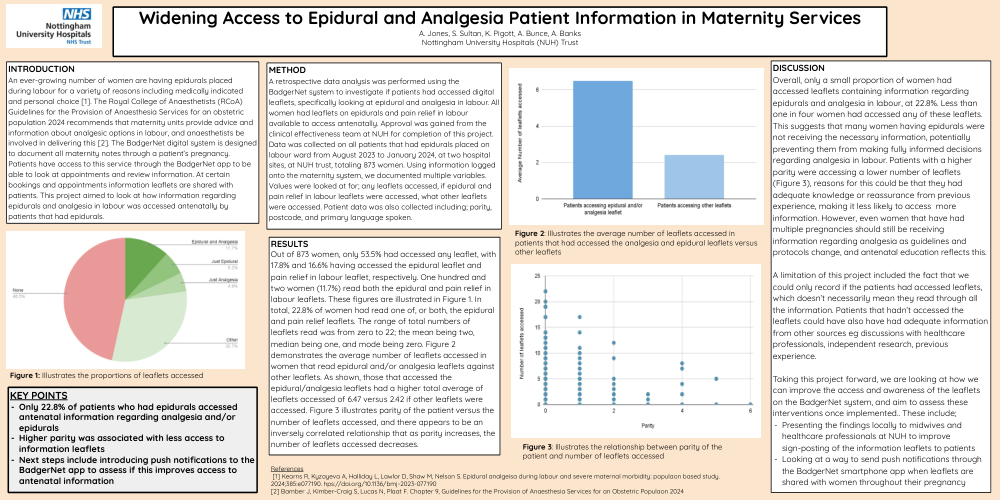
An ever-growing number of women are having epidurals placed during labour for a variety of reasons including medically indicated and personal choice [1]. The Royal College of Anaesthetists (RCoA) Guidelines for the Provision of Anaesthesia Services for an obstetric population 2024 recommends that maternity units provide advice and information about analgesic options in labour, and anaesthetists be involved in delivering this [2]. The BadgerNet digital system is designed to document all maternity notes through a patient’s pregnancy. Patients have access to this service through the BadgerNet app to be able to look at appointments and review information. At certain bookings and appointments information leaflets are shared with patients. This project aimed to look at how information regarding epidurals and analgesia in labour was accessed antenatally by patients that had epidurals.METHOD
A retrospective data analysis was performed using the BadgerNet system to investigate if patients had accessed digital leaflets, specifically looking at epidural and analgesia in labour. All women had leaflets on epidurals and pain relief in labour available to access antenatally. Approval was gained from the clinical effectiveness team at NUH for completion of this project. Data was collected on all patients that had epidurals placed on labour ward from August 2023 to January 2024, at two hospital sites, at NUH trust, totaling 873 women. Using information logged onto the maternity system, we documented multiple variables. Values were looked at for; any leaflets accessed, if epidural and pain relief in labour leaflets were accessed, what other leaflets were accessed. Patient data was also collected including; parity, postcode, and primary language spoken.
RESULTS
Out of 873 women, only 53.5% had accessed any leaflet, with 17.8% and 16.6% having accessed the epidural leaflet and pain relief in labour leaflet, respectively. One hundred and two women (11.7%) read both the epidural and pain relief in labour leaflets. These figures are illustrated in Figure 1. In total, 22.8% of women had read one of, or both, the epidural and pain relief leaflets. The range of total numbers of leaflets read was from zero to 22; the mean being two, median being one, and mode being zero. Figure 2 demonstrates the average number of leaflets accessed in women that read epidural and/or analgesia leaflets against other leaflets. As shown, those that accessed the epidural/analgesia leaflets had a higher total average of leaflets accessed of 6.47 versus 2.42 if other leaflets were accessed. Figure 3 illustrates parity of the patient versus the number of leaflets accessed, and there appears to be an inversely correlated relationship that as parity increases, the number of leaflets accessed decreases.
DISCUSSION
Overall, only a small proportion of women had accessed leaflets containing information regarding epidurals and analgesia in labour, at 22.8%. Less than one in four women had accessed any of these leaflets. This suggests that many women having epidurals were not receiving the necessary information, potentially preventing them from making fully informed decisions regarding analgesia in labour. Patients with a higher parity were accessing a lower number of leaflets (Figure 3), reasons for this could be that they had adequate knowledge or reassurance from previous experience, making it less likely to access more information. However, even women that have had multiple pregnancies should still be receiving information regarding analgesia as guidelines and protocols change, and antenatal education reflects this.
A limitation of this project included the fact that we could only record if the patients had accessed leaflets, which doesn’t necessarily mean they read through all the information. Patients that hadn’t accessed the leaflets could have also have had adequate information from other sources eg discussions with healthcare professionals, independent research, previous experience.
Taking this project forward, we are looking at how we can improve the access and awareness of the leaflets on the BadgerNet system, and aim to assess these interventions once implemented.. These include;
-
Presenting the findings locally to midwives and healthcare professionals at NUH to improve sign-posting of the information leaflets to patients
-
Looking at a way to send push notifications through the BadgerNet smartphone app when leaflets are shared with women throughout their pregnancy
KEY POINTS
-
Only 22.8% of patients who had epidurals accessed antenatal information regarding analgesia and/or epidurals
-
Higher parity was associated with less access to information leaflets
-
Next steps include introducing push notifications to the BadgerNet app to assess if this improves access to antenatal information
References
[1] Kearns R, Kyzayeva A, Halliday L, Lawlor D, Shaw M, Nelson S. Epidural analgeisa during labour and severe maternal morbidity: populaon based study. 2024;385:e077190. hps://doi.org/10.1136/bmj-2023-077190
[2] Bamber J, Kimber-Craig S, Lucas N, Plaat F. Chapter 9, Guidelines for the Provision of Anaesthesia Services for an Obstetric Populaon 2024