215 posters, 5 topics, 22 sessions, 596 authors, 283 institutions
ePostersLive by SciGen Technologies S.A. All rights reserved.
Obstetric Anaesthesia Annual Scientific Meeting 2025
May 15 - 16, 2025 | ICC, 2 Lanyon Place, Belfast BT1 3WH

6772909
Improving blood stewardship on the Labour Ward
Poster Presenter
Part of Topic
Quality Improvement
Introduction
Blood transfusion is a regular occurrence on a labour ward, with incidence of post partum haemorrhage (PPH) of 8.6% in a Welsh study (1). Our transfusion team reported large numbers of requests for cross matched (XM) blood from labour ward, with relatively low numbers of units being used, putting pressure on their blood stocks. Cross matched blood remains allocated, by default, to a patient for up to 36 hours before being available for other patients. This is costly to the Trust, and increases the Trust's requirements at a time of national shortage, with ongoing 'amber alerts' for products (2). We wanted to explore methods to improve our blood stewardship, although acknowledged that there will always be a relatively high demand for cross matched blood on labour ward. Labour wards can be isolated from the main hospital, with blood loss usually rapid but slightly unpredictable, meaning that blood may be cross matched at a lower threshold than elsewhere in the hospital.
Aims
-
- To audit cross match requests made from labour ward, to determine whether these were appropriate, or whether education of requesting teams may improve stewardship.
-
- To encourage return of blood to the laboratory following haemostasis at delivery.
Methods
Following local audit approval, the electronic notes of all women for whom blood had been cross-matched during a one month period were reviewed.
A list of patients was obtained from our transfusion team, and information about circumstances surrounding delivery with respect to bleeding risk was gathered. It was also noted what proportion of cross matched blood was used.Results
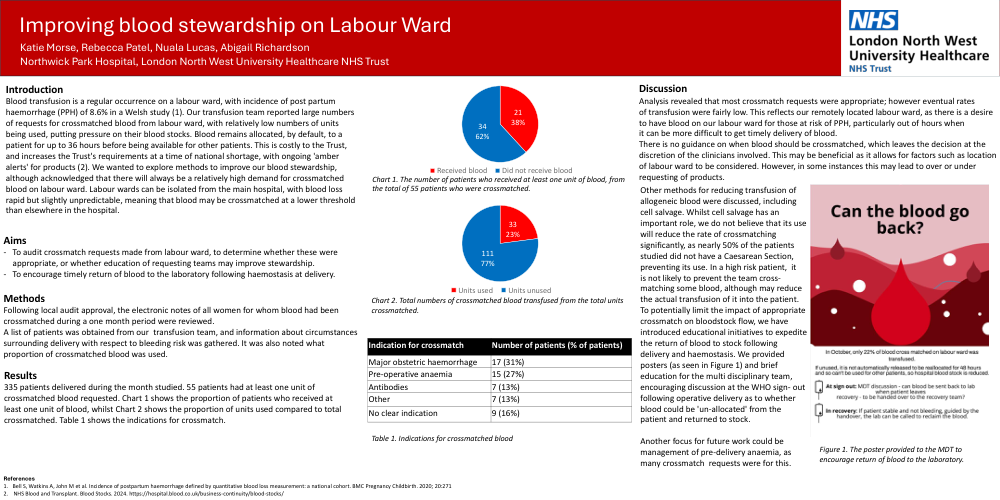
335 patients delivered during the month studied. 55 patients had at least one unit of XM blood requested. Chart 1 shows the proportion of patients who received at least one unit of blood, whilst Chart 2 shows the proportion of units used compared to total cross matched. Table 1 shows the indications for XM.
Discussion
Analysis revealed that most XM requests were appropriate; however eventual rates
of transfusion were fairly low. This reflects our remotely located labour ward, as there is a desire to have XM blood on our labour ward in those at risk of PPH, particularly out of hours when
it can be more difficult to get timely delivery of blood.
There is no guidance on when blood should be cross-matched, which leaves the decision at the discretion of the clinicians involved. This may be beneficial as it allows for factors such as location of labour ward to be considered. However, in some instances this may lead to over or under requesting of products.Other methods for reducing transfusion of allogeneic blood were discussed, including cell salvage. Whilst cell salvage has an important role, we do not believe that its use will reduce the rate of cross-matching significantly, as nearly 50% of the patients studied did not have a Caesarean Section, preventing its use. In a high risk patient, it is not likely to prevent the team cross- matching some blood, although may reduce the actual transfusion of it into the patient. To potentially limit the impact of appropriate XM on bloodstock flow, we have introduced educational initiatives to expedite the return of XM blood to stock following delivery and haemostasis. We provided posters (as seen in Figure 1) and brief education for the multi disciplinary team, encouraging discussion at the WHO sign- out following operative delivery as to whether blood could be 'un-allocated' from the patient and returned to stock.
Another focus for future work could be management of pre-delivery anaemia, as many XM requests were for this.
References:
1. Bell S, Watkins A, John M et al. Incidence of postpartum haemorrhage defined by quantitative blood loss measurement: a national cohort. BMC Pregnancy Childbirth. 2020; 20:271
2. NHS Blood and Transplant. Blood Stocks. 2024. hps://hospital.blood.co.uk/business-connuity/blood-stocks/