215 posters, 5 topics, 22 sessions, 596 authors, 283 institutions
ePostersLive by SciGen Technologies S.A. All rights reserved.
Obstetric Anaesthesia Annual Scientific Meeting 2025
May 15 - 16, 2025 | ICC, 2 Lanyon Place, Belfast BT1 3WH

6772780
Optimising Maternal Cardiac Arrest Management: Implementing an Obstetric-Specific Cardiac Arrest Trolley
Part of Topic
Quality Improvement
Optimising Maternal Cardiac Arrest Management: Implementing an Obstetric-Specific Cardiac Arrest Trolley
Jeremy Chui ¹, Gyuseong Cho ¹, Elia Keating ², Siobhan Scully ³, Abigail Richardson ⁴, Sneh Shah ⁴
Introduction
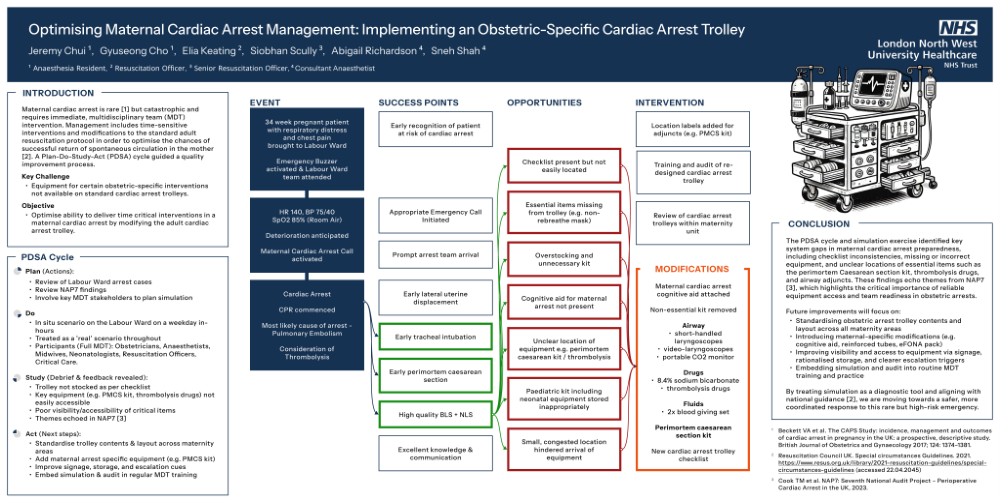
Maternal cardiac arrest is rare [1] but catastrophic and requires immediate, multidisciplinary team (MDT) intervention. Management includes time-sensitive interventions and modifications to the standard adult resuscitation protocol in order to optimise the chances of successful return of spontaneous circulation in the mother [2]. A Plan-Do-Study-Act (PDSA) cycle guided a quality improvement process.
Key Challenge
Equipment for certain obstetric-specific interventions not available on standard cardiac arrest trolleys.
Objective
Optimise ability to deliver time critical interventions in a maternal cardiac arrest by modifying the adult cardiac arrest trolley.
PDSA Cycle
Plan (Actions):
Review of Labour Ward arrest cases
Review NAP7 findings
Involve key MDT stakeholders to plan simulation
Do
In situ scenario on the Labour Ward on a weekday in-hours
Treated as a 'real' scenario throughout
Participants (Full MDT): Obstetricians, Anaesthetists, Midwives, Neonatologists, Resuscitation Officers, Critical Care.
Study (Debrief & feedback revealed):
Trolley not stocked as per checklist
Key equipment (e.g. PMCS kit, thrombolysis drugs) not easily accessible
Poor visibility/accessibility of critical items
Themes echoed in NAP7 [3]
Act (Next steps):
Standardise trolley contents & layout across maternity areas
Add maternal arrest specific equipment (e.g. PMCS kit)
Improve signage, storage, and escalation cues
Embed simulation & audit in regular MDT training
Conclusion
The PDSA cycle and simulation exercise identified key system gaps in maternal cardiac arrest preparedness, including checklist inconsistencies, missing or incorrect equipment, and unclear locations of essential items such as the perimortem Caesarean section kit, thrombolysis drugs, and airway adjuncts. These findings echo themes from NAP7 [3], which highlights the critical importance of reliable equipment access and team readiness in obstetric arrests.
Future improvements will focus on:
Standardising obstetric arrest trolley contents and layout across all maternity areas
Introducing maternal-specific modifications (e.g. cognitive aid, reinforced tubes, eFONA pack)
Improving visibility and access to equipment via signage, rationalised storage, and clearer escalation triggers
Embedding simulation and audit into routine MDT training and practice
By treating simulation as a diagnostic tool and aligning with national guidance [2], we are moving towards a safer, more coordinated response to this rare but high-risk emergency.