215 posters, 5 topics, 22 sessions, 596 authors, 283 institutions
ePostersLive by SciGen Technologies S.A. All rights reserved.
Obstetric Anaesthesia Annual Scientific Meeting 2025
May 15 - 16, 2025 | ICC, 2 Lanyon Place, Belfast BT1 3WH

6772756
Suprapannicular Caesarean Section- is a thoracic epidural really necessary?
Part of Topic
Service Evaluation
Suprapannicular Caesarean Section – Is a Thoracic Epidural Really Necessary?
Laura Graham ST7, Monica Morosan Consultant Obstetric Anaesthetist and Charles Bircher Consultant Obstetrician, Norfolk and Norwich University Hospital
INTRODUCTION
Severely obese parturients undergoing caesarean section (CS) have increased rates of surgical site infections (SSI) (1). Incisions above the panniculus aim to reduce infection by keeping the surgical site open to air. A modified skin incision as described by Tixier et al (2), evolved at our institution for such patients since 2017. Initially a thoracic epidural (TE) with lumbar spinal was performed. Now, local practice has evolved to a standard length infra/sub-umbilical transverse skin incision. We questioned if a TE was needed.
METHODS
Institutional information governance approval was obtained. Cases were identified from the surgeon’s log and data was collected from hospital electronic records for: operating time, BMI, weight, age, type of planned anaesthesia, presence and level of TE, additional intraoperative anaesthesia (opiate boluses, epidural top up, convert to GA), incision site, postoperative opiate use and length of stay (LOS) Mean and range for demographics and outcomes were calculated or percentage of cases as applicable.
RESULTS
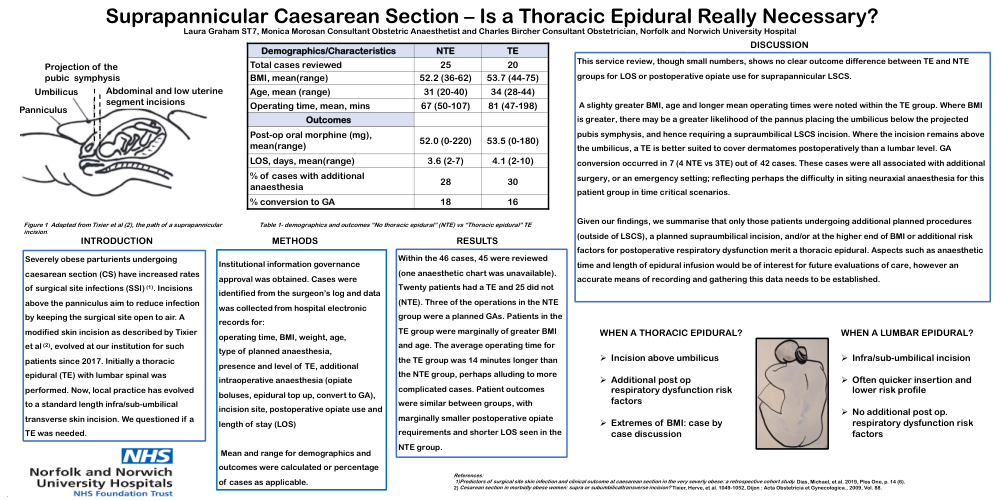
Within the 46 cases, 45 were reviewed (one anaesthetic chart was unavailable). Twenty patients had a TE and 25 did not (NTE). Three of the operations in the NTE group were a planned GAs. Patients in the TE group were marginally of greater BMI and age. The average operating time for the TE group was 14 minutes longer than the NTE group, perhaps alluding to more complicated cases. Patient outcomes were similar between groups, with marginally smaller postoperative opiate requirements and shorter LOS seen in the NTE group.
DISCUSSION
This service review, though small numbers, shows no clear outcome difference between TE and NTE groups for LOS or postoperative opiate use for suprapannicular LSCS.
A slighty greater BMI, age and longer mean operating times were noted within the TE group. Where BMI is greater, there may be a greater likelihood of the pannus placing the umbilicus below the projected pubis symphysis, and hence requiring a supraumbilical LSCS incision. Where the incision remains above the umbilicus, a TE is better suited to cover dermatomes postoperatively than a lumbar level. GA conversion occurred in 7 (4 NTE vs 3TE) out of 42 cases. These cases were all associated with additional surgery, or an emergency setting; reflecting perhaps the difficulty in siting neuraxial anaesthesia for this patient group in time critical scenarios.
Given our findings, we summarise that only those patients undergoing additional planned procedures (outside of LSCS), a planned supraumbilical incision, and/or at the higher end of BMI or additional risk factors for postoperative respiratory dysfunction merit a thoracic epidural. Aspects such as anaesthetic time and length of epidural infusion would be of interest for future evaluations of care, however an accurate means of recording and gathering this data needs to be established.
References:
1)Predictors of surgical site skin infection and clinical outcome at caesarean section in the very severly obese: a retrospective cohort study. Dias, Michael, et al. 2019, Plos One, p. 14 (6).
2) Cesarean section in morbidly obese women: supra or subumbilicaltransverse incision? Tixier, Herve, et al. 1049-1052, Dijon : Acta Obstetricia et Gynecologica., 2009, Vol. 88.