215 posters, 5 topics, 22 sessions, 596 authors, 283 institutions
ePostersLive by SciGen Technologies S.A. All rights reserved.
Obstetric Anaesthesia Annual Scientific Meeting 2025
May 15 - 16, 2025 | ICC, 2 Lanyon Place, Belfast BT1 3WH

6772487
The language barrier - a contributing factor to uptake of antenatal education leaflets on labour analgesia
Poster Presenter
Authors
Sanaah Sultan, Alice Jones, Pigott Kayleigh, Bunce Alice, Amelia Banks
Affiliations
Part of Topic
Quality Improvement
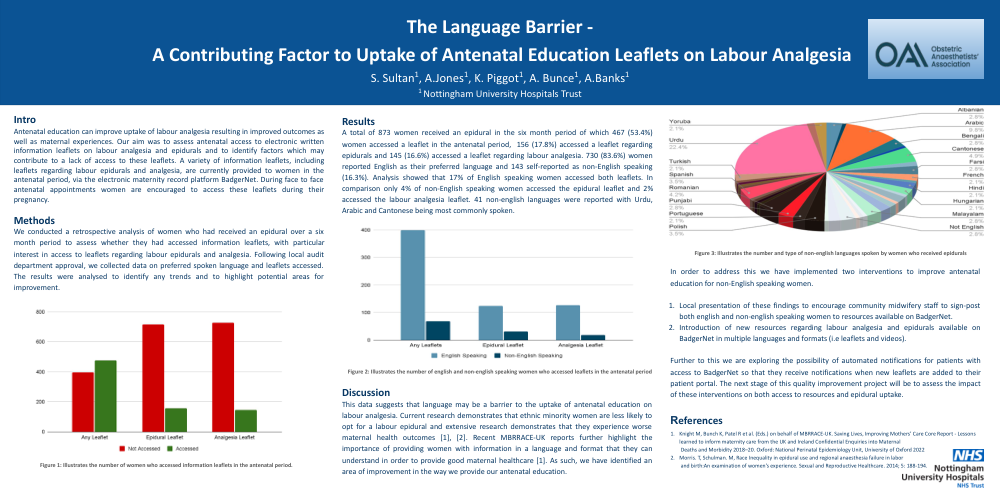
The Language Barrier - A Contributing Factor to Uptake of Antenatal Education Leaflets on Labour Analgesia S. Sultan 1 , A.Jones 1 , K. Piggot 1 , A. Bunce 1 , A.Banks 1 1 Nottingham University Hospitals Trust
Intro
Antenatal education can improve uptake of labour analgesia resulting in improved outcomes as well as maternal experiences. Our aim was to assess antenatal access to electronic written information leaflets on labour analgesia and epidurals and to identify factors which may contribute to a lack of access to these leaflets. A variety of information leaflets, including leaflets regarding labour epidurals and analgesia, are currently provided to women in the antenatal period, via the electronic maternity record platform BadgerNet. During face to face antenatal appointments women are encouraged to access these leaflets during their pregnancy.
Methods
We conducted a retrospective analysis of women who had received an epidural over a six month period to assess whether they had accessed information leaflets, with particular interest in access to leaflets regarding labour epidurals and analgesia. Following local audit department approval, we collected data on preferred spoken language and leaflets accessed. The results were analysed to identify any trends and to highlight potential areas for improvement.
Results
A total of 873 women received an epidural in the six month period of which 467 (53.4%) women accessed a leaflet in the antenatal period, 156 (17.8%) accessed a leaflet regarding epidurals and 145 (16.6%) accessed a leaflet regarding labour analgesia. 730 (83.6%) women reported English as their preferred language and 143 self-reported as non-English speaking (16.3%). Analysis showed that 17% of English speaking women accessed both leaflets. In comparison only 4% of non-English speaking women accessed the epidural leaflet and 2% accessed the labour analgesia leaflet. 41 non-english languages were reported with Urdu, Arabic and Cantonese being most commonly spoken.
Discussion
This data suggests that language may be a barrier to the uptake of antenatal education on labour analgesia. Current research demonstrates that ethnic minority women are less likely to opt for a labour epidural and extensive research demonstrates that they experience worse maternal health outcomes [1], [2]. Recent MBRRACE-UK reports further highlight the importance of providing women with information in a language and format that they can understand in order to provide good maternal healthcare [1]. As such, we have identified an area of improvement in the way we provide our antenatal education.
In order to address this we have implemented two interventions to improve antenatal education for non-English speaking women. 1. Local presentation of these findings to encourage community midwifery staff to sign-post both english and non-english speaking women to resources available on BadgerNet. 2. Introduction of new resources regarding labour analgesia and epidurals available on BadgerNet in multiple languages and formats (i.e leaflets and videos). Further to this we are exploring the possibility of automated notifications for patients with access to BadgerNet so that they receive notifications when new leaflets are added to their patient portal. The next stage of this quality improvement project will be to assess the impact of these interventions on both access to resources and epidural uptake.
References
1. Knight M, Bunch K, Patel R et al. (Eds.) on behalf of MBRRACE-UK. Saving Lives, Improving Mothers’ Care Core Report - Lessons learned to inform maternity care from the UK and Ireland Confidential Enquiries into Maternal Deaths and Morbidity 2018–20. Oxford: National Perinatal Epidemiology Unit, University of Oxford 2022
2. Morris. T, Schulman. M, Race Inequality in epidural use and regional anaesthesia failure in labor and birth:An examination of women’s experience. Sexual and Reproductive Healthcare. 2014; 5: 188-194.