215 posters, 5 topics, 22 sessions, 596 authors, 283 institutions
ePostersLive by SciGen Technologies S.A. All rights reserved.
Obstetric Anaesthesia Annual Scientific Meeting 2025
May 15 - 16, 2025 | ICC, 2 Lanyon Place, Belfast BT1 3WH

6781229
Patient choice in labour analgesia: improving patient education resources on labour ward
Part of Topic
Quality Improvement
Choices in labour analgesia: improving patient education resources on labour ward
A Stewart, G Thomson, J Keohone, J Sisk
Princess Royal Maternity, NHS Greater Glasgow and Clyde
Providing accessible, accurate and unit-specific information to patients and their birthing partners helps to promote shared decision making and informed consent on labour ward.
The aims of this QI project were:
- to update our unit patient information cards on anaesthetist-delivered analgesia interventions
- to produce a comparison card of analgesia options available to patients locally
- to assess the effectiveness of these changes for both staff and patients.
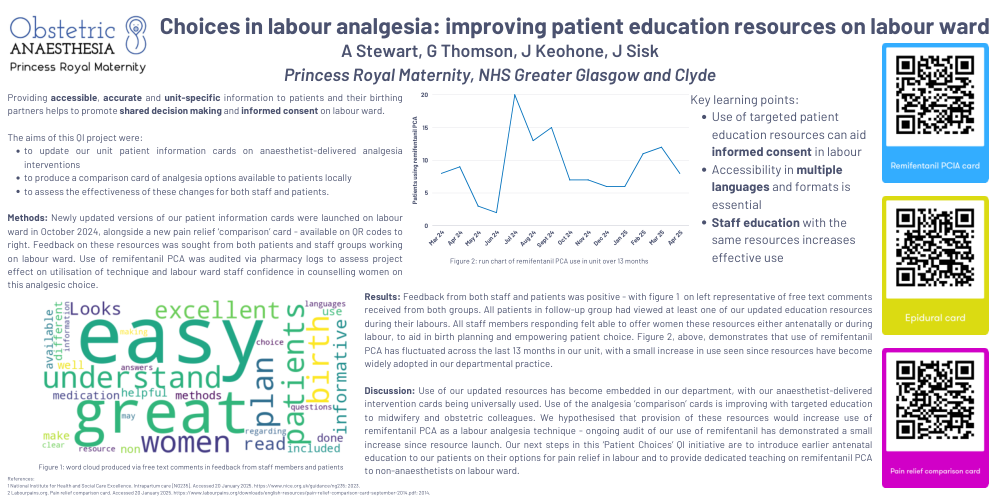
Methods: Newly updated versions of our patient information cards were launched on labour ward in October 2024, alongside a new pain relief ‘comparison’ card - available on QR codes to right. Feedback on these resources was sought from both patients and staff groups working on labour ward. Use of remifentanil PCA was audited via pharmacy logs to assess project effect on utilisation of technique and labour ward staff confidence in counselling women on this analgesic choice.
Results: Feedback from both staff and patients was positive - with figure 1on left representative of free text comments received from both groups. All patients in follow-up group had viewed at least one of our updated education resources during their labours. All staff members responding felt able to offer women these resources either antenatally or during labour, to aid in birth planning and empowering patient choice. Figure 2, above, demonstrates that use of remifentanil PCA has fluctuated across the last 13 months in our unit, with a small increase in use seen since resources have become widely adopted in our departmental practice.
Discussion: Use of our updated resources has become embedded in our department, with our anaesthetist-delivered intervention cards being universally used. Use of the analgesia ‘comparison’ cards is improving with targeted education to midwifery and obstetric colleagues. We hypothesised that provision of these resources would increase use of remifentanil PCA as a labour analgesia technique - ongoing audit of our use of remifentanil has demonstrated a small increase since resource launch. Our next steps in this ‘Patient Choices’ QI initiative are to introduce earlier antenatal education to our patients on their options for pain relief in labour and to provide dedicated teaching on remifentanil PCA to non-anaesthetists on labour ward.
Key learning points:
- Use of targeted patient education resources can aid informed consent in labour
- Accessibility in multiple languages and formats is essential
- Staff education with the same resources increases effective use
References:
1 National Institute for Health and Social Care Excellence. Intrapartum care [NG235]. Accessed 20 January 2025. https://www.nice.org.uk/guidance/ng235; 2023.
2 Labourpains.org. Pain relief comparison card. Accessed 20 January 2025. https://www.labourpains.org/downloads/english-resources/pain-relief-comparison-card-september-2014.pdf; 2014.