215 posters, 5 topics, 22 sessions, 596 authors, 283 institutions
ePostersLive by SciGen Technologies S.A. All rights reserved.
Obstetric Anaesthesia Annual Scientific Meeting 2025
May 15 - 16, 2025 | ICC, 2 Lanyon Place, Belfast BT1 3WH

6780397
Intraoperative cell salvage in major obstetric haemorrhage- does it make a difference?
Poster Presenter
Authors
Affiliations
Part of Topic
Service Evaluation
Intraoperative Cell Salvage in Major Obstetric Haemorrhage
Does it make a difference?
S. Gupta, L. Powell, D. Davis, S. Scutt
INTRODUCTION
Our obstetric department has incorporated Cell Salvage (CS), into routine practice utilising collection cycles in most non-elective caesarean sections and elective cases in at risk patients. This has the potential to reduce the degree of morbidity and mortality associated with Major Obstetric haemorrhage (MOH), reduce allogenic blood requirements and increasing post-operative haemoglobin levels. We wanted to analyse whether this practice was warranted.
METHODS
The project is registered with the Trust’s quality improvement department. Badgernet was used to identify PPH cases with estimated blood loss (EBL) over 1L during a 6-month period (June – December 2023). A CS database, transfusion department records and the trust’s electronic patient record were used to collect patient data. Graphpad Prism was utilised for Statistical analysis
RESULTS
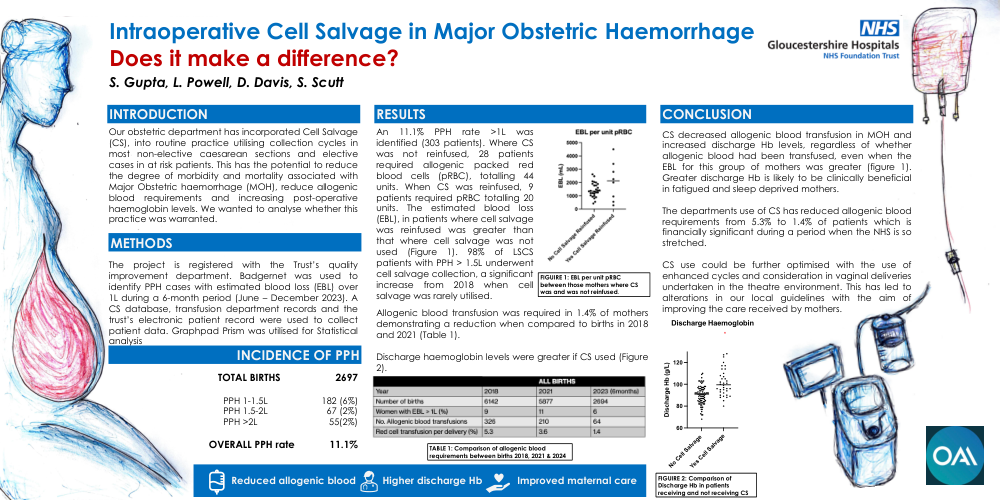
An 11.1% PPH rate >1L was identified (303 patients). Where CS was not reinfused, 28 patients required allogenic packed red blood cells (pRBC), totalling 44 units. When CS was reinfused, 9 patients required pRBC totalling 20 units. The estimated blood loss (EBL), in patients where cell salvage was reinfused was greater than that where cell salvage was not used (Figure 1). 98% of LSCS patients with PPH > 1.5L underwent cell salvage collection, a significant increase from 2018 when cell salvage was rarely utilised.
Allogenic blood transfusion was required in 1.4% of mothers demonstrating a reduction when compared to births in 2018 and 2021 (Table 1).
Discharge haemoglobin levels were greater if CS used (Figure 2).
CONCLUSION
CS decreased allogenic blood transfusion in MOH and increased discharge Hb levels, regardless of whether allogenic blood had been transfused, even when the EBL for this group of mothers was greater (figure 1). Greater discharge Hb is likely to be clinically beneficial in fatigued and sleep deprived mothers.
The departments use of CS has reduced allogenic blood requirements from 5.3% to 1.4% of patients which is financially significant during a period when the NHS is so stretched.
CS use could be further optimised with the use of enhanced cycles and consideration in vaginal deliveries undertaken in the theatre environment. This has led to alterations in our local guidelines with the aim of improving the care received by mothers.